
We read your photo as:
Solve for the derivative of y = ((6x2+1)3 * (2x-5)4) / ((x3-2x+1)2)
ScanSolve AI Answer
Use the left and right arrow keys to trace the curve, up and down to jump between key points, and plus and minus to zoom.
| Point | x | y |
|---|---|---|
| Minimum | −0.06 | 584.21 |
| y-intercept | 0 | 625 |
Step-by-step solution
6 stepsThe problem asks to "Solve this", which for a complex algebraic expression typically means finding its derivative. We will use logarithmic differentiation to find the derivative of the given function.
Let be the given expression:
Take the natural logarithm of both sides.
Use logarithm properties (, , ) to expand the right side.
Differentiate both sides with respect to .
Remember that .
Calculate the derivatives of the inner functions and substitute them back.
Substituting these into the equation from Step 3:
Multiply both sides by to solve for .
Substitute the original expression for back into the equation.
The final answer is:
Still stuck on this one?
Ask a follow-up, and the answer starts from this question.
More Mathematics Questions
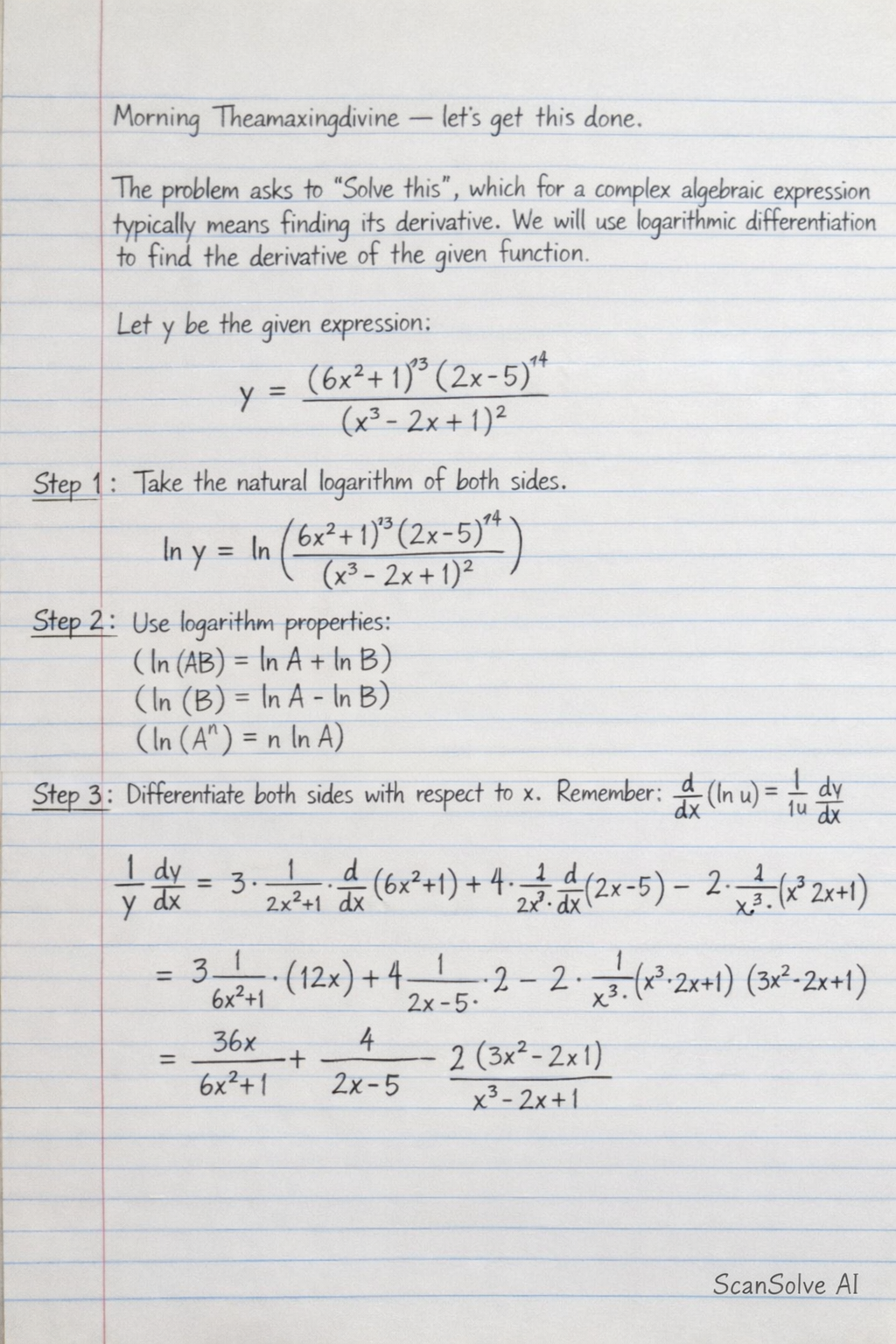
Handwritten Step-by-Step Solution
Get this as a handwritten image on WhatsApp — like a tutor wrote it for you.
Try on WhatsApp