We read your photo as:

For the given differential equation below, find the complementary function, particular integral of the function and general solution of the motion.

Mathematics

ScanSolve AI Answer

Step-by-step solution

5 steps

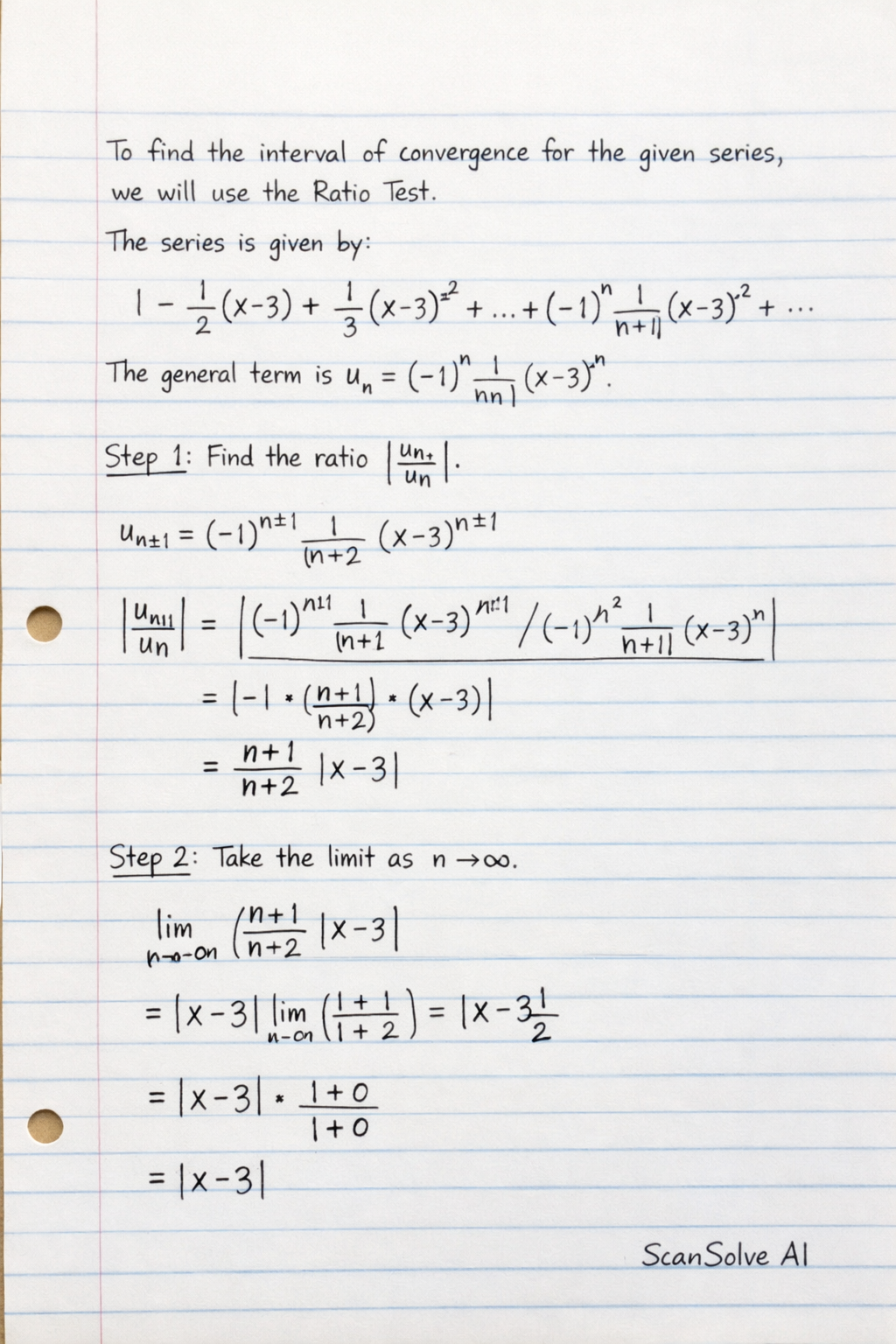
To find the interval of convergence for the given series, we will use the Ratio Test.

The series is given by:

1−12(x−3)+13(x−3)2+⋯+(−1)n1(n+1)(x−3)n+…1 - \frac{1}{2}(x-3) + \frac{1}{3}(x-3)^2 + \dots + (-1)^n \frac{1}{(n+1)}(x-3)^n + \dots

The general term of the series is un=(−1)n1n+1(x−3)nu_n = (-1)^n \frac{1}{n+1}(x-3)^n.

  1. Find the ratio ∣un+1un∣\left| \frac{u_{n+1}}{u_n} \right|.

    The (n+1)(n+1)-th term is un+1=(−1)n+11(n+1)+1(x−3)n+1=(−1)n+11n+2(x−3)n+1u_{n+1} = (-1)^{n+1} \frac{1}{(n+1)+1}(x-3)^{n+1} = (-1)^{n+1} \frac{1}{n+2}(x-3)^{n+1}.

    ∣un+1un∣=∣(−1)n+11n+2(x−3)n+1(−1)n1n+1(x−3)n∣\left| \frac{u_{n+1}}{u_n} \right| = \left| \frac{(-1)^{n+1} \frac{1}{n+2}(x-3)^{n+1}}{(-1)^n \frac{1}{n+1}(x-3)^n} \right| =∣(−1)⋅n+1n+2⋅(x−3)∣= \left| (-1) \cdot \frac{n+1}{n+2} \cdot (x-3) \right| =n+1n+2∣x−3∣= \frac{n+1}{n+2} |x-3|
  2. Take the limit as n→∞n \to \infty.

    lim⁡n→∞(n+1n+2∣x−3∣)=∣x−3∣lim⁡n→∞(1+1n1+2n)\lim_{n \to \infty} \left( \frac{n+1}{n+2} |x-3| \right) = |x-3| \lim_{n \to \infty} \left( \frac{1 + \frac{1}{n}}{1 + \frac{2}{n}} \right) =∣x−3∣⋅1+01+0=∣x−3∣= |x-3| \cdot \frac{1+0}{1+0} = |x-3|
  3. Determine the interval for convergence.

    For the series to converge, the limit must be less than 1:

    ∣x−3∣<1|x-3| < 1

    This inequality can be written as:

    −1<x−3<1-1 < x-3 < 1

    Add 3 to all parts of the inequality:

    −1+3<x<1+3-1+3 < x < 1+3 2<x<42 < x < 4
  4. Check the endpoints of the interval.

    At x=2x=2:
    Substitute x=2x=2 into the original series:

    ∑n=0∞(−1)n1n+1(2−3)n=∑n=0∞(−1)n1n+1(−1)n\sum_{n=0}^{\infty} (-1)^n \frac{1}{n+1}(2-3)^n = \sum_{n=0}^{\infty} (-1)^n \frac{1}{n+1}(-1)^n =∑n=0∞1n+1(−1)2n=∑n=0∞1n+1= \sum_{n=0}^{\infty} \frac{1}{n+1}(-1)^{2n} = \sum_{n=0}^{\infty} \frac{1}{n+1}

    This is the harmonic series (starting from n=0n=0, so it's 1+12+13+…1 + \frac{1}{2} + \frac{1}{3} + \dots), which is known to diverge.

    At x=4x=4:
    Substitute x=4x=4 into the original series:

    ∑n=0∞(−1)n1n+1(4−3)n=∑n=0∞(−1)n1n+1(1)n\sum_{n=0}^{\infty} (-1)^n \frac{1}{n+1}(4-3)^n = \sum_{n=0}^{\infty} (-1)^n \frac{1}{n+1}(1)^n =∑n=0∞(−1)n1n+1= \sum_{n=0}^{\infty} (-1)^n \frac{1}{n+1}

    This is the alternating harmonic series. We can apply the Alternating Series Test:
    Let bn=1n+1b_n = \frac{1}{n+1}.

    1. bn>0b_n > 0 for all n≥0n \ge 0.
    2. bnb_n is a decreasing sequence: 1n+1>1n+2\frac{1}{n+1} > \frac{1}{n+2}.
    3. lim⁡n→∞bn=lim⁡n→∞1n+1=0\lim_{n \to \infty} b_n = \lim_{n \to \infty} \frac{1}{n+1} = 0. Since all conditions are met, the series converges at x=4x=4.
  5. State the interval of convergence.

    Combining the results from the ratio test and the endpoint checks, the series converges for xx values such that 2<x≤42 < x \le 4.

    The interval of convergence is (2,4]\boxed{(2, 4]}.

Was this helpful?

Still stuck on this one?

Ask a follow-up, and the answer starts from this question.

Got a different question?Ask your own question
Handwritten step-by-step solution preview

Handwritten Step-by-Step Solution

Get this as a handwritten image on WhatsApp — like a tutor wrote it for you.

Try on WhatsApp