
We read your photo as:
For the range within which the probability of an event always lies.
Mathematics
ScanSolve AI Answer
Step-by-step solution
3 stepsThe question asks for the range within which the probability of an event always lies.
Understand the definition of probability.
The probability of an event is a numerical measure of the likelihood of that event occurring. It is always a value between 0 and 1, inclusive.
Interpret the bounds.
- A probability of 0 means the event is impossible.
- A probability of 1 means the event is certain to happen.
- Any probability between 0 and 1 indicates that the event may or may not happen, with values closer to 1 being more likely and values closer to 0 being less likely.
Evaluate the given options.
- "-1 and 1": Probabilities cannot be negative.
- "0 and 100": This range is used when expressing probability as a percentage (0% to 100%), but the standard numerical range for probability is 0 to 1.
- "0 and 1": This is the correct range for the probability of any event.
- "1 and 10": Probabilities cannot be greater than 1.
The probability of an event always satisfies the condition:
The correct option is 0 and 1.
Was this helpful?
Still stuck on this one?
Ask a follow-up, and the answer starts from this question.
Got a different question?Ask your own question
More Mathematics Questions
Q(ii) Probability is expressed asQA) i) Probability is a numerical measure of the likelihood that an event will occur. It is expressed…QWhat is the definition of range in statistics?QIdentify the given probability and the event for which the probability is required.
Browse by topic:Statistics
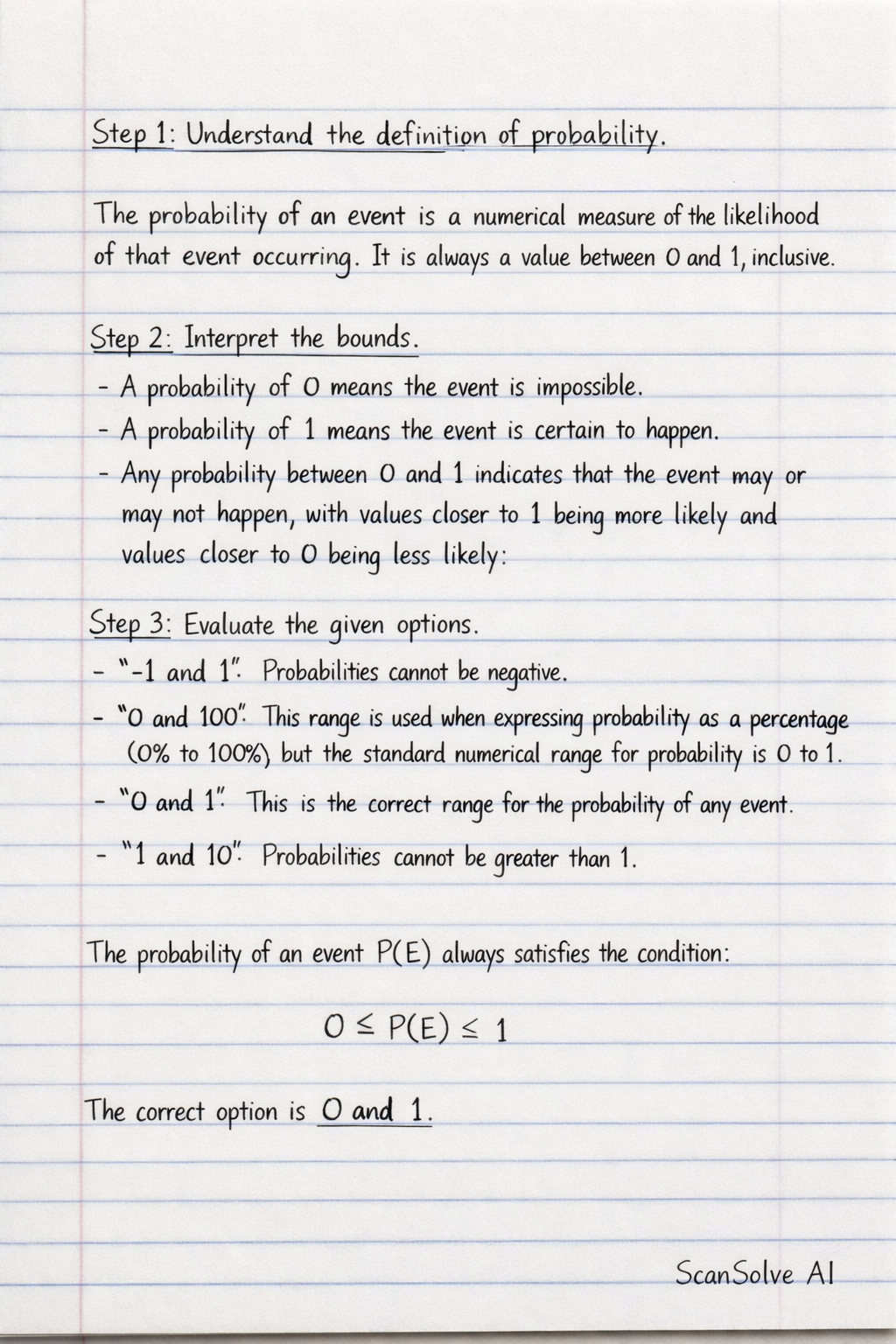
Handwritten Step-by-Step Solution
Get this as a handwritten image on WhatsApp — like a tutor wrote it for you.
Try on WhatsApp