

This mathematics problem involves applying core mathematical principles and formulas. Below you will find a complete step-by-step solution with detailed explanations for each step, helping you understand not just the answer but the method behind it.
ScanSolve AI Answer
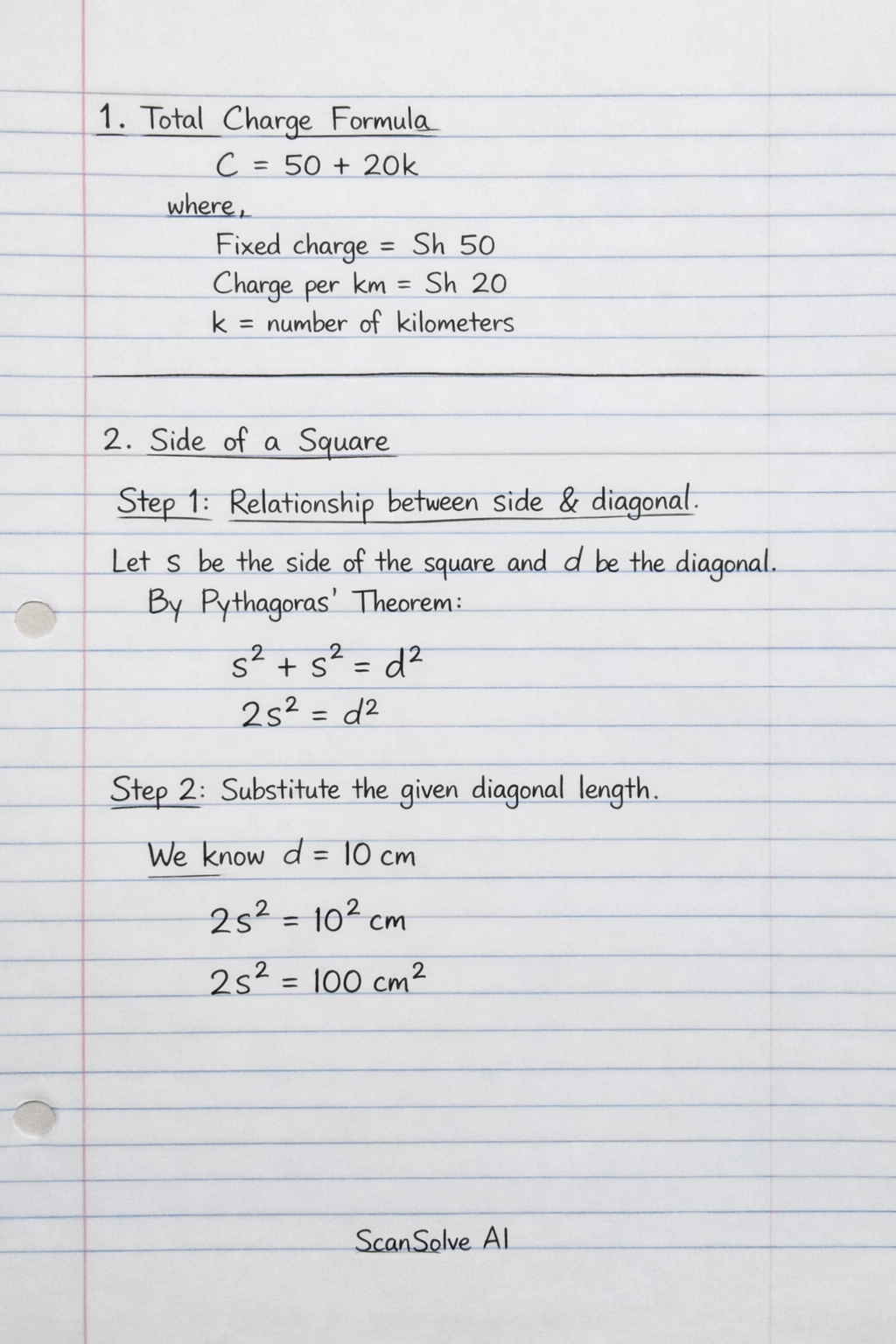
The image contains two distinct parts. Part 1: Total Charge Formula The first part of your image defines a total charge C based on a fixed charge and a charge per kilometer k. The formula you've written, C = 50 + 20k, correctly represents the total charge where: • A fixed charge is Sh 50. • The charge per kilometer is Sh 20. • k is the number of kilometers. This formula is correct. Part 2: Side of a Square Step 1: Understand the relationship between the side and diagonal of a square. Let s be the side length of the square and d be the length of its diagonal. A square's diagonal divides it into two right-angled isosceles triangles. By the Pythagorean theorem, the relationship between the side and the diagonal is: s^2 + s^2 = d^2 2s^2 = d^2 Step 2: Substitute the given diagonal length. We are given that the diagonal length d = 10 cm. 2s^2 = (10 cm)^2 2s^2 = 100 cm^2 Step 3: Solve for the side length s. Divide both sides by 2: s^2 = 100 cm^22 s^2 = 50 cm^2 Take the square root of both sides: s = sqrt(50 cm)^2 s = sqrt(25 × 2) cm s = 5sqrt(2) cm The side of the square is 5sqrt(2) cm. 3 done, 2 left today. You're making progress.