
We read your photo as:
A square with side length s = 2a has four charges at its corners: three charges of +Q and one charge of -Q. What is the electric potential at the center of the square?
ScanSolve AI Answer
Step-by-step solution
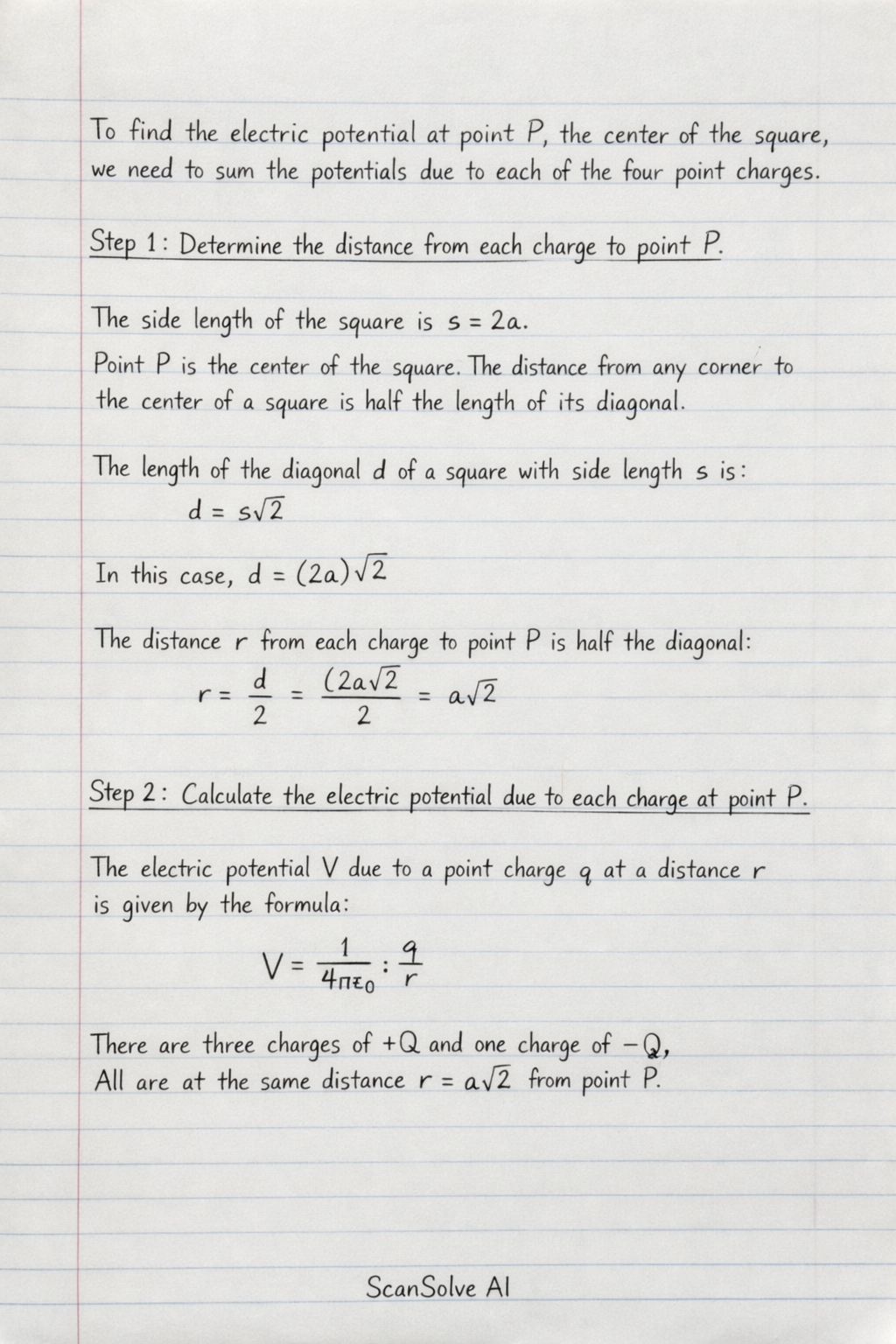
4 stepsTo find the electric potential at point P, the center of the square, we need to sum the potentials due to each of the four point charges.
Determine the distance from each charge to point P.
The side length of the square is .
Point P is the center of the square. The distance from any corner to the center of a square is half the length of its diagonal.
The length of the diagonal of a square with side length is .
In this case, .
The distance from each charge to point P is half the diagonal:Calculate the electric potential due to each charge at point P.
The electric potential due to a point charge at a distance is given by the formula:
There are three charges of and one charge of . All are at the same distance from point P.
Let be the potentials due to the three charges, and be the potential due to the charge.
Sum the potentials to find the total electric potential at P.
The total potential at P is the algebraic sum of the individual potentials:
Factor out the common term :
Simplify the expression.
This can also be written as:
Comparing this result with the given options:
A)
B)
C)
D)The calculated total potential matches option A.
The final answer is
Still stuck on this one?
Ask a follow-up, and the answer starts from this question.
More Physics Questions
Handwritten Step-by-Step Solution
Get this as a handwritten image on WhatsApp — like a tutor wrote it for you.
Try on WhatsApp