

This mathematics problem involves applying core mathematical principles and formulas. Below you will find a complete step-by-step solution with detailed explanations for each step, helping you understand not just the answer but the method behind it.
ScanSolve AI Answer
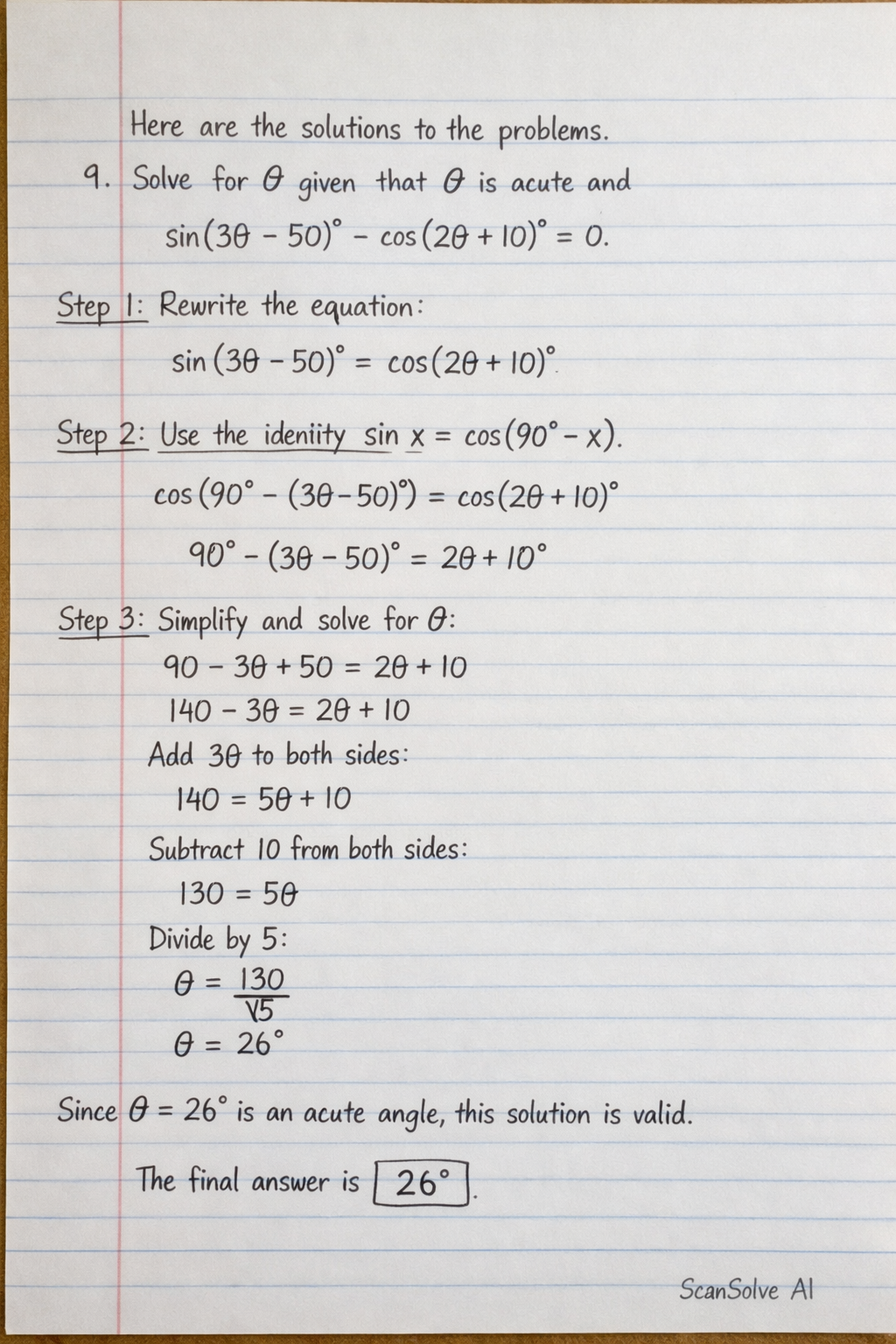
Here are the solutions to the problems. 9. Solve for given that is acute and (3 - 50)^ - (2 + 10)^ = 0. Step 1: Rewrite the equation. (3 - 50)^ = (2 + 10)^ Step 2: Use the trigonometric identity x = (90^ - x). Since (3 - 50)^ = (90^ - (3 - 50)^), we can equate the arguments of the cosine functions. 90^ - (3 - 50)^ = 2 + 10^ Step 3: Simplify and solve for . 90 - 3 + 50 = 2 + 10 140 - 3 = 2 + 10 Add 3 to both sides: 140 = 5 + 10 Subtract 10 from both sides: 130 = 5 Divide by 5: = (130)/(5) = 26^ Since = 26^ is an acute angle, this solution is valid. The final answer is 26^. 10. Miss Ludicy used to spend shs.720 per month on eggs, when the price of eggs went down by sh. 3.00 per egg she found that with the same amount of money she could buy 20 more eggs per month. How much per egg was she buying at the lower price. Step 1: Define variables. Let P_1 be the original price per egg (in shs). Let N_1 be the original number of eggs bought. Let P_2 be the new price per egg (in shs). Let N_2 be the new number of eggs bought. Step 2: Formulate equations based on the given information. Total spending is shs. 720: P_1 N_1 = 720 (1) P_2 N_2 = 720 (2) Price went down by sh. 3.00 per egg: P_2 = P_1 - 3 (3) She could buy 20 more eggs: N_2 = N_1 + 20 (4) Step 3: Substitute equations (3) and (4) into equation (2). (P_1 - 3)(N_1 + 20) = 720 Expand the equation: P_1 N_1 + 20P_1 - 3N_1 - 60 = 720 Step 4: Substitute P_1 N_1 = 720 (from equation 1) into the expanded equation. 720 + 20P_1 - 3N_1 - 60 = 720 Subtract 720 from both sides: 20P_1 - 3N_1 - 60 = 0 20P_1 - 3N_1 = 60 (5) Step 5: Express N_1 in terms of P_1 from equation (1) and substitute into equation (5). From (1), N_1 = (720)/(P_1). Substitute into (5): 20P_1 - 3((720)/(P_1)) = 60 20P_1 - (2160)/(P_1) = 60 Step 6: Solve the quadratic equation for P_1. Multiply the entire equation by P_1 (assuming P_1 ≠ 0): 20P_1^2 - 2160 = 60P_1 Rearrange into standard quadratic form aP_1^2 + bP_1 + c = 0: 20P_1^2 - 60P_1 - 2160 = 0 Divide by 20 to simplify: P_1^2 - 3P_1 - 108 = 0 Factor the quadratic equation: We need two numbers that multiply to -108 and add to -3. These are -12 and 9. (P_1 - 12)(P_1 + 9) = 0 This gives two possible values for P_1: P_1 = 12 or P_1 = -9. Since price cannot be negative, we take P_1 = 12 shs/egg. Step 7: Calculate the lower price (P_2). The question asks for the price per egg at the lower price, which is P_2. Using equation (3): P_2 = P_1 - 3 P_2 = 12 - 3 P_2 = 9 shs/egg The final answer is 9 shs/egg. 11. A line L is perpendicular to the line (2)/(3)x + (5)/(7)y = 1. Given that L passes through (4, 11), find a) Gradient of L Step 1: Find the gradient of the given line. The given line is (2)/(3)x + (5)/(7)y = 1. Rewrite this equation in the slope-intercept form y = mx + c. (5)/(7)y = -(2)/(3)x + 1 Multiply by (7)/(5): y = (-(2)/(3)) ((7)/(5))x + (1)((7)/(5)) y = -(14)/(15)x + (7)/(5) The gradient of this line is m_1 = -(14)/(15). Step 2: Find the gradient of line L. Line L is perpendicular to the given line. If two lines are perpendicular, the product of their gradients is -1. Let m_L be the gradient of line L. m_L · m_1 = -1 m_L · (-(14)/(15)) = -1 m_L = (-1)/(-14)15 m_L = (15)/(14) The final answer is (15)/(14). b) The equation of L in the form y = mx + c and m and c are constants Step 1: Use the point-slope form of a linear equation. We have the gradient of line L, m_L = (15)/(14), and a point it passes through, (x_1, y_1) = (4, 11). The point-slope form is y - y_1 = m_L(x - x_1). y - 11 = (15)/(14)(x - 4) Step 2: Convert the equation to the slope-intercept form y = mx + c. Multiply both sides by 14 to eliminate the fraction: 14(y - 11) = 15(x - 4) Distribute on both sides: 14y - 154 = 15x - 60 Add 154 to both sides: 14y = 15x - 60 + 154 14y = 15x + 94 Divide by 14: y = (15)/(14)x + (94)/(14) Simplify the constant term: (94)/(14) = (47)/(7). y = (15)/(14)x + (47)/(7) Here