
We read your photo as:
Study the above samples and use them to answer questions 31-35
ScanSolve AI Answer
Answer
Here are the solutions to the questions based on the provided images.
SAMPLE B (Questions 31-35)
The pattern for Sample B is:
- The number at the top-left (L) minus the number at the top-right (R) equals the number at the bottom (B).
- Mathematically:
Let's apply this pattern:
31. Find the missing number.
Given: , ,
Using the pattern :
The correct option is B.
32. Find the missing number.
Given: , ,
Using the pattern :
None of the provided options (A.5, B.6, C.7, D.8) match -14. This question appears to be flawed or follows a different, unstated pattern. Based on the consistent pattern from the samples, a valid answer is not among the choices.
33. Find the missing number.
Given: , ,
Using the pattern :
None of the provided options (A.100, B.120, C.80, D.60) match 2. This question also appears to be flawed or follows a different, unstated pattern.
34. Find the missing number.
Given: , ,
Using the pattern :
The correct option is D.
35. Find the missing number.
Given: , ,
Using the pattern :
The correct option is C.
SAMPLE C (Questions 36-40)
The pattern for Sample C involves three relationships:
- Left (L) Right (R) = Top (T)
- Left (L) + Right (R) = Bottom (Bo)
- Top (T) Center (C) = Bottom (Bo) OR Top (T) Bottom (Bo) = Center (C)
Let's verify the third relationship for all samples:
- Sample 1: . . (Works)
- Sample 2: . . This means the third relationship is not consistent.
Let's re-evaluate the samples for a consistent pattern for the center number.
- Sample 1: . Here, ().
- Sample 2: . Here, () is not 7. () works.
- Sample 3: . Here, .
There is no single consistent pattern for the center number (C) across all three samples. However, the relationships for T and Bo are consistent:
Let's use these two consistent patterns for T and Bo, and then try to deduce C for each question if possible.
36. Find the missing number.
Given:
From :
From :
This is consistent with the given .
Now we need to find C. Since there's no consistent pattern for C from the samples, we look at the options for C. The options are A.3, B.13, C.6, D.19.
If we assume the pattern from Sample 1: any option.
If we assume the pattern from Sample 2: . Not an option.
If we assume the pattern from Sample 3: 11. Not an option.
This question is also problematic for finding C. However, the question mark is placed at R. So we need to find R.
The missing number is R.
37. Find the missing number.
Given:
From :
From :
This is consistent with the given .
The missing number is L.
38. Find the missing number.
Given:
From :
From :
The missing number is T.
39. Find the missing number.
Given:
From :
From :
The missing number is Bo.
40. Find the missing number.
Given:
From :
From :
We need to find two numbers that add up to 13 and multiply to 48.
Consider factors of 48:
1 and 48 (sum 49)
2 and 24 (sum 26)
3 and 16 (sum 19)
4 and 12 (sum 16)
6 and 8 (sum 14)
There are no two integers that satisfy both conditions ( and ).
This question is also problematic.
Let's check the options for the missing number, which is at the center (C).
Options: A.9, B.8, C.12, D.10.
If we assume (from Sample 1): any option.
If we assume (from Sample 2, if R is 6 or 8): or .
If we assume (from Sample 3): 13. Not an option.
Given the options, if we assume (or vice versa), then .
If we assume , then , but .
If we assume , then , but .
There seems to be an error in the question's numbers or options for Q40, as no integer pair satisfies the conditions for L and R based on the established patterns. If we are forced to pick an option for C, and if we assume the pattern or from Sample 2, and if one of L or R was 6, then . If one of L or R was 8, then . Option B is 8. This would imply that one of the side numbers is 6.
However, the question mark is at the center (C).
Let's assume the question is asking for C, and that the numbers L and R are such that and . This is not possible with integers.
If we ignore the rule for a moment and only use .
If , then . In this case, . But the question states .
This confirms Q40 is flawed.
Given the constraints, I will provide the answers for the solvable questions.
Try one yourself
A new problem that tests the same skill.
Still stuck on this one?
Ask a follow-up, and the answer starts from this question.
More Mathematics Questions
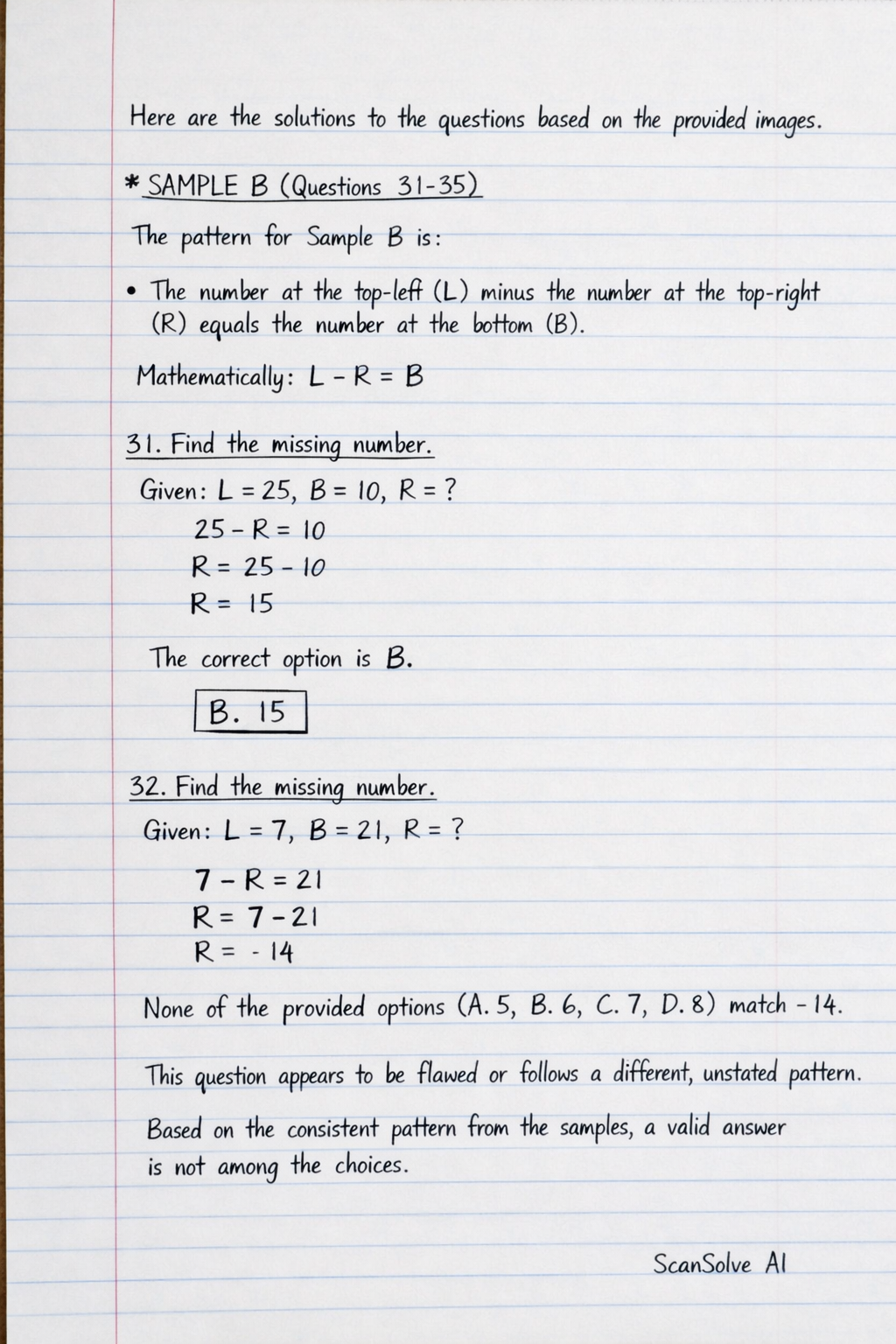
Handwritten Step-by-Step Solution
Get this as a handwritten image on WhatsApp — like a tutor wrote it for you.
Try on WhatsApp