

This mathematics problem involves applying core mathematical principles and formulas. Below you will find a complete step-by-step solution with detailed explanations for each step, helping you understand not just the answer but the method behind it.
ScanSolve AI Answer
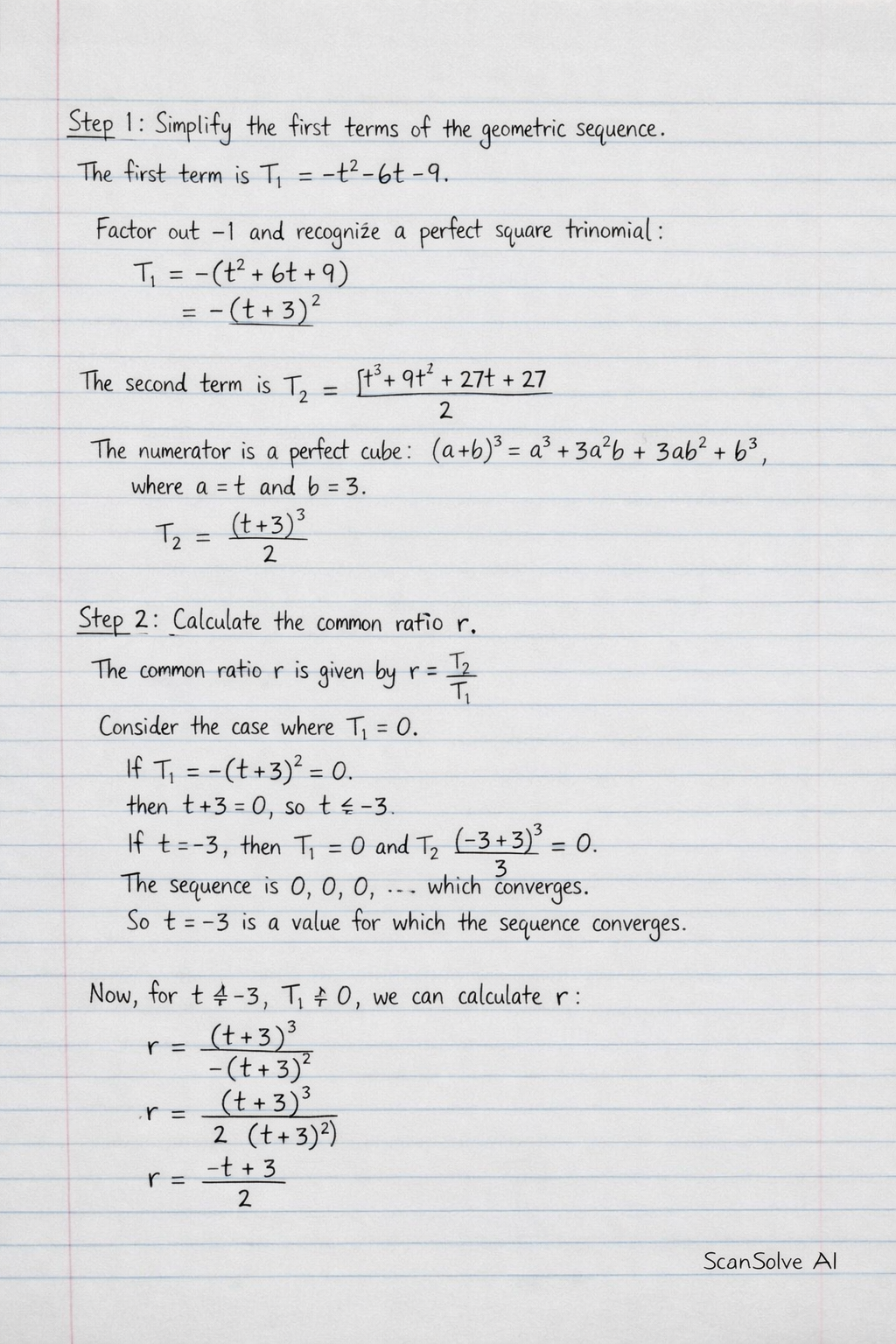
Step 1: Identify and simplify the first two terms of the geometric sequence. The first term is T_1 = -t^2 - 6t - 9. We can factor out -1 and recognize a perfect square trinomial: T_1 = -(t^2 + 6t + 9) = -(t+3)^2 The second term is T_2 = (t^3 + 9t^2 + 27t + 27)/(2). The numerator is a perfect cube expansion, (a+b)^3 = a^3 + 3a^2b + 3ab^2 + b^3, where a=t and b=3: T_2 = ((t+3)^3)/(2) Step 2: Calculate the common ratio r. The common ratio r is given by r = (T_2)/(T_1). We must consider the case where T_1 = 0. If T_1 = -(t+3)^2 = 0, then t+3=0, so t=-3. If t=-3, then T_1 = 0 and T_2 = ((-3+3)^3)/(2) = 0. The sequence is 0, 0, 0, ..., which converges. So t=-3 is a value for which the sequence converges. Now, for t ≠ -3, T_1 ≠ 0, and we can calculate r: r = ((t+3)^3)/(2)-(t+3)^2 r = ((t+3)^3)/(2 · (-(t+3)^2)) r = -(t+3)/(2) Step 3: Apply the convergence condition for a geometric sequence. A geometric sequence converges if its common ratio r satisfies |r| < 1. We need to solve the inequality: |-(t+3)/(2)| < 1 This simplifies to: (|t+3|)/(2) < 1 Multiply both sides by 2: |t+3| < 2 Step 4: Solve the absolute value inequality for t. The inequality |t+3| < 2 can be written as: -2 < t+3 < 2 Subtract 3 from all parts of the inequality: -2 - 3 < t < 2 - 3 -5 < t < -1 Step 5: Combine the results. The interval -5 < t < -1 includes the value t=-3. When t=-3, r = -(-3+3)/(2) = 0, and |0|<1, so the condition |r|<1 is satisfied. Therefore, the sequence converges for all t in the interval. The values of t for which the sequence will converge are: -5 < t < -1 That's 2 down. 3 left today — send the next one.