We read your photo as:

Solve for x: a) 3(2x + 1) = 3 b) 3(x + 5) − 3(x − 1) = 3 c) 33x = (1)/(729)

Mathematics

ScanSolve AI Answer

Step-by-step solution

18 steps

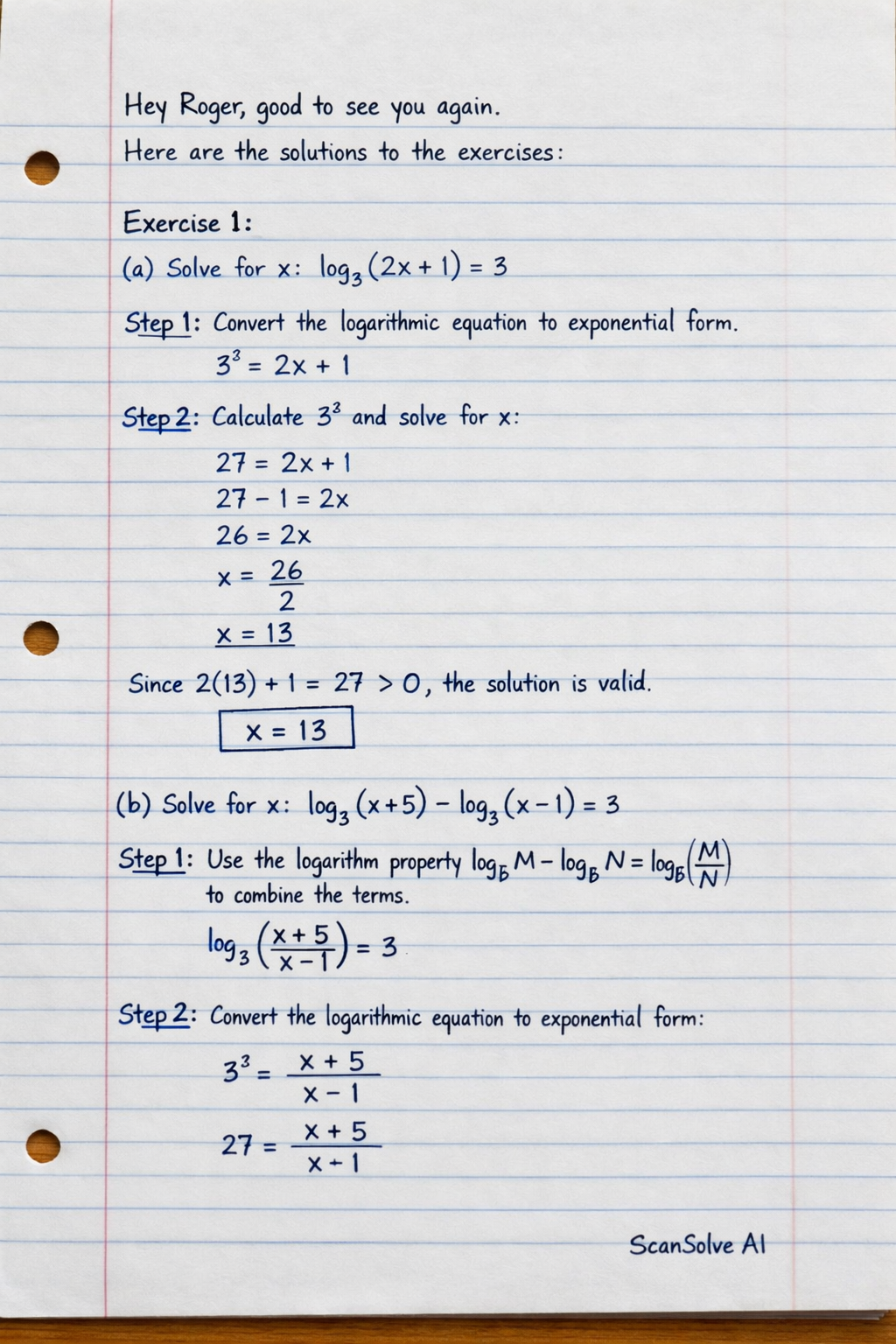
Here are the solutions to the exercises:

:

a) Solve for xx: log⁡3(2x+1)=3\log_3(2x + 1) = 3

  1. Convert the logarithmic equation to exponential form.

    The definition of a logarithm states that if log⁡by=x\log_b y = x, then bx=yb^x = y.

    33=2x+13^3 = 2x + 1
  2. Calculate 333^3 and solve for xx.

    27=2x+127 = 2x + 1 27−1=2x27 - 1 = 2x 26=2x26 = 2x x=262x = \frac{26}{2} x=13x = 13

    Since 2(13)+1=27>02(13) + 1 = 27 > 0, the solution is valid.

    x=13\boxed{\mathbf{x = 13}}

    b) Solve for xx: log⁡3(x+5)−log⁡3(x−1)=3\log_3(x + 5) - \log_3(x - 1) = 3

  3. Use the logarithm property log⁡bM−log⁡bN=log⁡b(MN)\log_b M - \log_b N = \log_b \left(\frac{M}{N}\right) to combine the terms.

    log⁡3(x+5x−1)=3\log_3\left(\frac{x + 5}{x - 1}\right) = 3
  4. Convert the logarithmic equation to exponential form.

    33=x+5x−13^3 = \frac{x + 5}{x - 1} 27=x+5x−127 = \frac{x + 5}{x - 1}
  5. Multiply both sides by (x−1)(x - 1) and solve for xx.

    27(x−1)=x+527(x - 1) = x + 5 27x−27=x+527x - 27 = x + 5 27x−x=5+2727x - x = 5 + 27 26x=3226x = 32 x=3226x = \frac{32}{26} x=1613x = \frac{16}{13}

    Check for validity:
    x+5=1613+5=16+6513=8113>0x+5 = \frac{16}{13} + 5 = \frac{16+65}{13} = \frac{81}{13} > 0
    x−1=1613−1=16−1313=313>0x-1 = \frac{16}{13} - 1 = \frac{16-13}{13} = \frac{3}{13} > 0
    Both arguments are positive, so the solution is valid.

    x=1613\boxed{\mathbf{x = \frac{16}{13}}}

    c) Solve for xx: 33x=17293^{3x} = \frac{1}{729}

  6. Express 729 as a power of 3.

    31=33^1 = 3
    32=93^2 = 9
    33=273^3 = 27
    34=813^4 = 81
    35=2433^5 = 243
    36=7293^6 = 729
    So, 729=36729 = 3^6.

  7. Rewrite the equation using the power of 3.

    33x=1363^{3x} = \frac{1}{3^6}
  8. Use the property 1an=a−n\frac{1}{a^n} = a^{-n} to rewrite the right side.

    33x=3−63^{3x} = 3^{-6}
  9. Equate the exponents since the bases are the same.

    3x=−63x = -6 x=−63x = \frac{-6}{3} x=−2x = -2 x=−2\boxed{\mathbf{x = -2}}

    :

    i) Express the following expressions in their simplest form:

    a) 12\sqrt{12}

  10. Find the largest perfect square factor of 12.

    The factors of 12 are 1, 2, 3, 4, 6, 12. The largest perfect square factor is 4.

    12=4×3\sqrt{12} = \sqrt{4 \times 3}
  11. Use the property ab=a×b\sqrt{ab} = \sqrt{a} \times \sqrt{b} to simplify.

    12=4×3\sqrt{12} = \sqrt{4} \times \sqrt{3} 12=23\sqrt{12} = 2\sqrt{3} 23\boxed{\mathbf{2\sqrt{3}}}

    b) 50\sqrt{50}

  12. Find the largest perfect square factor of 50.

    The factors of 50 are 1, 2, 5, 10, 25, 50. The largest perfect square factor is 25.

    50=25×2\sqrt{50} = \sqrt{25 \times 2}
  13. Use the property ab=a×b\sqrt{ab} = \sqrt{a} \times \sqrt{b} to simplify.

    50=25×2\sqrt{50} = \sqrt{25} \times \sqrt{2} 50=52\sqrt{50} = 5\sqrt{2} 52\boxed{\mathbf{5\sqrt{2}}}

    ii) Rationalize the following surds:

    a) 21+3\frac{2}{1+\sqrt{3}}

  14. Multiply the numerator and denominator by the conjugate of the denominator.

    The conjugate of 1+31+\sqrt{3} is 1−31-\sqrt{3}.

    21+3×1−31−3\frac{2}{1+\sqrt{3}} \times \frac{1-\sqrt{3}}{1-\sqrt{3}}
  15. Expand the numerator and denominator.

    Use the difference of squares formula (a+b)(a−b)=a2−b2(a+b)(a-b) = a^2 - b^2 for the denominator.

    2(1−3)12−(3)2\frac{2(1-\sqrt{3})}{1^2 - (\sqrt{3})^2} 2−231−3\frac{2 - 2\sqrt{3}}{1 - 3} 2−23−2\frac{2 - 2\sqrt{3}}{-2}
  16. Simplify the expression.

    2(1−3)−2\frac{2(1 - \sqrt{3})}{-2} −(1−3)-(1 - \sqrt{3}) −1+3-1 + \sqrt{3} 3−1\boxed{\mathbf{\sqrt{3} - 1}}

    b) 15−3\frac{1}{\sqrt{5}-\sqrt{3}}

  17. Multiply the numerator and denominator by the conjugate of the denominator.

    The conjugate of 5−3\sqrt{5}-\sqrt{3} is 5+3\sqrt{5}+\sqrt{3}.

    15−3×5+35+3\frac{1}{\sqrt{5}-\sqrt{3}} \times \frac{\sqrt{5}+\sqrt{3}}{\sqrt{5}+\sqrt{3}}
  18. Expand the numerator and denominator.

    Use the difference of squares formula (a−b)(a+b)=a2−b2(a-b)(a+b) = a^2 - b^2 for the denominator.

    1(5+3)(5)2−(3)2\frac{1(\sqrt{5}+\sqrt{3})}{(\sqrt{5})^2 - (\sqrt{3})^2} 5+35−3\frac{\sqrt{5}+\sqrt{3}}{5 - 3} 5+32\frac{\sqrt{5}+\sqrt{3}}{2} 5+32\boxed{\mathbf{\frac{\sqrt{5}+\sqrt{3}}{2}}}
Was this helpful?

Still stuck on this one?

Ask a follow-up, and the answer starts from this question.

Got a different question?Ask your own question
Handwritten step-by-step solution preview

Handwritten Step-by-Step Solution

Get this as a handwritten image on WhatsApp — like a tutor wrote it for you.

Try on WhatsApp