

This mathematics problem involves applying core mathematical principles and formulas. Below you will find a complete step-by-step solution with detailed explanations for each step, helping you understand not just the answer but the method behind it.
ScanSolve AI Answer
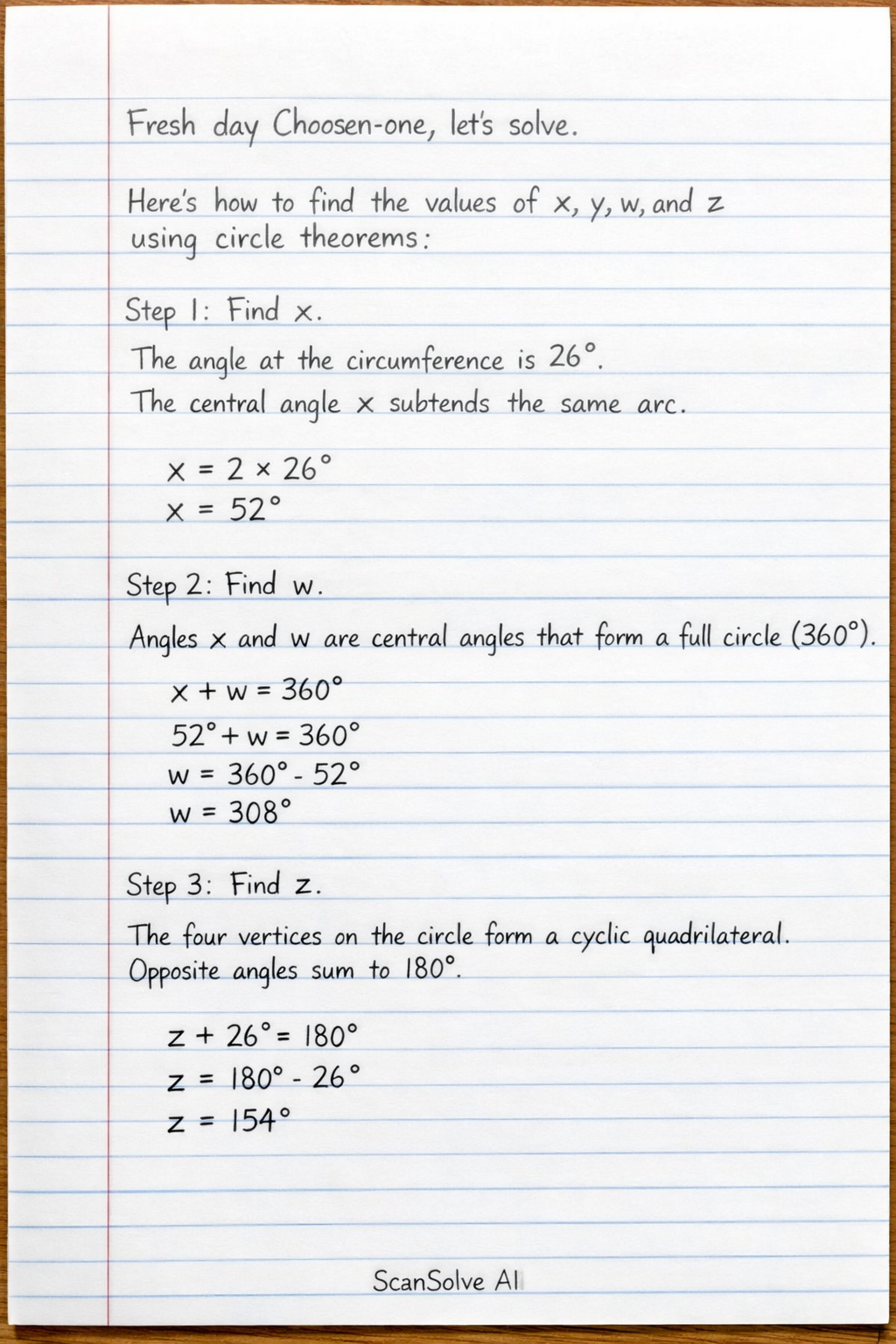
Here's how to find the values of x, y, w, and z using circle theorems: Step 1: Find x. The angle at the circumference is 26^. The central angle x subtends the same arc (the arc from the top-left vertex to the bottom-right vertex). The angle subtended by an arc at the center is twice the angle subtended by the same arc at any point on the remaining part of the circle. x = 2 × 26^ x = 52^ Step 2: Find w. Angles x and w are central angles that together form a full circle (360^). x + w = 360^ 52^ + w = 360^ w = 360^ - 52^ w = 308^ Step 3: Find z. The four vertices on the circle form a cyclic quadrilateral. In a cyclic quadrilateral, opposite angles sum to 180^. The angle z is at the top-right vertex, and the angle 26^ is at the bottom-left vertex. These are opposite angles. z + 26^ = 180^ z = 180^ - 26^ z = 154^ Step 4: Find y. The angle y is at the top-left vertex. It subtends the arc from the bottom-left vertex to the top-right vertex. The central angle subtending this arc is not directly given. However, we can use the property that angles subtended by the same arc at the circumference are equal. Alternatively, we can use the property that the angle at the circumference is half the central angle subtending the same arc. Angle y subtends the arc from the bottom-left vertex to the top-right vertex. Angle z subtends the arc from the bottom-left vertex to the bottom-right vertex. Let's re-examine the diagram for y. Angle y is at the top-left vertex. The angle opposite to y in the cyclic quadrilateral is the angle at the bottom-right vertex. Let's call this angle . So y + = 180^. The angle y subtends the arc from the bottom-left vertex to the top-right vertex. The central angle w is the reflex angle subtending the arc from the top-left vertex to the bottom-right vertex. The angle y is at the circumference and subtends the major arc from the bottom-left vertex to the top-right vertex. The angle z is at the circumference and subtends the major arc from the top-left vertex to the bottom-right vertex. Let's use the property that angles subtended by the same arc at the circumference are equal. Angle y is at the top-left vertex. Angle z is at the top-right vertex. The angle 26^ is at the bottom-left vertex. The central angle x subtends the arc from the top-left vertex to the bottom-right vertex. The angle z is at the top-right vertex. It subtends the arc from the bottom-left vertex to the bottom-right vertex. The central angle subtending the arc from the bottom-left vertex to the bottom-right vertex is not x or w. Let's re-evaluate z and y based on the central angles x and w. The angle 26^ is at the circumference and subtends the arc whose central angle is x. So x = 2 × 26^ = 52^. The angle z is at the circumference and subtends the arc whose central angle is w. z = (1)/(2) w z = (1)/(2) × 308^ z = 154^ This matches the result from the cyclic quadrilateral property. This confirms the interpretation of z. Now for y. Angle y is at the circumference. It subtends the arc whose central angle is x. y = (1)/(2) x y = (1)/(2) × 52^ y = 26^ Final values: z = 154^ y = 26^ w = 308^ x = 52^ Send me the next one 📸