
We read your photo as:
Solve for y in the given diagram.
ScanSolve AI Answer
Answer
Step-by-step solution
4 stepsIdentify the properties of the given figure.
The diagram shows two parallel lines intersected by two transversals, forming a triangle. The arrows on the horizontal lines indicate they are parallel. The tick marks on the two slanted sides of the triangle indicate that these sides are equal in length, making it an isosceles triangle.
Use the property of alternate interior angles.
When a transversal intersects two parallel lines, the alternate interior angles are equal.
The angle is an alternate interior angle to the bottom-left angle of the triangle. Therefore, the bottom-left angle of the triangle is .
The angle is an alternate interior angle to the bottom-right angle of the triangle. Therefore, the bottom-right angle of the triangle is .Apply the property of an isosceles triangle.
In an isosceles triangle, the angles opposite the equal sides are equal. Since the two slanted sides of the triangle are marked as equal, the base angles (the angles opposite these sides) must be equal.
So, the bottom-left angle of the triangle is equal to the bottom-right angle of the triangle.Set up the equation and solve for .
From Step 2 and Step 3, we have:
Divide both sides by 2:
The value of is .
Try one yourself
A new problem that tests the same skill.
Still stuck on this one?
Ask a follow-up, and the answer starts from this question.
More Mathematics Questions
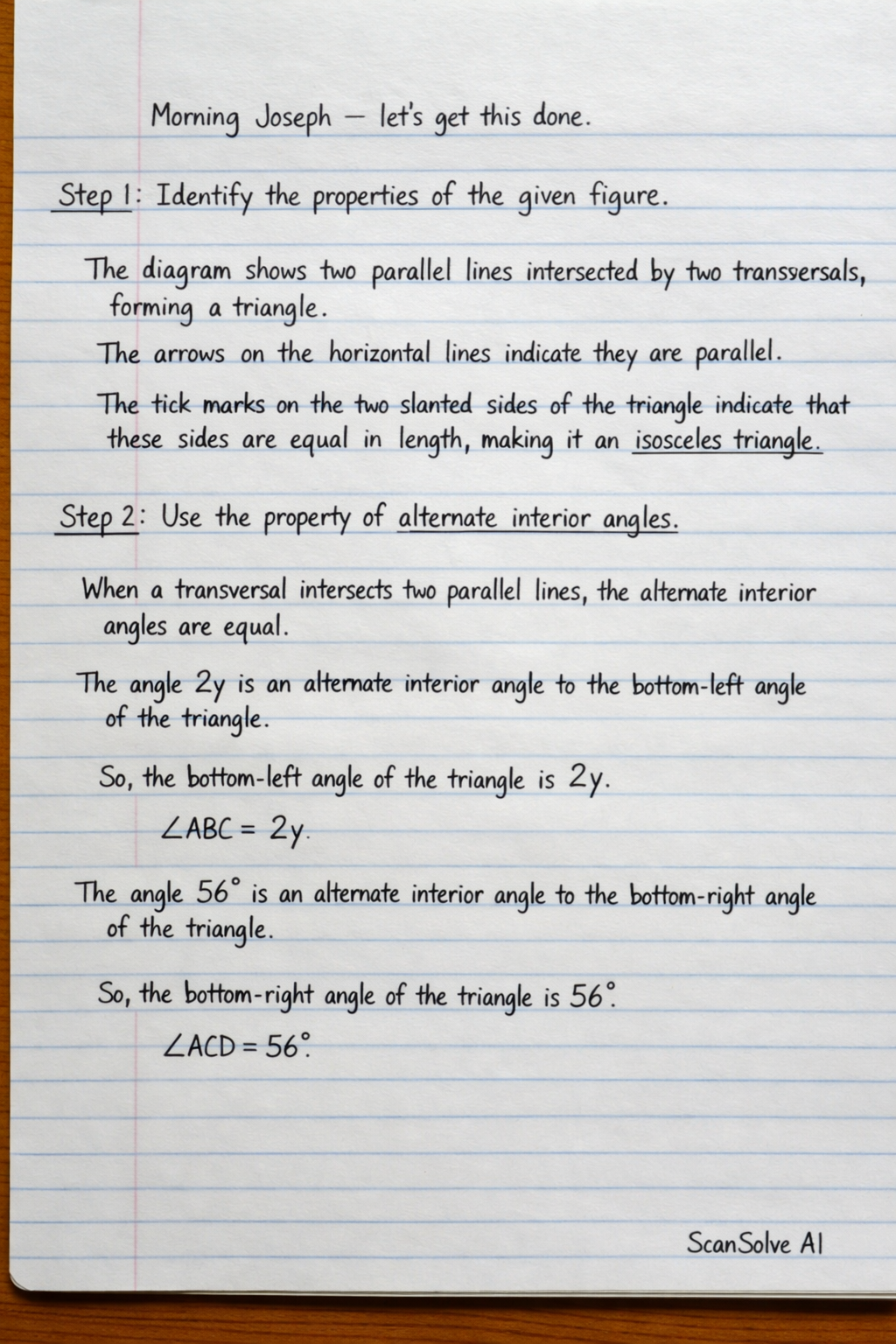
Handwritten Step-by-Step Solution
Get this as a handwritten image on WhatsApp — like a tutor wrote it for you.
Try on WhatsApp