
We read your photo as:
Explain the four classes of addition/subtraction problems and illustrate 1/2 using area and set models.
ScanSolve AI Answer
Step-by-step solution
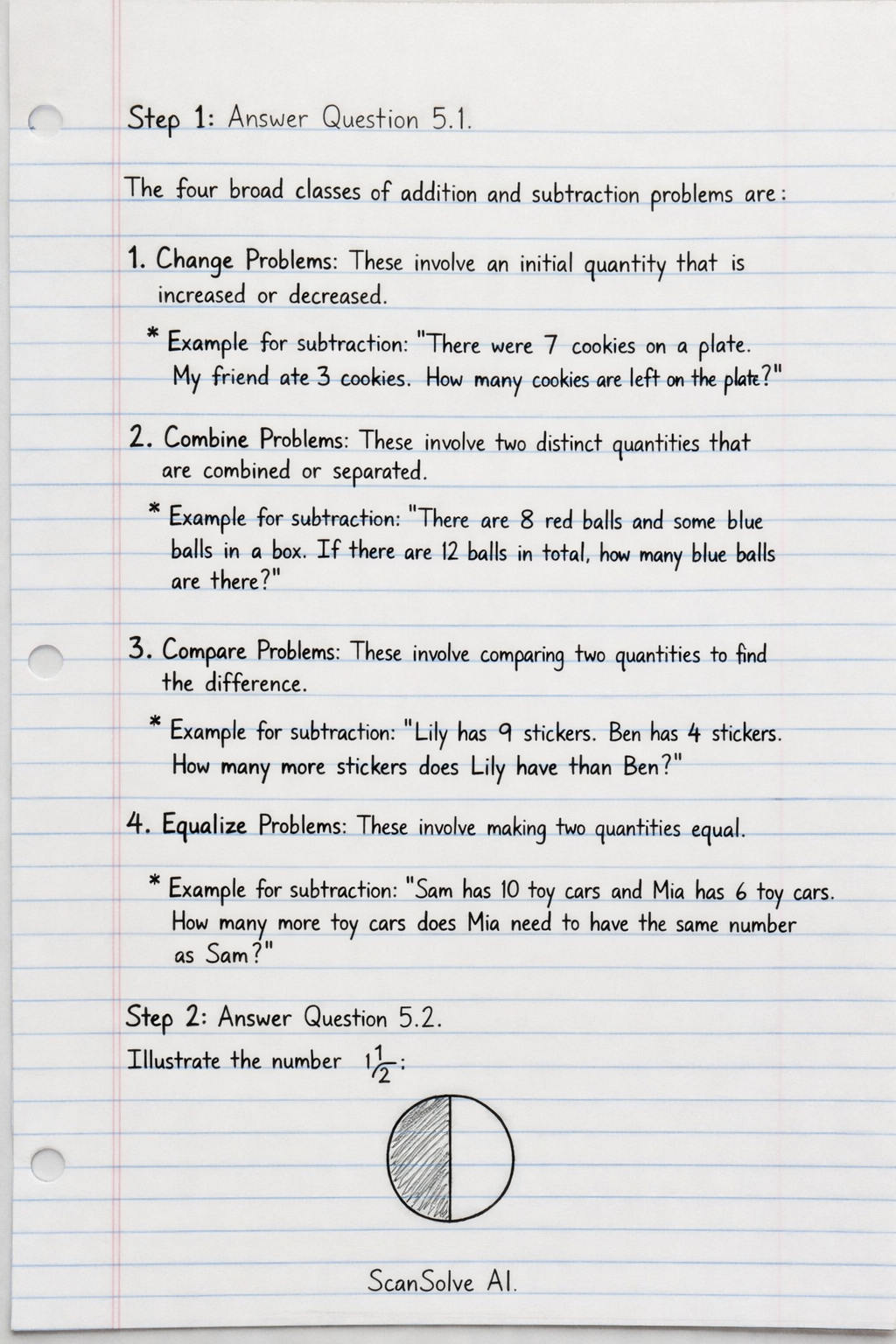
3 stepsAnswer Question 5.1.
The four broad classes of addition and subtraction problems are:
- 1. Change Problems: These involve an initial quantity that is increased or decreased.
- Example for subtraction: "There were 7 cookies on a plate. My friend ate 3 cookies. How many cookies are left on the plate?"
- 2. Combine Problems: These involve two distinct quantities that are combined or separated.
- Example for subtraction: "There are 8 red balls and some blue balls in a box. If there are 12 balls in total, how many blue balls are there?"
- 3. Compare Problems: These involve comparing two quantities to find the difference.
- Example for subtraction: "Lily has 9 stickers. Ben has 4 stickers. How many more stickers does Lily have than Ben?"
- 4. Equalize Problems: These involve making two quantities equal.
- Example for subtraction: "Sam has 10 toy cars and Mia has 6 toy cars. How many more toy cars does Mia need to have the same number as Sam?"
- 1. Change Problems: These involve an initial quantity that is increased or decreased.
Answer Question 5.2.
Illustrate the number :
-
a) An area model: Draw a circle and divide it into two equal halves. Shade one of the halves. (Imagine a pizza cut in half, with one slice shaded).
-
b) A set model: Draw two identical objects (e.g., two apples). Circle or highlight one of the apples to represent one out of the two. (Imagine two apples, one of which is red and the other green. The red apple represents of the set).
-
c) A number line: Draw a straight line segment. Mark the beginning as 0 and the end as 1. Place a mark exactly in the middle of the segment and label it .
-
Answer Question 5.3.
Checklist for Assessing Grade R Learners' Knowledge of Numbers
Skill/Concept Achieved Developing Not Yet Achieved Notes/Observations Cardinal Numbers (How Many) Counts objects up to 5 accurately (e.g., counts 3 blocks and says "three") Counts objects up to 10 accurately (e.g., counts 7 buttons and says "seven") Identifies the quantity of a small group (e.g., shown 4 pencils, says "four") Ordinal Numbers (Position) Identifies the first, second, and third item in a line (e.g., points to the "second" child in a queue) Arranges objects in a specific order (e.g., 1st, 2nd, 3rd) (e.g., places toys in order as instructed) Measure Numbers (Quantity/Size) Compares length (e.g., identifies "longer" or "shorter") (e.g., picks the "shorter" stick) Compares mass (e.g., identifies "heavier" or "lighter") (e.g., holds two objects and says which is "heavier") Compares capacity (e.g., identifies "more" or "less" liquid) (e.g., points to the glass with "more" water)
Still stuck on this one?
Ask a follow-up, and the answer starts from this question.
More Mathematics Questions
Handwritten Step-by-Step Solution
Get this as a handwritten image on WhatsApp — like a tutor wrote it for you.
Try on WhatsApp