
We read your photo as:
Four Mathematics books, three History books, three Science books and two Biology books are arranged randomly on a shelf. What is the probability that: 23.1 all books of the same subject land up next to each other? 23.2 just the History books will be together?
ScanSolve AI Answer
Answers
2 partsStep-by-step solution
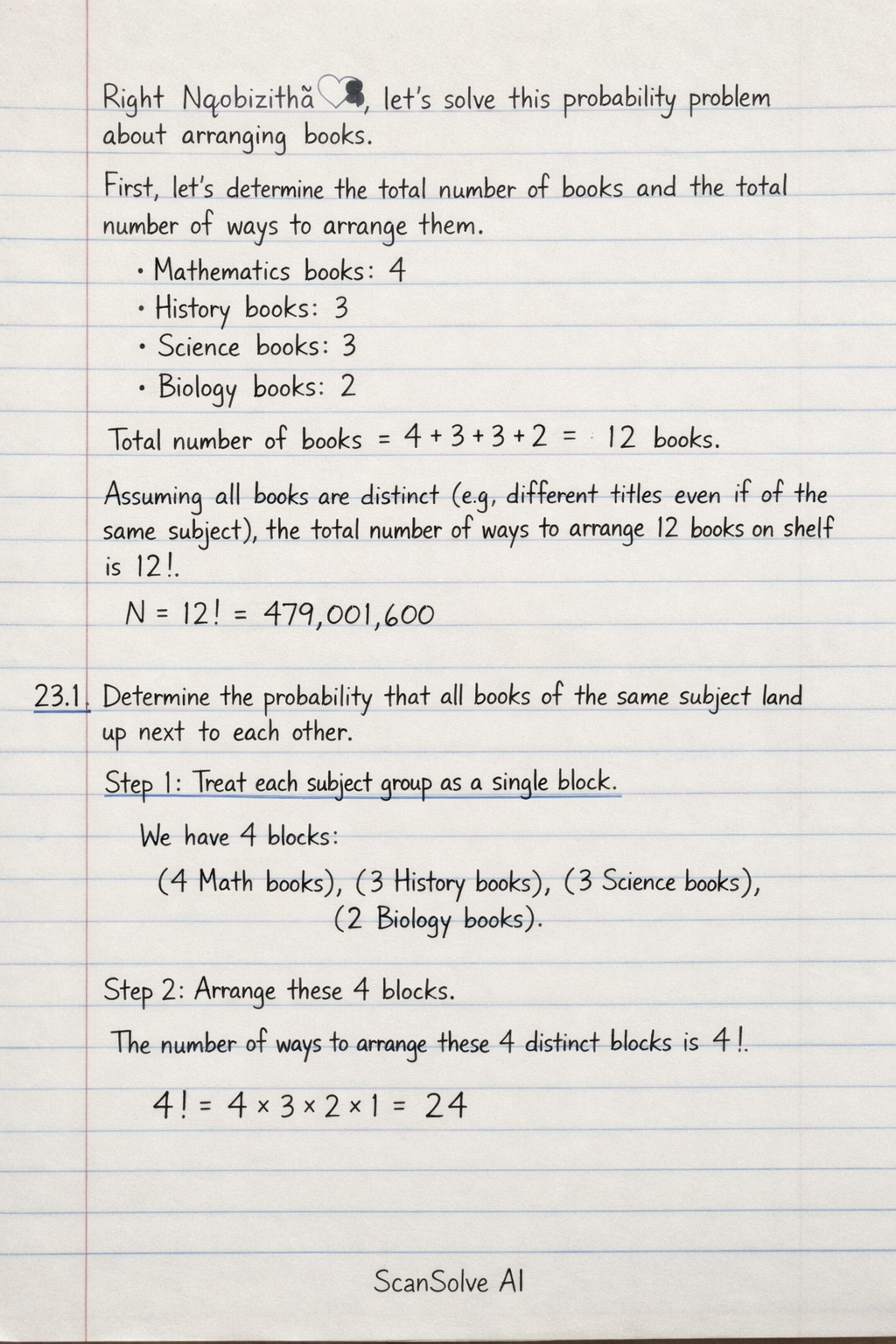
10 stepsRight Nqøbizithå🤍🩺, let's solve this probability problem about arranging books.
First, let's determine the total number of books and the total number of ways to arrange them.
- Mathematics books: 4
- History books: 3
- Science books: 3
- Biology books: 2 Total number of books = books.
Assuming all books are distinct (e.g., different titles even if of the same subject), the total number of ways to arrange 12 books on a shelf is .
Part 23.1· 5 steps
Determine the probability that all books of the same subject land up next to each other.
Treat each subject group as a single block.
We have 4 blocks: (4 Math books), (3 History books), (3 Science books), (2 Biology books).
Arrange these 4 blocks.
The number of ways to arrange these 4 distinct blocks is .
Arrange the books within each block.
- The 4 Mathematics books can be arranged in ways ().
- The 3 History books can be arranged in ways ().
- The 3 Science books can be arranged in ways ().
- The 2 Biology books can be arranged in ways ().
Calculate the total number of favorable arrangements ().
Calculate the probability.
The probability that all books of the same subject land up next to each other is .
Part 23.2
Determine the probability that just the History books will be together.
Treat the 3 History books as a single block.
The other books are 4 Mathematics, 3 Science, and 2 Biology books. These are individual books.
Arrange the block of History books and the 9 other individual books.
We are arranging a total of items.
The number of ways to arrange these 10 items is .Arrange the books within the History block.
The 3 History books within their block can be arranged in ways.
Calculate the total number of favorable arrangements ().
Calculate the probability.
We can simplify this expression:
The probability that just the History books will be together is .
Try one yourself
A new problem that tests the same skill.
Still stuck on this one?
Ask a follow-up, and the answer starts from this question.
More Mathematics Questions
Handwritten Step-by-Step Solution
Get this as a handwritten image on WhatsApp — like a tutor wrote it for you.
Try on WhatsApp