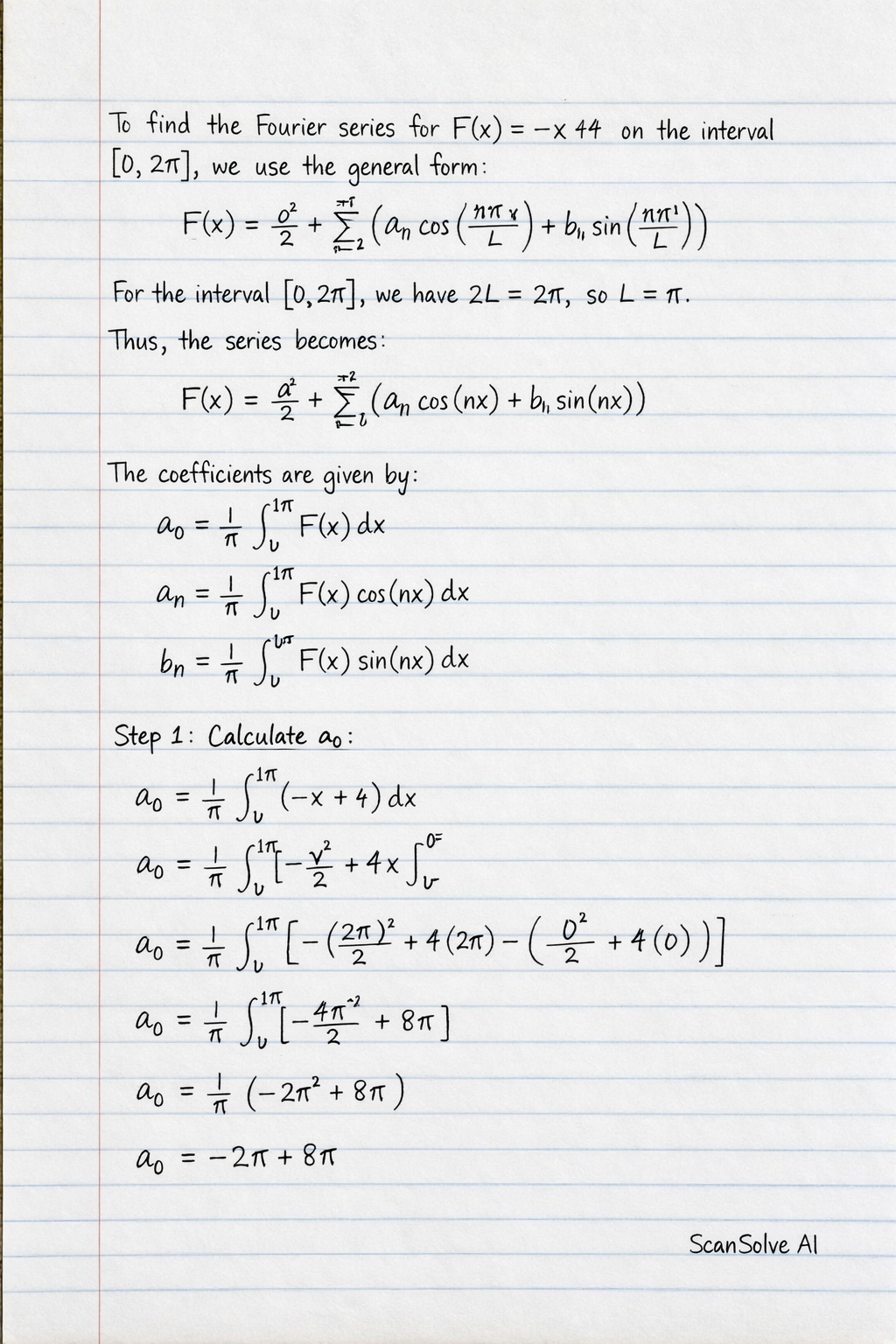
To find the Fourier series for F(x)=−x+4 on the interval [0,2π], we use the general form:
F(x)=2a0+∑n=1∞(ancos(Lnπx)+bnsin(Lnπx))
For the interval [0,2π], we have 2L=2π, so L=π.
Thus, the series becomes:
F(x)=2a0+∑n=1∞(ancos(nx)+bnsin(nx))
The coefficients are given by:
a0=L1∫02LF(x)dx
an=L1∫02LF(x)cos(Lnπx)dx
bn=L1∫02LF(x)sin(Lnπx)dx
Step 1: Calculate a0.
a0=π1∫02π(−x+4)dx
a0=π1[−2x2+4x]02π
a0=π1((−2(2π)2+4(2π))−(−202+4(0)))
a0=π1(−24π2+8π)
a0=π1(−2π2+8π)
a0=−2π+8
Step 2: Calculate an for n≥1.
an=π1∫02π(−x+4)cos(nx)dx
We use integration by parts, ∫udv=uv−∫vdu. Let u=−x+4 and dv=cos(nx)dx. Then du=−dx and v=n1sin(nx).
∫(−x+4)cos(nx)dx=[(−x+4)n1sin(nx)]02π−∫02πn1sin(nx)(−dx)
=[n−x+4sin(nx)]02π+n1∫02πsin(nx)dx
=(n−2π+4sin(2nπ)−n4sin(0))+n1[−n1cos(nx)]02π
Since sin(2nπ)=0 and sin(0)=0:
=(0−0)−n21[cos(2nπ)−cos(0)]
Since cos(2nπ)=1 and cos(0)=1:
=−n21[1−1]=0
Therefore, an=π1(0)=0 for n≥1.
Step 3: Calculate bn for n≥1.
bn=π1∫02π(−x+4)sin(nx)dx
We use integration by parts. Let u=−x+4 and dv=sin(nx)dx. Then du=−dx and v=−n1cos(nx).
∫(−x+4)sin(nx)dx=[(−x+4)(−n1cos(nx))]02π−∫02π(−n1cos(nx))(−dx)
=[−n−x+4cos(nx)]02π−n1∫02πcos(nx)dx
=(−n−2π+4cos(2nπ)−(−n4cos(0)))−n1[n1sin(nx)]02π
Since cos(2nπ)=1 and cos(0)=1:
=(−n−2π+4(1)+n4(1))−n21[sin(2nπ)−sin(0)]
Since sin(2nπ)=0 and sin(0)=0:
=(n2π−4+n4)−0
=n2π
Therefore, bn=π1(n2π)=n2 for n≥1.
Step 4: Assemble the Fourier series.
Substitute the calculated coefficients into the Fourier series formula:
F(x)=2a0+∑n=1∞(ancos(nx)+bnsin(nx))
F(x)=2−2π+8+∑n=1∞(0⋅cos(nx)+n2sin(nx))
F(x)=(4−π)+∑n=1∞n2sin(nx)
The Fourier series for F(x)=−x+4 on the interval [0,2π] is:
F(x)=(4−π)+2n=1∑∞nsin(nx)
What's next? Send 'em! 📸