
We read your photo as:
If the universal set is the set of integers from 1 to 20 inclusive, list the elements of each of the following sets: i. A = all even numbers ii. B = all prime numbers iii. C = all perfect squares iv. D = all perfect cubes v. E = all odd numbers
ScanSolve AI Answer
Step-by-step solution
5 steps2B, Question 1:
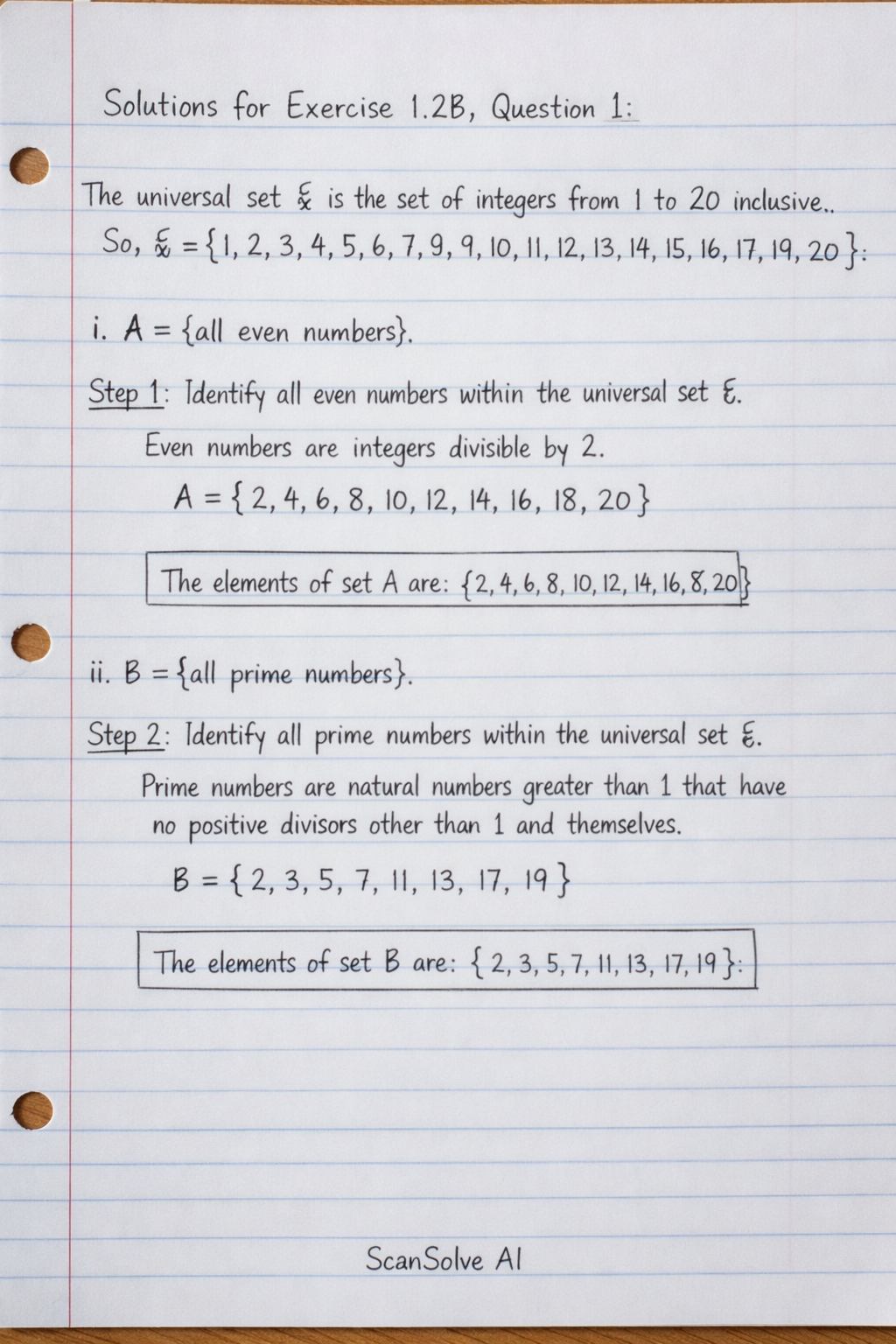
The universal set is the set of integers from 1 to 20 inclusive.
So, .
Part i· 1 step
A = {all even numbers}
Identify all even numbers within the universal set .
Even numbers are integers divisible by 2.
The elements of set A are .
Part ii· 1 step
B = {all prime numbers}
Identify all prime numbers within the universal set .
Prime numbers are natural numbers greater than 1 that have no positive divisors other than 1 and themselves.
The elements of set B are .
Part iii· 1 step
C = {all perfect squares}
Identify all perfect squares within the universal set .
Perfect squares are numbers that can be expressed as the square of an integer.
(This is greater than 20, so it is not in )The elements of set C are .
Part iv· 1 step
D = {all perfect cubes}
Identify all perfect cubes within the universal set .
Perfect cubes are numbers that can be expressed as the cube of an integer.
(This is greater than 20, so it is not in )The elements of set D are .
Part v· 1 step
E = {all odd numbers}
Identify all odd numbers within the universal set .
Odd numbers are integers not divisible by 2.
The elements of set E are .
Still stuck on this one?
Ask a follow-up, and the answer starts from this question.
More Mathematics Questions
Handwritten Step-by-Step Solution
Get this as a handwritten image on WhatsApp — like a tutor wrote it for you.
Try on WhatsApp