Determine the general solution for the following: 1.1 sin2 x - sin x = cos2 x 1.2 sin2 x + sin x cos x = 0
|Mathematics
Determine the general solution for the following: 1.1 sin2 x - sin x = cos2 x 1.2 sin2 x + sin x cos x = 0
ScanSolve AI Answer
Answer
x=90∘+360∘k,x=210∘+360∘k,x=330∘+360∘k,k∈Z
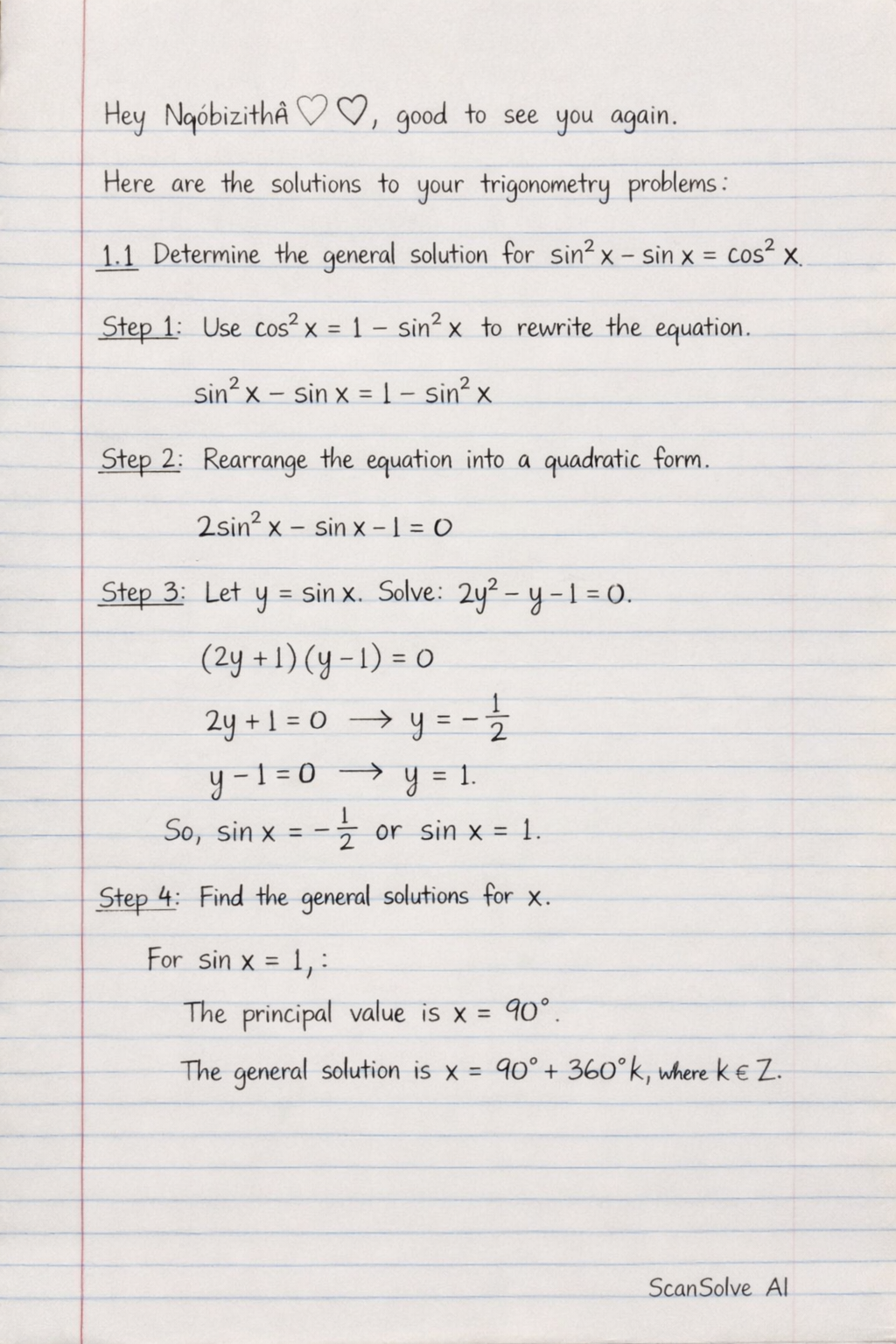
Here are the solutions to your trigonometry problems:
1.1 Determine the general solution for sin2x−sinx=cos2x
Step 1: Use the identity cos2x=1−sin2x to rewrite the equation in terms of sinx.
sin2x−sinx=1−sin2x
Step 2: Rearrange the equation into a quadratic form.
2sin2x−sinx−1=0
Step 3: Let y=sinx. Solve the quadratic equation 2y2−y−1=0.
Factoring the quadratic:
(2y+1)(y−1)=0
This gives two possible values for y:
2y+1=0⟹y=−21y−1=0⟹y=1
So, sinx=−21 or sinx=1.
Step 4: Find the general solutions for x.
For sinx=1:
The principal value is x=90∘.
The general solution is x=90∘+360∘k, where k∈Z.
For sinx=−21:
The reference angle is 30∘. Since sinx is negative, x lies in the third or fourth quadrants.
In the third quadrant: x=180∘+30∘=210∘.
In the fourth quadrant: x=360∘−30∘=330∘.
The general solutions are x=210∘+360∘k and x=330∘+360∘k, where k∈Z.
The general solution is x=90∘+360∘k,x=210∘+360∘k,x=330∘+360∘k,k∈Z.
1.2 Determine the general solution for sin2x+sinxcosx=0
Step 1: Factor out sinx.
sinx(sinx+cosx)=0
Step 2: Set each factor to zero and solve for x.
Case 1: sinx=0
The general solution is x=180∘k, where k∈Z.
Case 2: sinx+cosx=0
Divide by cosx (assuming cosx=0. If cosx=0, then sinx=±1, so sinx+cosx=±1=0. Thus cosx=0 is a valid assumption).
cosxsinx+cosxcosx=0tanx+1=0tanx=−1
The principal value for tanx=−1 is x=−45∘ or x=135∘.
The general solution is x=135∘+180∘k, where k∈Z.
The general solution is x=180∘k,x=135∘+180∘k,k∈Z.
2. Determine the general solution of 3cos2x=1+5cosx
Step 1: Use the double angle identity cos2x=2cos2x−1 to rewrite the equation in terms of cosx.
3(2cos2x−1)=1+5cosx
Step 2: Expand and rearrange the equation into a quadratic form.
6cos2x−3=1+5cosx6cos2x−5cosx−4=0
Step 3: Let y=cosx. Solve the quadratic equation 6y2−5y−4=0.
Using the quadratic formula y=2a−b±b2−4ac:
y=2(6)−(−5)±(−5)2−4(6)(−4)y=125±25+96y=125±121y=125±11
This gives two possible values for y:
y1=125+11=1216=34y2=125−11=12−6=−21
So, cosx=34 or cosx=−21.
Step 4: Find the general solutions for x.
For cosx=34: This has no solution because the range of cosx is [−1,1].
For cosx=−21:
The principal value is x=120∘.
The general solution is x=±120∘+360∘k, where k∈Z.
The general solution is x=±120∘+360∘k,k∈Z.
3. Solve for x: 4sin2x−3sinx−1=0 for x∈[0∘;360∘]
Step 1: This is a quadratic equation in terms of sinx. Let y=sinx.
4y2−3y−1=0
Step 2: Solve the quadratic equation for y.
Factoring the quadratic:
(4y+1)(y−1)=0
This gives two possible values for y:
4y+1=0⟹y=−41y−1=0⟹y=1
So, sinx=−41 or sinx=1.
Step 3: Find the values of x in the range [0∘;360∘].
For sinx=1:
x=90∘
For sinx=−41:
The reference angle is α=arcsin(41)≈14.48∘.
Since sinx is negative, x lies in the third or fourth quadrants.
In the third quadrant: x=180∘+α≈180∘+14.48∘=194.48∘.
In the fourth quadrant: x=360∘−α≈360∘−14.48∘=345.52∘.
The values of x in the given range are x=90∘,194.48∘,345.52∘.
4. Determine the general solution of tanx=2sin2x where cosx<0.
Step 1: Rewrite tanx as cosxsinx and sin2x as 2sinxcosx.
cosxsinx=2(2sinxcosx)cosxsinx=4sinxcosx
Step 2: Rearrange the equation to solve for x.
sinx=4sinxcos2xsinx−4sinxcos2x=0sinx(1−4cos2x)=0
Step 3: Set each factor to zero.
Case 1: sinx=0
The general solution is x=180∘k, where k∈Z.
We also need to consider the condition cosx<0.
If x=180∘k:
If k is even, x=0∘,360∘,…, then cosx=1. This does not satisfy cosx<0.
If k is odd, x=180∘,540∘,…, then cosx=−1. This satisfies cosx<0.
So, for this case, x=180∘(2m+1), where m∈Z. This can be written as x=180∘+360∘m.
Case 2: 1−4cos2x=04cos2x=1cos2x=41cosx=±21
We are given the condition cosx<0, so we must have cosx=−21.
For cosx=−21:
The principal value is x=120∘.
The general solution is x=±120∘+360∘k, where k∈Z.
Both 120∘ and −120∘ (or 240∘) have negative cosine values.
So, x=120∘+360∘k and x=240∘+360∘k (or x=−120∘+360∘k).
Combining the valid solutions from both cases:
The general solution is x=180∘+360∘k,x=120∘+360∘k,x=240∘+360∘k,k∈Z.
5. Calculate the value of x, if x∈[−180∘;360∘] for cos2x=cosx+2
Step 1: Use the double angle identity cos2x=2cos2x−1 to rewrite the equation in terms of cosx.
2cos2x−1=cosx+2
Step 2: Rearrange the equation into a quadratic form.
2cos2x−cosx−3=0
Step 3: Let y=cosx. Solve the quadratic equation 2y2−y−3=0.
Factoring the quadratic:
(2y−3)(y+1)=0
This gives two possible values for y:
2y−3=0⟹y=23y+1=0⟹y=−1
So, cosx=23 or cosx=−1.
Step 4: Find the values of x in the range [−180∘;360∘].
For cosx=23: This has no solution because the range of cosx is [−1,1].
For cosx=−1:
The values of x in the range [−180∘;360∘] are:
x=180∘x=−180∘
The values of x in the given range are x=−180∘,180∘.
What's next? Send 'em! 📸
Was this helpful?
Need help with your own homework?
Get instant step-by-step solutions to any question. Free to start.
This mathematics problem involves applying core mathematical principles and formulas. Below you will find a complete step-by-step solution with detailed explanations for each step, helping you understand not just the answer but the method behind it.
ScanSolve AI Answer
Here are the solutions to your trigonometry problems: 1.1 Determine the general solution for ^2 x - x = ^2 x Step 1: Use the identity ^2 x = 1 - ^2 x to rewrite the equation in terms of x. ^2 x - x = 1 - ^2 x Step 2: Rearrange the equation into a quadratic form. 2^2 x - x - 1 = 0 Step 3: Let y = x. Solve the quadratic equation 2y^2 - y - 1 = 0. Factoring the quadratic: (2y + 1)(y - 1) = 0 This gives two possible values for y: 2y + 1 = 0 y = -(1)/(2) y - 1 = 0 y = 1 So, x = -(1)/(2) or x = 1. Step 4: Find the general solutions for x. For x = 1: The principal value is x = 90^. The general solution is x = 90^ + 360^ k, where k Z. For x = -(1)/(2): The reference angle is 30^. Since x is negative, x lies in the third or fourth quadrants. In the third quadrant: x = 180^ + 30^ = 210^. In the fourth quadrant: x = 360^ - 30^ = 330^. The general solutions are x = 210^ + 360^ k and x = 330^ + 360^ k, where k Z. The general solution is x = 90^ + 360^ k, x = 210^ + 360^ k, x = 330^ + 360^ k, k Z. 1.2 Determine the general solution for ^2 x + x x = 0 Step 1: Factor out x. x ( x + x) = 0 Step 2: Set each factor to zero and solve for x. Case 1: x = 0 The general solution is x = 180^ k, where k Z. Case 2: x + x = 0 Divide by x (assuming x ≠ 0. If x = 0, then x = ± 1, so x + x = ± 1 ≠ 0. Thus x ≠ 0 is a valid assumption). ( x)/( x) + ( x)/( x) = 0 x + 1 = 0 x = -1 The principal value for x = -1 is x = -45^ or x = 135^. The general solution is x = 135^ + 180^ k, where k Z. The general solution is x = 180^ k, x = 135^ + 180^ k, k Z. 2. Determine the general solution of 3 2x = 1 + 5 x Step 1: Use the double angle identity 2x = 2^2 x - 1 to rewrite the equation in terms of x. 3(2^2 x - 1) = 1 + 5 x Step 2: Expand and rearrange the equation into a quadratic form. 6^2 x - 3 = 1 + 5 x 6^2 x - 5 x - 4 = 0 Step 3: Let y = x. Solve the quadratic equation 6y^2 - 5y - 4 = 0. Using the quadratic formula y = -b ± sqrt(b^2 - 4ac)2a: y = -(-5) ± sqrt((-5)^2 - 4(6)(-4))2(6) y = 5 ± sqrt(25 + 96)12 y = 5 ± sqrt(121)12 y = (5 ± 11)/(12) This gives two possible values for y: y_1 = (5 + 11)/(12) = (16)/(12) = (4)/(3) y_2 = (5 - 11)/(12) = (-6)/(12) = -(1)/(2) So, x = (4)/(3) or x = -(1)/(2). Step 4: Find the general solutions for x. For x = (4)/(3): This has no solution because the range of x is [-1, 1]. For x = -(1)/(2): The principal value is x = 120^. The general solution is x = ± 120^ + 360^ k, where k Z. The general solution is x = ± 120^ + 360^ k, k Z. 3. Solve for x: 4^2 x - 3 x - 1 = 0 for x [0^; 360^] Step 1: This is a quadratic equation in terms of x. Let y = x. 4y^2 - 3y - 1 = 0 Step 2: Solve the quadratic equation for y. Factoring the quadratic: (4y + 1)(y - 1) = 0 This gives two possible values for y: 4y + 1 = 0 y = -(1)/(4) y - 1 = 0 y = 1 So, x = -(1)/(4) or x = 1. Step 3: Find the values of x in the range [0^; 360^]. For x = 1: x = 90^ For x = -(1)/(4): The reference angle is = ((1)/(4)) ≈ 14.48^. Since x is negative, x lies in the third or fourth quadrants. In the third quadrant: x = 180^ + ≈ 180^ + 14.48^ = 194.48^. In the fourth quadrant: x = 360^ - ≈ 360^ - 14.48^ = 345.52^. The values of x in the given range are x = 90^, 194.48^, 345.52^. 4. Determine the general solution of x = 2 2x where x < 0. Step 1: Rewrite x as ( x)/( x) and 2x as 2 x x. ( x)/( x) = 2(2 x x) ( x)/( x) = 4 x x Step 2: Rearrange the equation to solve for x. x = 4 x ^2 x x - 4 x ^2 x = 0 x (1 - 4^2 x) = 0 Step 3: Set each factor to zero. Case 1: x = 0 The general solution is x = 180^ k, where k Z. We also need to consider the condition x < 0. If x = 180^ k: If k is even, x = 0^, 360^, , then x = 1. This does not satisfy x < 0. If k is odd, x = 180^, 540^, , then x = -1. This satisfies x < 0. So, for this case, x = 180^ (2m+1), where m Z. This can be written as x = 180^ + 360^ m. Case 2: 1 - 4^2 x = 0 4^2 x = 1 ^2 x = (1)/(4) x = ± (1)/(2) We are given the condition x < 0, so we must have x = -(1)/(2). For x = -(1)/(2): The principal value is x = 120^. The general solution is x = ± 120^ + 360^ k, where k Z. Both 120^ and -120^ (or 240^) have negative cosine values. So, x = 120^ + 360^ k and x = 240^ + 360^ k (or x = -120^ + 360^ k). Combining the valid solutions from both cases: The general solution is x = 180^ + 360^ k, x = 120^ + 360^ k, x = 240^ + 360^ k, k Z. 5. Calculate the value of x, if x [-180^; 360^] for 2x = x + 2 Step 1: Use the double angle identity 2x = 2^2 x - 1 to rewrite the equation in terms of x. 2^2 x - 1 = x + 2 Step 2: Rearrange the equation into a quadratic form. 2^2 x - x - 3 = 0 Step 3: Let y = x. Solve the quadratic equation 2y^2 - y - 3 = 0. Factoring the quadratic: (2y - 3)(y + 1) = 0 This gives two possible values for y: 2y - 3 = 0 y = (3)/(2) y + 1 = 0 y = -1 So, x = (3)/(2) or x = -1. Step 4: Find the values of x in the range [-180^; 360^]. For x = (3)/(2): This has no solution because the range of x is [-1, 1]. For x = -1: The values of x in the range [-180^; 360^] are: x = 180^ x = -180^ The values of x in the given range are x = -180^, 180^. What's next? Send 'em! 📸