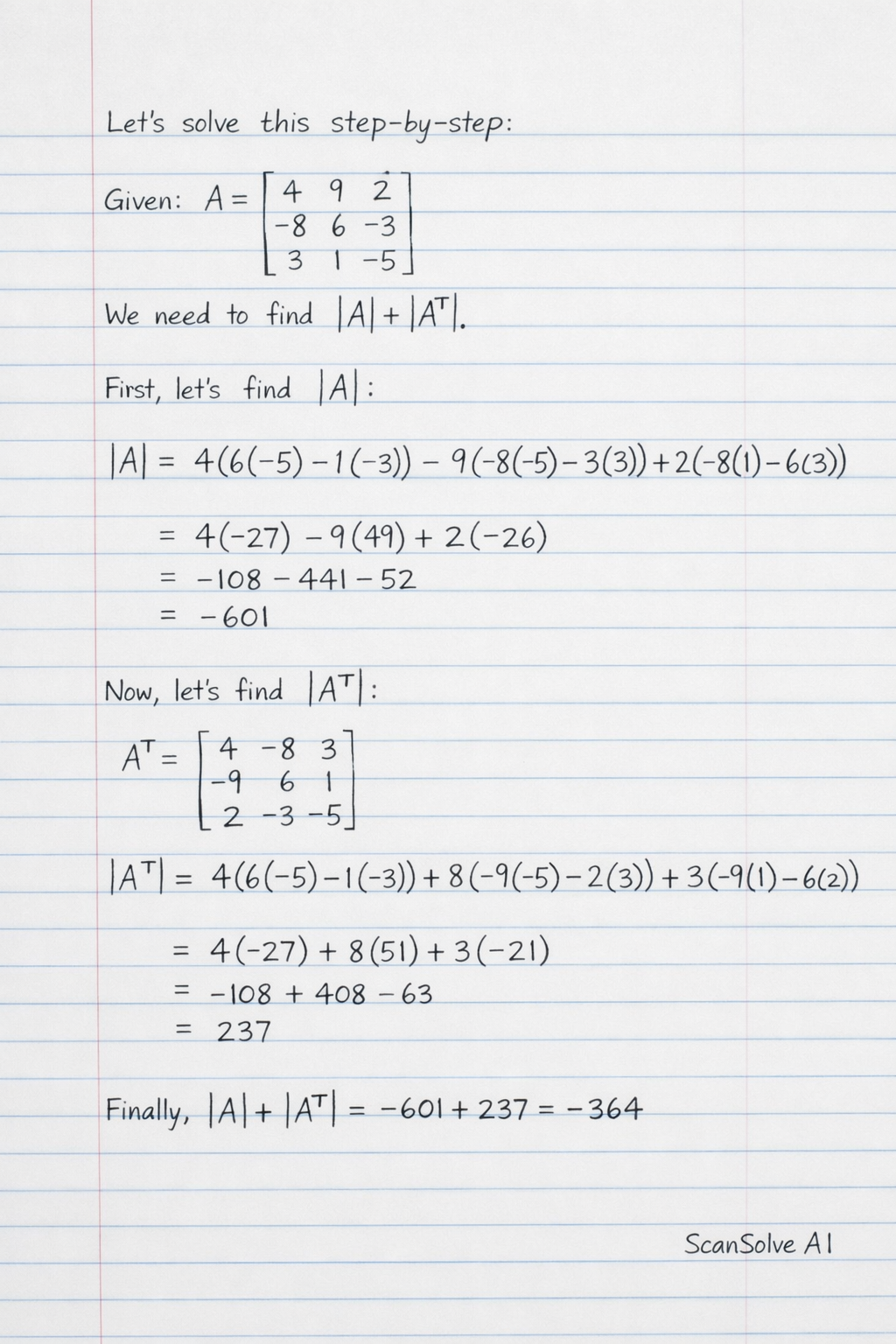
Let's re-solve Question D, breaking it down into clear, understandable steps.
Question D:
Given the matrix A=4−839612−3−5
Evaluate ∣A∣+∣AT∣
Understanding Determinants (∣A∣):
The determinant of a matrix is a special number that can be calculated from its elements. For a 3×3 matrix, we use a method called cofactor expansion.
For a matrix adgbehcfi, the determinant is calculated as:
a(ei−fh)−b(di−fg)+c(dh−eg).
Step 1: Calculate the determinant of matrix A, denoted as ∣A∣.
We'll expand along the first row:
∣A∣=461−3−5−9−83−3−5+2−8361
Now, calculate each 2×2 determinant (ad−bc):
∣A∣=4((6)(−5)−(−3)(1))−9((−8)(−5)−(−3)(3))+2((−8)(1)−(6)(3))∣A∣=4(−30+3)−9(40+9)+2(−8−18)∣A∣=4(−27)−9(49)+2(−26)∣A∣=−108−441−52∣A∣=−601
Understanding Transpose Determinant (∣AT∣):
The transpose of a matrix (AT) is created by flipping the matrix over its diagonal, meaning rows become columns and columns become rows. A key property of determinants is that the determinant of a matrix is always equal to the determinant of its transpose.
So, ∣AT∣=∣A∣.
Step 2: Use the property ∣AT∣=∣A∣.
Since ∣A∣=−601, then ∣AT∣ is also −601.
∣AT∣=−601
Step 3: Evaluate ∣A∣+∣AT∣.
∣A∣+∣AT∣=−601+(−601)∣A∣+∣AT∣=−1202
The value of ∣A∣+∣AT∣ is −1202.
Hence or otherwise solve the equations:4x+9y+2z=21−8x+6y−3z=413x+y−5z=−73
Understanding Cramer's Rule:
Cramer's Rule is a method for solving systems of linear equations using determinants. For a system AX=B, where A is the coefficient matrix, X is the variable matrix, and B is the constant matrix, the solutions for x,y,z are given by:
x=∣A∣∣Ax∣,y=∣A∣∣Ay∣,z=∣A∣∣Az∣
Here, ∣A∣ is the determinant of the coefficient matrix. ∣Ax∣ is the determinant of a new matrix formed by replacing the x-column of A with the constant terms from B. Similarly for ∣Ay∣ and ∣Az∣.
Step 4: Write the system of equations in matrix form AX=B.
The coefficient matrix A is:
A=4−839612−3−5
The constant matrix B is:
B=2141−73
We already calculated ∣A∣=−601.
Step 5: Calculate ∣Ax∣ to find x.
Replace the first column of A with the constants from B:
A_x = \begin{bmatrix} 21 & 9 & 2 \\ 41 & 6 & -3 \\ -73 & 1 & -5 \end{vmatrix}
Now, calculate its determinant:
∣Ax∣=2161−3−5−941−73−3−5+241−7361∣Ax∣=21((6)(−5)−(−3)(1))−9((41)(−5)−(−3)(−73))+2((41)(1)−(6)(−73))∣Ax∣=21(−30+3)−9(−205−219)+2(41+438)∣Ax∣=21(−27)−9(−424)+2(479)∣Ax∣=−567+3816+958∣Ax∣=4207
Now find x:
x=∣A∣∣Ax∣=−6014207=−7
Step 6: Calculate ∣Ay∣ to find y.
Replace the second column of A with the constants from B:
A_y = \begin{bmatrix} 4 & 21 & 2 \\ -8 & 41 & -3 \\ 3 & -73 & -5 \end{vmatrix}
Now, calculate its determinant:
∣Ay∣=441−73−3−5−21−83−3−5+2−8341−73∣Ay∣=4((41)(−5)−(−3)(−73))−21((−8)(−5)−(−3)(3))+2((−8)(−73)−(41)(3))∣Ay∣=4(−205−219)−21(40+9)+2(584−123)∣Ay∣=4(−424)−21(49)+2(461)∣Ay∣=−1696−1029+922∣Ay∣=−1803
Now find y:
y=∣A∣∣Ay∣=−601−1803=3
Step 7: Calculate ∣Az∣ to find z.
Replace the third column of A with the constants from B:
A_z = \begin{bmatrix} 4 & 9 & 21 \\ -8 & 6 & 41 \\ 3 & 1 & -73 \end{vmatrix}
Now, calculate its determinant:
∣Az∣=46141−73−9−8341−73+21−8361∣Az∣=4((6)(−73)−(41)(1))−9((−8)(−73)−(41)(3))+21((−8)(1)−(6)(3))∣Az∣=4(−438−41)−9(584−123)+21(−8−18)∣Az∣=4(−479)−9(461)+21(−26)∣Az∣=−1916−4149−546∣Az∣=−6611
Now find z:
z=∣A∣∣Az∣=−601−6611=11
The solution to the system of equations is x=−7,y=3,z=11.
What's next?
Was this helpful?
Need help with your own homework?
Get instant step-by-step solutions to any question. Free to start.
Question D: Given the matrix A = 4 & 9 & 2 \\ -8 & 6 & -3 \\ 3 & 1 & -5 Evaluate |A| + |A^T| Understanding Determinants (|A|): The determinant of a matrix is a special number that can be calculated from its elements.
This mathematics problem involves applying core mathematical principles and formulas. Below you will find a complete step-by-step solution with detailed explanations for each step, helping you understand not just the answer but the method behind it.
ScanSolve AI Answer
Let's re-solve Question D, breaking it down into clear, understandable steps. Question D: Given the matrix A = 4 & 9 & 2 \\ -8 & 6 & -3 \\ 3 & 1 & -5 Evaluate |A| + |A^T| Understanding Determinants (|A|): The determinant of a matrix is a special number that can be calculated from its elements. For a 3 × 3 matrix, we use a method called cofactor expansion. For a matrix a & b & c \\ d & e & f \\ g & h & i , the determinant is calculated as: a(ei - fh) - b(di - fg) + c(dh - eg). Step 1: Calculate the determinant of matrix A, denoted as |A|. We'll expand along the first row: |A| = 4 6 & -3 \\ 1 & -5 - 9 -8 & -3 \\ 3 & -5 + 2 -8 & 6 \\ 3 & 1 Now, calculate each 2 × 2 determinant (ad-bc): |A| = 4((6)(-5) - (-3)(1)) - 9((-8)(-5) - (-3)(3)) + 2((-8)(1) - (6)(3)) |A| = 4(-30 + 3) - 9(40 + 9) + 2(-8 - 18) |A| = 4(-27) - 9(49) + 2(-26) |A| = -108 - 441 - 52 |A| = -601 Understanding Transpose Determinant (|A^T|): The transpose of a matrix (A^T) is created by flipping the matrix over its diagonal, meaning rows become columns and columns become rows. A key property of determinants is that the determinant of a matrix is always equal to the determinant of its transpose. So, |A^T| = |A|. Step 2: Use the property |A^T| = |A|. Since |A| = -601, then |A^T| is also -601. |A^T| = -601 Step 3: Evaluate |A| + |A^T|. |A| + |A^T| = -601 + (-601) |A| + |A^T| = -1202 The value of |A| + |A^T| is -1202. Hence or otherwise solve the equations: 4x+9y+2z = 21 -8x+6y-3z = 41 3x+y-5z = -73 Understanding Cramer's Rule: Cramer's Rule is a method for solving systems of linear equations using determinants. For a system AX=B, where A is the coefficient matrix, X is the variable matrix, and B is the constant matrix, the solutions for x, y, z are given by: x = (|A_x|)/(|A|), y = (|A_y|)/(|A|), z = (|A_z|)/(|A|) Here, |A| is the determinant of the coefficient matrix. |A_x| is the determinant of a new matrix formed by replacing the x-column of A with the constant terms from B. Similarly for |A_y| and |A_z|. Step 4: Write the system of equations in matrix form AX = B. The coefficient matrix A is: A = 4 & 9 & 2 \\ -8 & 6 & -3 \\ 3 & 1 & -5 The constant matrix B is: B = 21 \\ 41 \\ -73 We already calculated |A| = -601. Step 5: Calculate |A_x| to find x. Replace the first column of A with the constants from B: A_x = 21 & 9 & 2 \\ 41 & 6 & -3 \\ -73 & 1 & -5 Now, calculate its determinant: |A_x| = 21 6 & -3 \\ 1 & -5 - 9 41 & -3 \\ -73 & -5 + 2 41 & 6 \\ -73 & 1 |A_x| = 21((6)(-5) - (-3)(1)) - 9((41)(-5) - (-3)(-73)) + 2((41)(1) - (6)(-73)) |A_x| = 21(-30 + 3) - 9(-205 - 219) + 2(41 + 438) |A_x| = 21(-27) - 9(-424) + 2(479) |A_x| = -567 + 3816 + 958 |A_x| = 4207 Now find x: x = (|A_x|)/(|A|) = (4207)/(-601) = -7 Step 6: Calculate |A_y| to find y. Replace the second column of A with the constants from B: A_y = 4 & 21 & 2 \\ -8 & 41 & -3 \\ 3 & -73 & -5 Now, calculate its determinant: |A_y| = 4 41 & -3 \\ -73 & -5 - 21 -8 & -3 \\ 3 & -5 + 2 -8 & 41 \\ 3 & -73 |A_y| = 4((41)(-5) - (-3)(-73)) - 21((-8)(-5) - (-3)(3)) + 2((-8)(-73) - (41)(3)) |A_y| = 4(-205 - 219) - 21(40 + 9) + 2(584 - 123) |A_y| = 4(-424) - 21(49) + 2(461) |A_y| = -1696 - 1029 + 922 |A_y| = -1803 Now find y: y = (|A_y|)/(|A|) = (-1803)/(-601) = 3 Step 7: Calculate |A_z| to find z. Replace the third column of A with the constants from B: A_z = 4 & 9 & 21 \\ -8 & 6 & 41 \\ 3 & 1 & -73 Now, calculate its determinant: |A_z| = 4 6 & 41 \\ 1 & -73 - 9 -8 & 41 \\ 3 & -73 + 21 -8 & 6 \\ 3 & 1 |A_z| = 4((6)(-73) - (41)(1)) - 9((-8)(-73) - (41)(3)) + 21((-8)(1) - (6)(3)) |A_z| = 4(-438 - 41) - 9(584 - 123) + 21(-8 - 18) |A_z| = 4(-479) - 9(461) + 21(-26) |A_z| = -1916 - 4149 - 546 |A_z| = -6611 Now find z: z = (|A_z|)/(|A|) = (-6611)/(-601) = 11 The solution to the system of equations is x = -7, y = 3, z = 11. What's next?