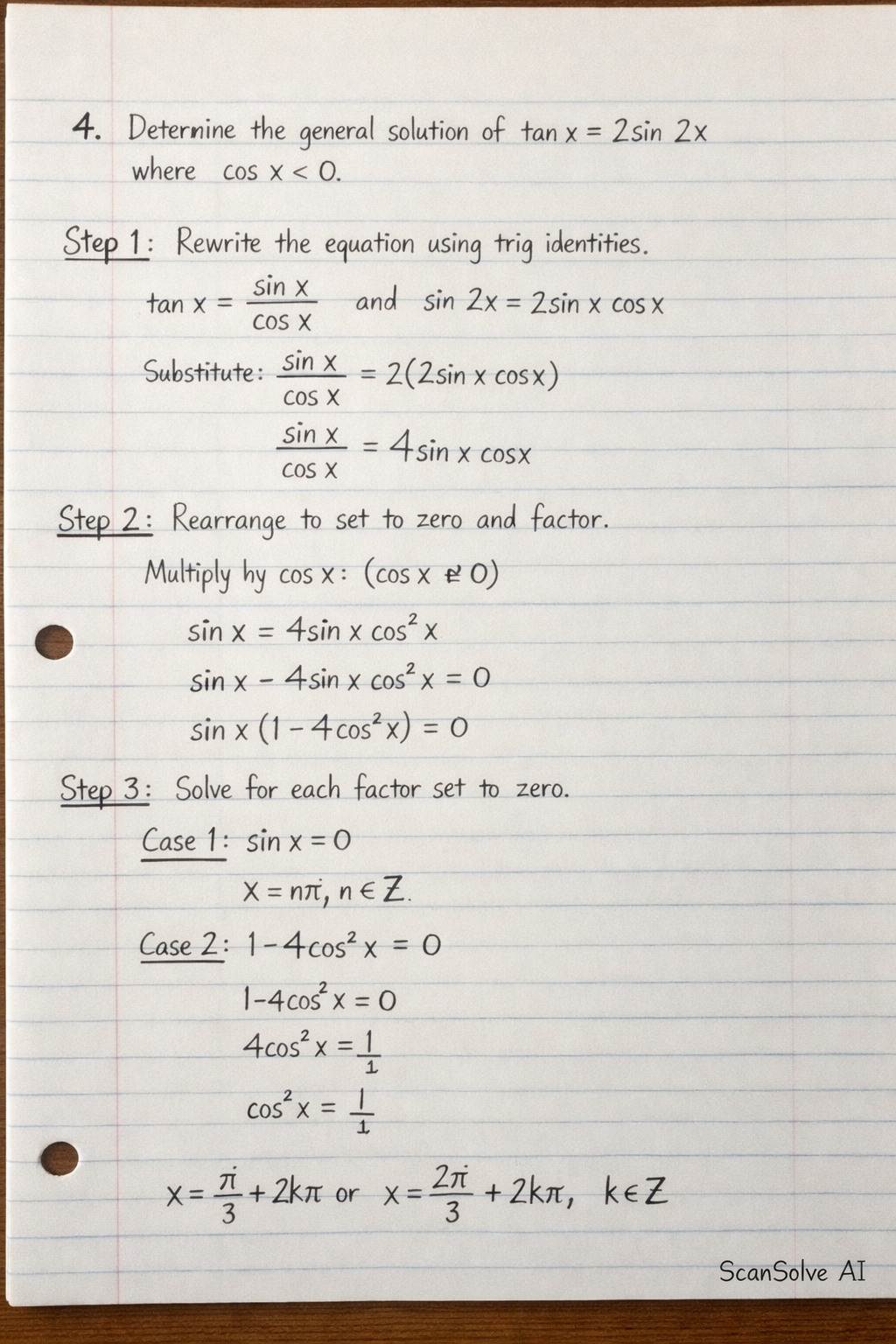
We read your photo as:

Determine the general solution of tan x = 2 sin 2x where cos x < 0.

Mathematics

ScanSolve AI Answer

Step-by-step solution

6 steps

Here's a detailed breakdown for question 4:

4. Determine the general solution of tan⁡x=2sin⁡2x\tan x = 2\sin 2x where cos⁡x<0\cos x < 0.

  1. Rewrite the equation using fundamental trigonometric identities.

    Recall that tan⁡x=sin⁡xcos⁡x\tan x = \frac{\sin x}{\cos x} and sin⁡2x=2sin⁡xcos⁡x\sin 2x = 2\sin x \cos x.
    Substitute these into the given equation:

    sin⁡xcos⁡x=2(2sin⁡xcos⁡x)\frac{\sin x}{\cos x} = 2(2\sin x \cos x) sin⁡xcos⁡x=4sin⁡xcos⁡x\frac{\sin x}{\cos x} = 4\sin x \cos x
  2. Rearrange the equation to set it to zero and factor.

    Multiply both sides by cos⁡x\cos x (note: cos⁡x≠0\cos x \neq 0 for tan⁡x\tan x to be defined, so we must check solutions where cos⁡x=0\cos x = 0 separately if they arise from the original equation, but here we are given cos⁡x<0\cos x < 0, so cos⁡x≠0\cos x \neq 0 is already implied).

    sin⁡x=4sin⁡xcos⁡2x\sin x = 4\sin x \cos^2 x

    Move all terms to one side:

    sin⁡x−4sin⁡xcos⁡2x=0\sin x - 4\sin x \cos^2 x = 0

    Factor out sin⁡x\sin x:

    sin⁡x(1−4cos⁡2x)=0\sin x (1 - 4\cos^2 x) = 0
  3. Solve for each factor being equal to zero.

    This gives two separate cases:
    Case 1: sin⁡x=0\sin x = 0
    Case 2: 1−4cos⁡2x=01 - 4\cos^2 x = 0

  4. Solve Case 1 and apply the condition cos⁡x<0\cos x < 0.

    For sin⁡x=0\sin x = 0, the general solution is x=180∘kx = 180^\circ k, where k∈Zk \in \mathbb{Z}.
    Now, we apply the condition cos⁡x<0\cos x < 0.

    • If kk is an even integer (e.g., k=0,2,−2,…k=0, 2, -2, \dots), then x=0∘,360∘,−360∘,…x = 0^\circ, 360^\circ, -360^\circ, \dots. For these values, cos⁡x=1\cos x = 1, which does not satisfy cos⁡x<0\cos x < 0.
    • If kk is an odd integer (e.g., k=1,3,−1,…k=1, 3, -1, \dots), then x=180∘,540∘,−180∘,…x = 180^\circ, 540^\circ, -180^\circ, \dots. For these values, cos⁡x=−1\cos x = -1, which satisfies cos⁡x<0\cos x < 0. So, the solutions from Case 1 that satisfy cos⁡x<0\cos x < 0 are x=180∘+360∘kx = 180^\circ + 360^\circ k, where k∈Zk \in \mathbb{Z}.
  5. Solve Case 2 and apply the condition cos⁡x<0\cos x < 0.

    For 1−4cos⁡2x=01 - 4\cos^2 x = 0:

    4cos⁡2x=14\cos^2 x = 1 cos⁡2x=14\cos^2 x = \frac{1}{4}

    Take the square root of both sides:

    cos⁡x=±14\cos x = \pm \sqrt{\frac{1}{4}} cos⁡x=±12\cos x = \pm \frac{1}{2}

    Now, apply the condition cos⁡x<0\cos x < 0. This means we only consider cos⁡x=−12\cos x = -\frac{1}{2}.
    For cos⁡x=−12\cos x = -\frac{1}{2}:
    The reference angle is 60∘60^\circ. Since cos⁡x\cos x is negative, xx lies in the second or third quadrants.

    • In the second quadrant: x=180∘−60∘=120∘x = 180^\circ - 60^\circ = 120^\circ.
    • In the third quadrant: x=180∘+60∘=240∘x = 180^\circ + 60^\circ = 240^\circ. The general solutions for these are: x=120∘+360∘kx = 120^\circ + 360^\circ k, where k∈Zk \in \mathbb{Z}. x=240∘+360∘kx = 240^\circ + 360^\circ k, where k∈Zk \in \mathbb{Z}.
  6. Combine all valid general solutions.

    The general solutions satisfying cos⁡x<0\cos x < 0 are:

    x=180∘+360∘kx = 180^\circ + 360^\circ k x=120∘+360∘kx = 120^\circ + 360^\circ k x=240∘+360∘kx = 240^\circ + 360^\circ k

    where k∈Zk \in \mathbb{Z}.

    The general solution is x=180∘+360∘k,x=120∘+360∘k,x=240∘+360∘k,k∈Z\boxed{x = 180^\circ + 360^\circ k, x = 120^\circ + 360^\circ k, x = 240^\circ + 360^\circ k, k \in \mathbb{Z}}.

Was this helpful?

Still stuck on this one?

Ask a follow-up, and the answer starts from this question.

Got a different question?Ask your own question
Handwritten step-by-step solution preview

Handwritten Step-by-Step Solution

Get this as a handwritten image on WhatsApp — like a tutor wrote it for you.

Try on WhatsApp