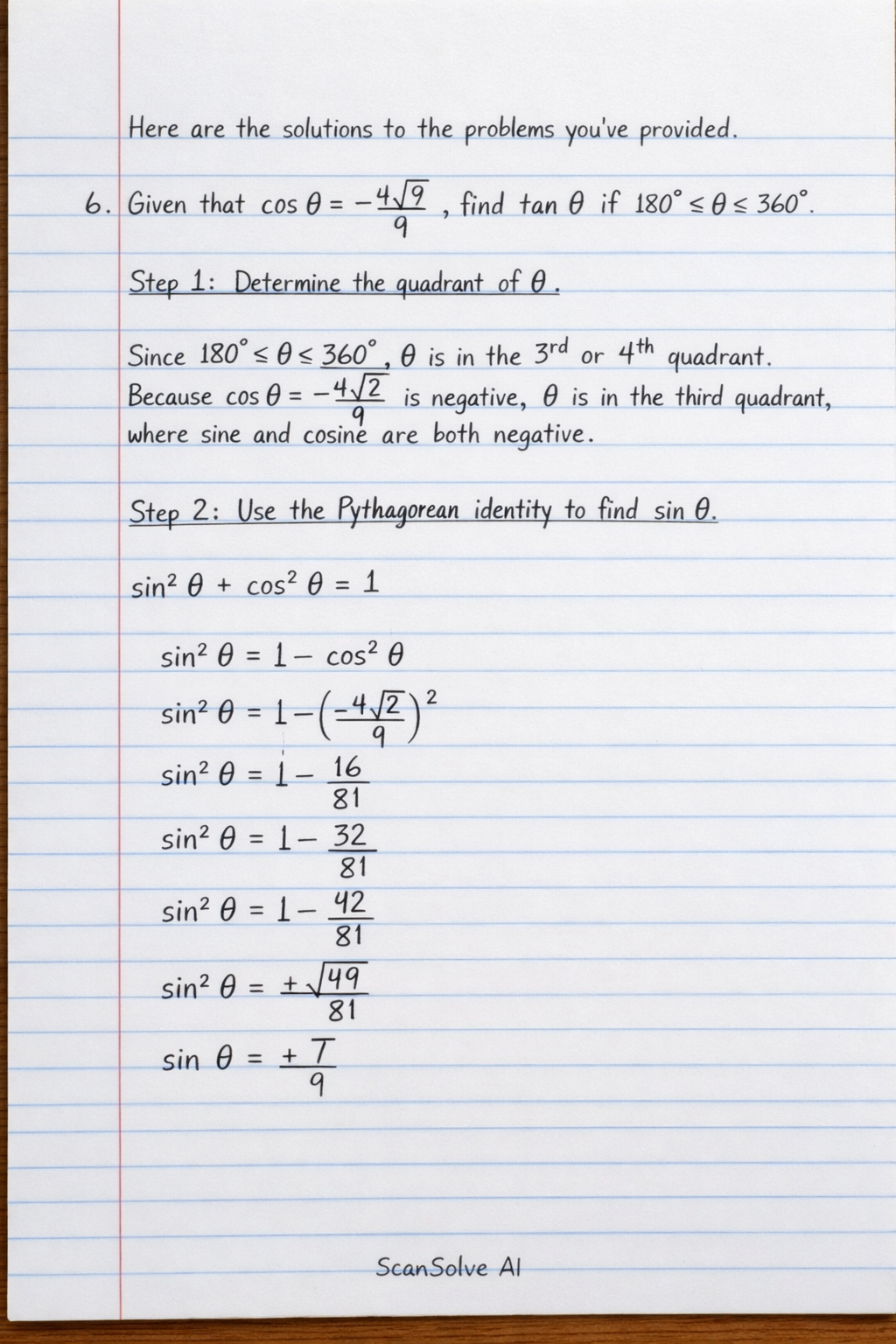
Given 180^ theta 360^, theta is in either the third or fourth quadrant. Since theta = -4sqrt(2)9 is negative, theta must be in the third quadrant, where bo
|Mathematics
Given 180^ theta 360^, theta is in either the third or fourth quadrant. Since theta = -4sqrt(2)9 is negative, theta must be in the third quadrant, where bo
ScanSolve AI Answer
Answer
\frac{7\sqrt{2
Here are the solutions to the problems you've provided.
6. Given that cosθ=−942, find without using mathematical tables or calculators the value of tanθ if 180∘≤θ≤360∘.
Step 1: Determine the quadrant of θ.
Given 180∘≤θ≤360∘, θ is in either the third or fourth quadrant. Since cosθ=−942 is negative, θ must be in the third quadrant, where both sine and cosine are negative.
Step 2: Use the Pythagorean identity to find sinθ.
The identity is sin2θ+cos2θ=1.
sin2θ=1−cos2θsin2θ=1−(−942)2sin2θ=1−8116×2sin2θ=1−8132sin2θ=8181−32sin2θ=8149sinθ=±8149=±97
Step 3: Choose the correct sign for sinθ.
Since θ is in the third quadrant, sinθ must be negative.
sinθ=−97
Step 4: Calculate tanθ.
The formula for tanθ is cosθsinθ.
tanθ=−942−97tanθ=427
Step 5: Rationalize the denominator.tanθ=427×22tanθ=4×272\tan \theta = \frac{7\sqrt{2}{8}}
7. Janet was required to increase a number by 20%. By mistake, she decreased it by 20%. By what percentage should it be increased to give the correct value?
Step 1: Define the original number and the required value.
Let the original number be N.
The required value (increase by 20%) is N+0.20N=1.20N.
Step 2: Define the value Janet obtained by mistake.
The mistake value (decrease by 20%) is N−0.20N=0.80N.
Step 3: Calculate the percentage increase needed from the mistake value to the required value.
The increase needed is the difference between the required value and the mistake value, divided by the mistake value, then multiplied by 100%.
PercentageIncrease=MistakeValueRequiredValue−MistakeValue×100%PercentageIncrease=0.80N1.20N−0.80N×100%PercentageIncrease=0.80N0.40N×100%PercentageIncrease=0.800.40×100%PercentageIncrease=0.5×100%PercentageIncrease=50%
Step 1: Simplify the numerator.
First, simplify (2a3b5)4:
(2a3b5)4=24(a3)4(b5)4=16a12b20
Now, perform the division in the numerator:
16a12b20÷(21a3b2)=16a12b20×a3b22=(16×2)a12−3b20−2=32a9b18
Step 2: Simplify the denominator.
First, simplify (4a4b2)2:
(4a4b2)2=42(a4)2(b2)2=16a8b4
Next, simplify (8ab)3:
(8ab)3=83a3b3=512a3b3
Now, perform the multiplication in the denominator:
16a8b4×512a3b3=(16×512)a8+3b4+3=8192a11b7
Step 3: Combine the simplified numerator and denominator.8192a11b732a9b18
Step 4: Simplify the expression.
Divide the numerical coefficients:
819232=2561
Divide the a terms:
a11a9=a9−11=a−2=a21
Divide the b terms:
b7b18=b18−7=b11
Combine these simplified parts:
Was this helpful?
Need help with your own homework?
Get instant step-by-step solutions to any question. Free to start.
Determine the quadrant of . Given 180^ 360^, is in either the third or fourth quadrant.
Given 180^ theta 360^, theta is in either the third or fourth quadrant. Since theta = -4sqrt(2)9 is negative, theta must be in the third quadrant, where bo
This mathematics problem involves applying core mathematical principles and formulas. Below you will find a complete step-by-step solution with detailed explanations for each step, helping you understand not just the answer but the method behind it.
ScanSolve AI Answer
Here are the solutions to the problems you've provided. 6. Given that = -4sqrt(2)9, find without using mathematical tables or calculators the value of if 180^ 360^. Step 1: Determine the quadrant of . Given 180^ 360^, is in either the third or fourth quadrant. Since = -4sqrt(2)9 is negative, must be in the third quadrant, where both sine and cosine are negative. Step 2: Use the Pythagorean identity to find . The identity is ^2 + ^2 = 1. ^2 = 1 - ^2 ^2 = 1 - (-4sqrt(2)9)^2 ^2 = 1 - (16 × 2)/(81) ^2 = 1 - (32)/(81) ^2 = (81 - 32)/(81) ^2 = (49)/(81) = ±sqrt((49)/(81)) = ±(7)/(9) Step 3: Choose the correct sign for . Since is in the third quadrant, must be negative. = -(7)/(9) Step 4: Calculate . The formula for is ( )/( ). = (-7)/(9)-4sqrt(2)9 = (7)/(4sqrt(2)) Step 5: Rationalize the denominator. = (7)/(4sqrt(2)) × sqrt(2)sqrt(2) = 7sqrt(2)4 × 2 = 7sqrt(2)8 7. Janet was required to increase a number by 20%. By mistake, she decreased it by 20%. By what percentage should it be increased to give the correct value? Step 1: Define the original number and the required value. Let the original number be N. The required value (increase by 20%) is N + 0.20N = 1.20N. Step 2: Define the value Janet obtained by mistake. The mistake value (decrease by 20%) is N - 0.20N = 0.80N. Step 3: Calculate the percentage increase needed from the mistake value to the required value. The increase needed is the difference between the required value and the mistake value, divided by the mistake value, then multiplied by 100%. Percentage Increase = Required Value - Mistake ValueMistake Value × 100\% Percentage Increase = (1.20N - 0.80N)/(0.80N) × 100\% Percentage Increase = (0.40N)/(0.80N) × 100\% Percentage Increase = (0.40)/(0.80) × 100\% Percentage Increase = 0.5 × 100\% Percentage Increase = 50\% 8. Simplify completely ((2a^3b^5)^4 ÷ (1)/(2)a^3b^2)(4a^4b^2)^2 × (8ab)^3 Step 1: Simplify the numerator. First, simplify (2a^3b^5)^4: (2a^3b^5)^4 = 2^4 (a^3)^4 (b^5)^4 = 16a^12b^20 Now, perform the division in the numerator: 16a^12b^20 ÷ ((1)/(2)a^3b^2) = 16a^12b^20 × (2)/(a^3b^2) = (16 × 2) a^12-3 b^20-2 = 32a^9b^18 Step 2: Simplify the denominator. First, simplify (4a^4b^2)^2: (4a^4b^2)^2 = 4^2 (a^4)^2 (b^2)^2 = 16a^8b^4 Next, simplify (8ab)^3: (8ab)^3 = 8^3 a^3 b^3 = 512a^3b^3 Now, perform the multiplication in the denominator: 16a^8b^4 × 512a^3b^3 = (16 × 512) a^8+3 b^4+3 = 8192a^11b^7 Step 3: Combine the simplified numerator and denominator. 32a^9b^188192a^11b^7 Step 4: Simplify the expression. Divide the numerical coefficients: (32)/(8192) = (1)/(256) Divide the a terms: (a^9)/(a^11) = a^9-11 = a^-2 = (1)/(a^2) Divide the b terms: b^18b^7 = b^18-7 = b^11 Combine these simplified parts: (1)/(256) × (1)/(a^2) × b^11 = \