
We read your photo as:
Given a < b < 0, which of the following inequalities is true?
ScanSolve AI Answer
Step-by-step solution
12 stepsThis question tests your understanding of how inequalities behave when dealing with negative numbers. The key condition is , which means both and are negative, and is a smaller (more negative) number than . For example, you can think of and .
Let's analyze each option:
Given:
A.
Consider the inequality .
We can subtract from both sides to get .
Factor out from the expression
.
Analyze the signs of the factors
- Since , is a negative number.
- Since , if we subtract from both sides, we get . So, is also a negative number.
Multiply the signs
(negative number) (negative number) = (positive number).
So, is indeed positive, meaning is true.
Therefore, is true.Example: Let and .
Is ? Yes, it is.B.
Start with the given .
Since and are both negative, taking the reciprocal of both sides reverses the inequality sign:
Multiply both sides by .
This also reverses the inequality sign:
This contradicts the statement in option B. Therefore, option B is false.
Example: Let and .
Is ? No, .C.
Analyze the signs of each term.
- Since , is negative. Therefore, is positive.
- Since , is negative.
Compare a positive number to a negative number.
A positive number is always greater than a negative number. So, .
This contradicts the statement in option C. Therefore, option C is false.Example: Let and .
Is ? No, .D.
Consider the inequality .
We can subtract from both sides to get .
Factor out from the expression
.
Analyze the signs of the factors
- Since , is a negative number.
- Since , it means is a negative number.
Multiply the signs
(negative number) (negative number) = (positive number).
So, is positive, meaning .
This contradicts the statement in option D. Therefore, option D is false.Example: Let and .
Is ? No, .Based on the analysis, only option A is true.
The final answer is
Still stuck on this one?
Ask a follow-up, and the answer starts from this question.
More Mathematics Questions
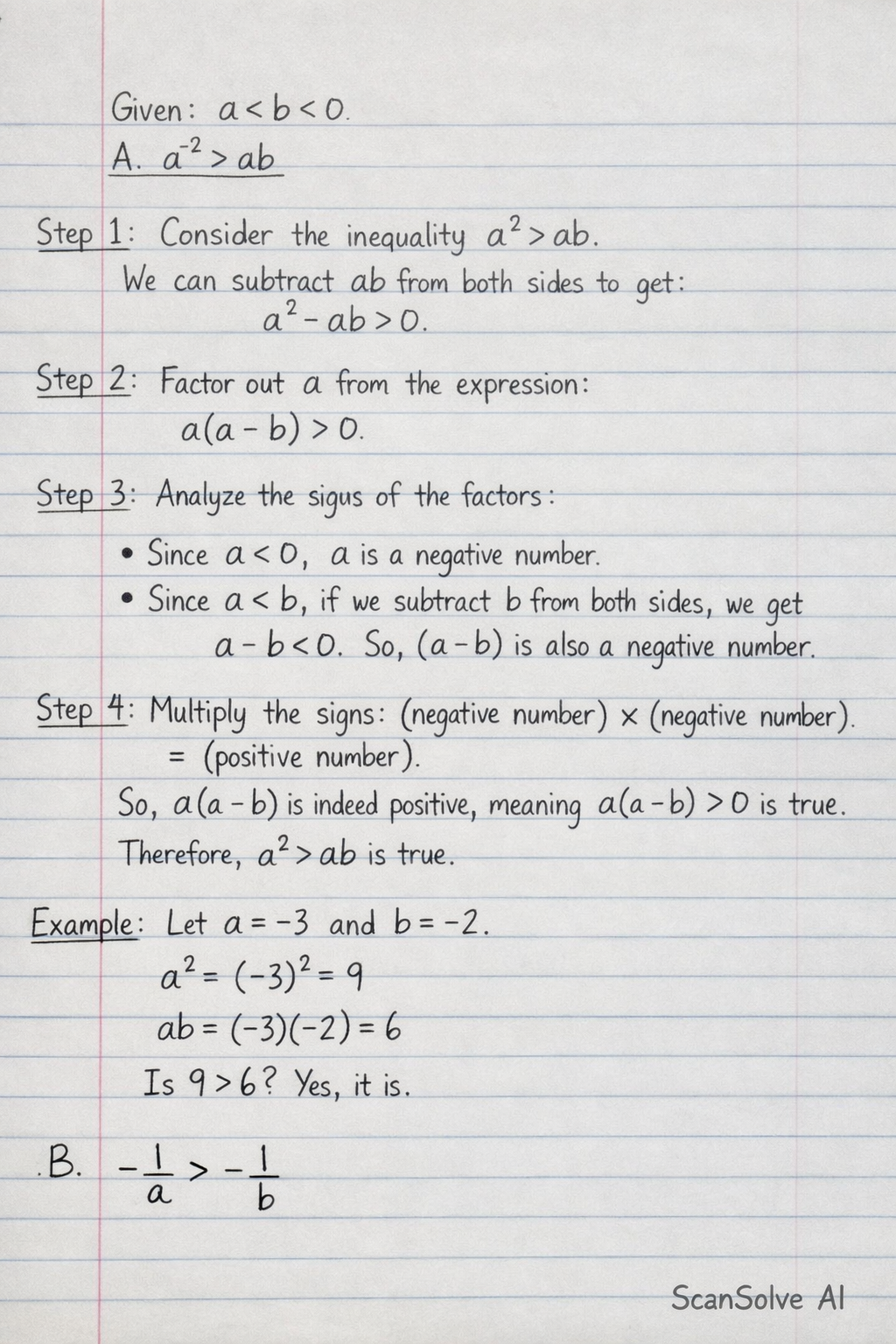
Handwritten Step-by-Step Solution
Get this as a handwritten image on WhatsApp — like a tutor wrote it for you.
Try on WhatsApp