
We read your photo as:
Given: A circle with center O. XY and X'Y' are two parallel tangents. AB is another tangent at point C, intersecting XY at A and X'Y' at B. P is the point of tangency for XY, and Q is the point of tan
ScanSolve AI Answer
Answer
Step-by-step solution
5 stepsIdentify given information and properties.
Given: A circle with center O. XY and X'Y' are two parallel tangents. AB is another tangent at point C, intersecting XY at A and X'Y' at B. P is the point of tangency for XY, and Q is the point of tangency for X'Y'.
To prove: .We use the property that tangents drawn from an external point to a circle are equal in length, and the line segment joining the center to the external point bisects the angle between the tangents.
Apply tangent properties for point A.
From external point A, AP and AC are tangents to the circle.
Therefore, .
Consider and :- (radii of the same circle)
- (common side)
- (tangents from external point A) By SSS congruence criterion, . Thus, by CPCTC (Corresponding Parts of Congruent Triangles are Congruent), . Let . Then .
Apply tangent properties for point B.
From external point B, BQ and BC are tangents to the circle.
Therefore, .
Consider and :- (radii of the same circle)
- (common side)
- (tangents from external point B) By SSS congruence criterion, . Thus, by CPCTC, . Let . Then .
Use the property of parallel tangents.
Since XY and X'Y' are parallel tangents, the line segment PQ passing through the center O is a diameter. This means P, O, and Q are collinear.
Therefore, the angle is a straight angle, i.e., .
We can express as the sum of the angles around O:Substitute the values from Step 2 and Step 3:
Divide by 2:
Conclude the proof.
The angle is the sum of and .
Substitute the values from Step 2 and Step 3:
From Step 4, we found that .
Therefore,
Try one yourself
A new problem that tests the same skill.
Still stuck on this one?
Ask a follow-up, and the answer starts from this question.
More Mathematics Questions
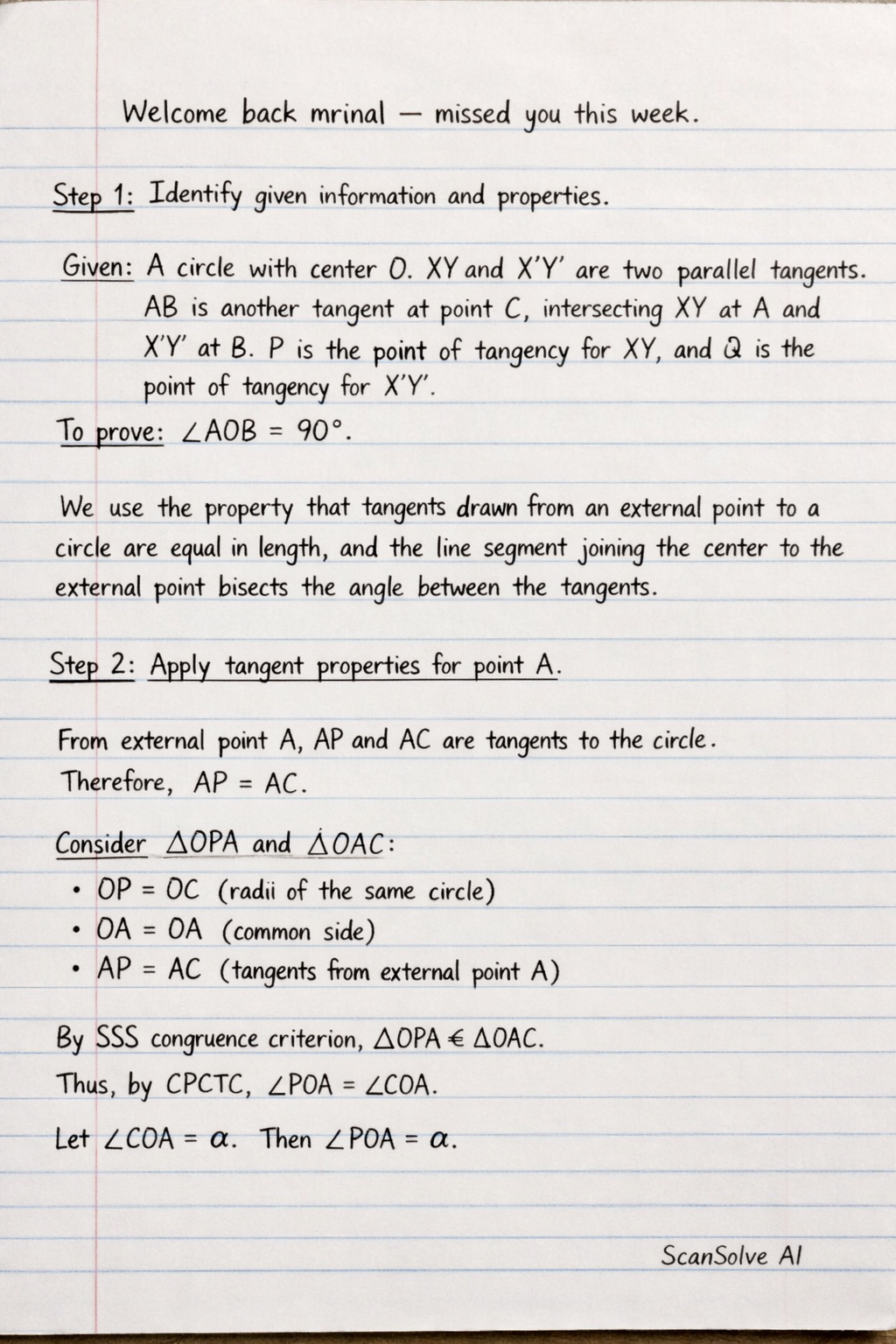
Handwritten Step-by-Step Solution
Get this as a handwritten image on WhatsApp — like a tutor wrote it for you.
Try on WhatsApp