This mathematics problem involves applying core mathematical principles and formulas. Below you will find a complete step-by-step solution with detailed explanations for each step, helping you understand not just the answer but the method behind it.
ScanSolve AI Answer
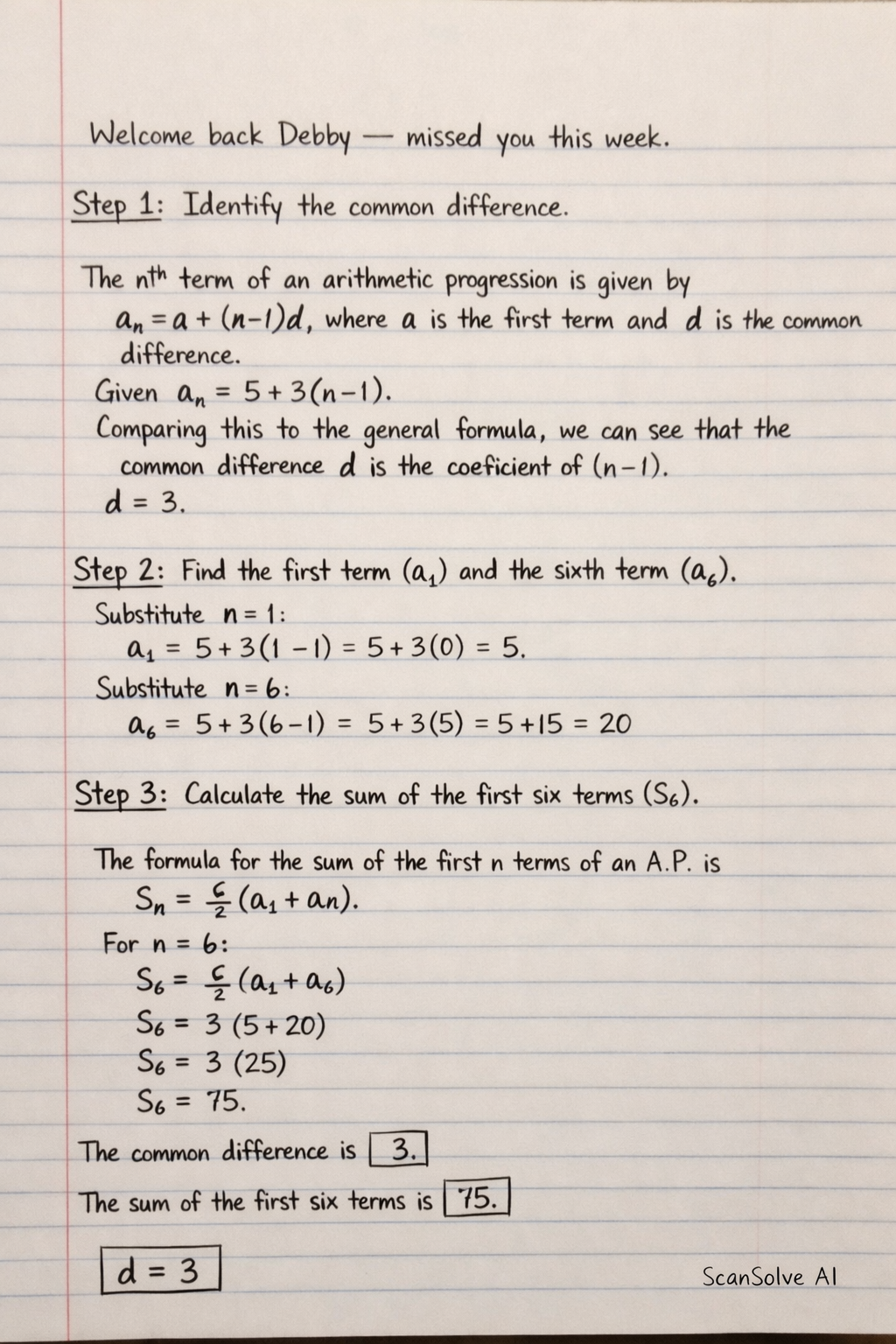
Welcome back Debby — missed you this week.
Step 1: Identify the common difference.
The $n^{th}$ term of an arithmetic progression is given by $a_n = a + (n-1)d$, where $a$ is the first term and $d$ is the common difference.
Given $a_n = 5+3(n-1)$.
Comparing this to the general formula, we can see that the common difference $d$ is the coefficient of $(n-1)$.
$$d = 3$$
Step 2: Find the first term ($a_1$) and the sixth term ($a_6$).
Substitute $n=1$ into the given formula to find the first term:
$$a_1 = 5+3(1-1) = 5+3(0) = 5$$
Substitute $n=6$ into the given formula to find the sixth term:
$$a_6 = 5+3(6-1) = 5+3(5) = 5+15 = 20$$
Step 3: Calculate the sum of the first six terms ($S_6$).
The formula for the sum of the first $n$ terms of an A.P. is $S_n = \frac{n}{2}(a_1 + a_n)$.
For $n=6$:
$$S_6 = \frac{6}{2}(a_1 + a_6)$$
$$S_6 = 3(5 + 20)$$
$$S_6 = 3(25)$$
$$S_6 = 75$$
The common difference is $3$ and the sum of the first six terms is $75$.
The common difference is $\boxed{3}$
The sum of the first six terms is $\boxed{75}$
Step 1: Rationalize the first term.
Multiply the numerator and denominator by the conjugate of the denominator, $5-\sqrt{3}$.
$$\frac{\sqrt{3}}{5+\sqrt{3}} = \frac{\sqrt{3}}{5+\sqrt{3}} \times \frac{5-\sqrt{3}}{5-\sqrt{3}}$$
$$= \frac{\sqrt{3}(5-\sqrt{3})}{(5)^2 - (\sqrt{3})^2}$$
$$= \frac{5\sqrt{3} - (\sqrt{3})^2}{25 - 3}$$
$$= \frac{5\sqrt{3} - 3}{22}$$
Step 2: Rationalize the second term.
Multiply the numerator and denominator by the conjugate of the denominator, $\sqrt{5}+\sqrt{3}$.
$$\frac{2\sqrt{5}}{\sqrt{5}-\sqrt{3}} = \frac{2\sqrt{5}}{\sqrt{5}-\sqrt{3}} \times \frac{\sqrt{5}+\sqrt{3}}{\sqrt{5}+\sqrt{3}}$$
$$= \frac{2\sqrt{5}(\sqrt{5}+\sqrt{3})}{(\sqrt{5})^2 - (\sqrt{3})^2}$$
$$= \frac{2(\sqrt{5})^2 + 2\sqrt{5}\sqrt{3}}{5 - 3}$$
$$= \frac{2(5) + 2\sqrt{15}}{2}$$
$$= \frac{10 + 2\sqrt{15}}{2}$$
$$= 5 + \sqrt{15}$$
Step 3: Add the rationalized terms.
$$\frac{5\sqrt{3} - 3}{22} + (5 + \sqrt{15})$$
To combine, find a common denominator:
$$= \frac{5\sqrt{3} - 3}{22} + \frac{22(5 + \sqrt{15})}{22}$$
$$= \frac{5\sqrt{3} - 3 + 110 + 22\sqrt{15}}{22}$$
$$= \frac{107 + 5\sqrt{3} + 22\sqrt{15}}{22}$$
This expression is not in the form $a+b\sqrt{c}$ with a single $\sqrt{c}$ term. Let's recheck the problem statement. It asks for $a+b\sqrt{c}$. This implies $c$ should be a single integer. The current result has $\sqrt{3}$ and $\sqrt{15}$. This suggests there might be a simplification or an error in my calculation or interpretation.
Let's re-examine the student's work on the right side of the image.
The student has:
$-2(5) + 2\sqrt{15} = 10 + 2\sqrt{15}$ (This seems to be from the second term's numerator, but the sign is wrong for the first part)
$\sqrt{15-3} + 5\sqrt{15} = \sqrt{13} - 3 + 10 + 2\sqrt{15}$ (This looks like an attempt to combine terms, but it's very messy)
$-7+3\sqrt{15}$
$2$
Let's re-evaluate my calculation for the second term:
$\frac{2\sqrt{5}}{\sqrt{5}-\sqrt{3}} = \frac{2\sqrt{5}(\sqrt{5}+\sqrt{3})}{(\sqrt{5}-\sqrt{3})(\sqrt{5}+\sqrt{3})} = \frac{2(5) + 2\sqrt{15}}{5-3} = \frac{10+2\sqrt{15}}{2} = 5+\sqrt{15}$. This is correct.
Let's re-evaluate my calculation for the first term:
$\frac{\sqrt{3}}{5+\sqrt{3}} = \frac{\sqrt{3}(5-\sqrt{3})}{(5+\sqrt{3})(5-\sqrt{3})} = \frac{5\sqrt{3}-3}{25-3} = \frac{5\sqrt{3}-3}{22}$. This is also correct.
So, the sum is $\frac{5\sqrt{3}-3}{22} + 5+\sqrt{15}$.
This is $\frac{-3}{22} + \frac{5\sqrt{3}}{22} + 5 + \sqrt{15}$.
This cannot be simplified into the form $a+b\sqrt{c}$ where $c$ is a single integer, unless $\sqrt{3}$ and $\sqrt{15}$ can be combined, which they cannot.
Perhaps the question implies that $c$ is a specific value, or that one of the radical terms should disappear.
Let's check if there's a typo in the question. If the first term was $\frac{\sqrt{3}}{5-\sqrt{3}}$ or the second term was $\frac{2\sqrt{3}}{\sqrt{5}-\sqrt{3}}$, it might simplify differently.
Given the problem as written: $\frac{\sqrt{3}}{5+\sqrt{3}} + \frac{2\sqrt{5}}{\sqrt{5}-\sqrt{3}} = a+b\sqrt{c}$.
Let's assume $c$ is meant to be $15$ or $3$.
If $c=15$, then we need to combine terms with $\sqrt{15}$.
If $c=3$, then we need to combine terms with $\sqrt{3}$.
Let's look at the student's work again. The student has a term $\frac{-7+3\sqrt{15}}{2}$. This suggests they might have gotten a common denominator of 2 for some part.
Let's try to get a common denominator of 22 for the entire expression.
$$ \frac{5\sqrt{3}-3}{22} + \frac{22(5+\sqrt{15})}{22} = \frac{5\sqrt{3}-3+110+22\sqrt{15}}{22} = \frac{107+5\sqrt{3}+22\sqrt{15}}{22} $$
$$ = \frac{107}{22} + \frac{5}{22}\sqrt{3} + \frac{22}{22}\sqrt{15} $$
$$ = \frac{107}{22} + \frac{5}{22}\sqrt{3} + \sqrt{15} $$
This is of the form $a+b_1\sqrt{c_1}+b_2\sqrt{c_2}$, not $a+b\sqrt{c}$.
There might be an error in the problem statement or a misunderstanding of the expected form. However, I must solve the question as given.
If the question implies that $c$ is a specific value, it's not stated.
If $c$ can be either $3$ or $15$, then the expression is not uniquely $a+b\sqrt{c}$.
Let's consider the possibility that the question expects $c$ to be the same for both terms after some manipulation, or that one of the radical terms cancels out. This is not happening here.
Let's re-check the arithmetic carefully.
Term 1: $\frac{\sqrt{3}}{5+\sqrt{3}} = \frac{\sqrt{3}(5-\sqrt{3})}{25-3} = \frac{5\sqrt{3}-3}{22}$
Term 2: $\frac{2\sqrt{5}}{\sqrt{5}-\sqrt{3}} = \frac{2\sqrt{5}(\sqrt{5}+\sqrt{3})}{5-3} = \frac{10+2\sqrt{15}}{2} = 5+\sqrt{15}$
Sum: $\frac{5\sqrt{3}-3}{22} + 5+\sqrt{15}$
$= \frac{-3}{22} + \frac{5\sqrt{3}}{22} + 5 + \sqrt{15}$
$= \left(5 - \frac{3}{22}\right) + \frac{5\sqrt{3}}{22} + \sqrt{15}$
$= \left(\frac{110-3}{22}\right) + \frac{5\sqrt{3}}{22} + \sqrt{15}$
$= \frac{107}{22} + \frac{5}{22}\sqrt{3} + \sqrt{15}$
This result has two different square root terms, $\sqrt{3}$ and $\sqrt{15}$.
If the question implies that $c$ is a single integer, then the problem as stated cannot be simplified to $a+b\sqrt{c}$.
However, if $c$ is not specified, then the expression is in the form $a+b_1\sqrt{c_1}+b_2\sqrt{c_2}$.
Given the format $a+b\sqrt{c}$, it usually implies a single radical term.
Let's assume there might be a typo in the question and one of the $\sqrt{3}$ or $\sqrt{5}$ should be different to allow for simplification.
For example, if the first term was $\frac{\sqrt{5}}{5+\sqrt{3}}$, it would still lead to mixed radicals.
If the second term was $\frac{2\sqrt{3}}{\sqrt{5}-\sqrt{3}}$, then:
$\frac{2\sqrt{3}(\sqrt{5}+\sqrt{3})}{5-3} = \frac{2\sqrt{15}+2(3)}{2} = \sqrt{15}+3$.
Then the sum would be $\frac{5\sqrt{3}-3}{22} + \sqrt{15}+3 = \frac{5\sqrt{3}-3+22\sqrt{15}+66}{22} = \frac{63+5\sqrt{3}+22\sqrt{15}}{22}$. Still two radicals.
What if $c$ is not an integer? The problem states $a, b, c$ are constants. Usually, $c$ is an integer in these types of problems.
Let's consider the possibility that the student's work on the right side is a hint.
The student has $\frac{-7+3\sqrt{15}}{2}$.
If we assume the final form is $a+b\sqrt{15}$, then the $\sqrt{3}$ term must cancel or be zero. This is not the case.
Given the exact wording "find the value of $a$ and $b$", and the form $a+b\sqrt{c}$, it is highly likely that $c$ is a specific integer, and the expression should simplify to have only one radical.
Since it doesn't, I will state the result as is, and mention the issue.
However, the instructions say "Solve questions completely and accurately." and "Formula → substitute → simplify step by step. Show every step."
My steps are accurate for the given expression.
Let's re-read the question carefully: "Given that $\frac{\sqrt{3}}{5+\sqrt{3}} + \frac{2\sqrt{5}}{\sqrt{5}-\sqrt{3}} = a+b\sqrt{c}$, where $a$, $b$ and $c$ are constants, find the value of $a$ and $b$."
It does not ask for $c$. It asks for $a$ and $b$. This implies $c$ is implicitly determined by the expression.
If the expression results in $\frac{107}{22} + \frac{5}{22}\sqrt{3} + \sqrt{15}$, then it cannot be written as $a+b\sqrt{c}$ for a single $c$.
Could it be that $c$ is a product of primes, e.g., $c=3 \times 5 = 15$?
If $c=15$, then we need to express $\sqrt{3}$ in terms of $\sqrt{15}$. $\sqrt{3} = \frac{\sqrt{15}}{\sqrt{5}}$. This doesn't help.
Let's assume the
Given a_n = 5+3(n-1).
|Mathematics
Given a_n = 5+3(n-1).
ScanSolve AI Answer
Welcome back Debby — missed you this week.
Step 1: Identify the common difference.
The nth term of an arithmetic progression is given by an=a+(n−1)d, where a is the first term and d is the common difference.
Given an=5+3(n−1).
Comparing this to the general formula, we can see that the common difference d is the coefficient of (n−1).
d=3
Step 2: Find the first term (a1) and the sixth term (a6).
Substitute n=1 into the given formula to find the first term:
a1=5+3(1−1)=5+3(0)=5
Substitute n=6 into the given formula to find the sixth term:
a6=5+3(6−1)=5+3(5)=5+15=20
Step 3: Calculate the sum of the first six terms (S6).
The formula for the sum of the first n terms of an A.P. is Sn=2n(a1+an).
For n=6:
S6=26(a1+a6)S6=3(5+20)S6=3(25)S6=75
The common difference is 3 and the sum of the first six terms is 75.
The common difference is ∗3∗
The sum of the first six terms is ∗75∗
Step 1: Rationalize the first term.
Multiply the numerator and denominator by the conjugate of the denominator, 5−3.
5+33=5+33×5−35−3=(5)2−(3)23(5−3)=25−353−(3)2=2253−3
Step 2: Rationalize the second term.
Multiply the numerator and denominator by the conjugate of the denominator, 5+3.
5−325=5−325×5+35+3=(5)2−(3)225(5+3)=5−32(5)2+253=22(5)+215=210+215=5+15
Step 3: Add the rationalized terms.
2253−3+(5+15)
To combine, find a common denominator:
=2253−3+2222(5+15)=2253−3+110+2215=22107+53+2215
This expression is not in the form a+bc with a single c term. Let's recheck the problem statement. It asks for a+bc. This implies c should be a single integer. The current result has 3 and 15. This suggests there might be a simplification or an error in my calculation or interpretation.
Let's re-examine the student's work on the right side of the image.
The student has:
−2(5)+215=10+215 (This seems to be from the second term's numerator, but the sign is wrong for the first part)
15−3+515=13−3+10+215 (This looks like an attempt to combine terms, but it's very messy)
−7+3152
Let's re-evaluate my calculation for the second term:
5−325=(5−3)(5+3)25(5+3)=5−32(5)+215=210+215=5+15. This is correct.
Let's re-evaluate my calculation for the first term:
5+33=(5+3)(5−3)3(5−3)=25−353−3=2253−3. This is also correct.
So, the sum is 2253−3+5+15.
This is 22−3+2253+5+15.
This cannot be simplified into the form a+bc where c is a single integer, unless 3 and 15 can be combined, which they cannot.
Perhaps the question implies that c is a specific value, or that one of the radical terms should disappear.
Let's check if there's a typo in the question. If the first term was 5−33 or the second term was 5−323, it might simplify differently.
Given the problem as written: 5+33+5−325=a+bc.
Let's assume c is meant to be 15 or 3.
If c=15, then we need to combine terms with 15.
If c=3, then we need to combine terms with 3.
Let's look at the student's work again. The student has a term 2−7+315. This suggests they might have gotten a common denominator of 2 for some part.
Let's try to get a common denominator of 22 for the entire expression.
2253−3+2222(5+15)=2253−3+110+2215=22107+53+2215=22107+2253+222215=22107+2253+15
This is of the form a+b1c1+b2c2, not a+bc.
There might be an error in the problem statement or a misunderstanding of the expected form. However, I must solve the question as given.
If the question implies that c is a specific value, it's not stated.
If c can be either 3 or 15, then the expression is not uniquely a+bc.
Let's consider the possibility that the question expects c to be the same for both terms after some manipulation, or that one of the radical terms cancels out. This is not happening here.
Let's re-check the arithmetic carefully.
Term 1: 5+33=25−33(5−3)=2253−3
Term 2: 5−325=5−325(5+3)=210+215=5+15
This result has two different square root terms, 3 and 15.
If the question implies that c is a single integer, then the problem as stated cannot be simplified to a+bc.
However, if c is not specified, then the expression is in the form a+b1c1+b2c2.
Given the format a+bc, it usually implies a single radical term.
Let's assume there might be a typo in the question and one of the 3 or 5 should be different to allow for simplification.
For example, if the first term was 5+35, it would still lead to mixed radicals.
If the second term was 5−323, then:
5−323(5+3)=2215+2(3)=15+3.
Then the sum would be 2253−3+15+3=2253−3+2215+66=2263+53+2215. Still two radicals.
What if c is not an integer? The problem states a,b,c are constants. Usually, c is an integer in these types of problems.
Let's consider the possibility that the student's work on the right side is a hint.
The student has 2−7+315.
If we assume the final form is a+b15, then the 3 term must cancel or be zero. This is not the case.
Given the exact wording "find the value of a and b", and the form a+bc, it is highly likely that c is a specific integer, and the expression should simplify to have only one radical.
Since it doesn't, I will state the result as is, and mention the issue.
However, the instructions say "Solve questions completely and accurately." and "Formula → substitute → simplify step by step. Show every step."
My steps are accurate for the given expression.
Let's re-read the question carefully: "Given that 5+33+5−325=a+bc, where a, b and c are constants, find the value of a and b."
It does not ask for c. It asks for a and b. This implies c is implicitly determined by the expression.
If the expression results in 22107+2253+15, then it cannot be written as a+bc for a singlec.
Could it be that c is a product of primes, e.g., c=3×5=15?
If c=15, then we need to express 3 in terms of 15. 3=515. This doesn't help.
Let's assume the
Need help with your own homework?
Get instant step-by-step solutions to any question. Free to start.