
We read your photo as:
In the diagram below, the graphs of f(x) = a/x + q and g(x) = -x + 4 are drawn. Graphs of f and g intersect at A and C. f and g intersect the x-axis at point E and D respectively. B lies on the y-axis. The horizontal asymptote of f intersect g at point B.
ScanSolve AI Answer
Step-by-step solution
4 stepsDetermine the coordinates of B.
Point B lies on the y-axis, so its x-coordinate is 0.
Point B is also the intersection of the horizontal asymptote of and the graph of .
The equation of is given as .
Substitute into to find the y-coordinate of B:So, the coordinates of B are .
Since B is on the horizontal asymptote of , and the horizontal asymptote is , we can conclude that .The coordinates of B are .
Determine the equation of .
The general equation for is .
From Step 1, we found . So, .
We are given that point P lies on the graph of . Substitute these coordinates into the equation for :Subtract 4 from both sides:
Divide by 4:
Therefore, the equation of is .
The equation of is .
Determine the x-coordinates of A and C.
Points A and C are the intersection points of and .
Set :Subtract 4 from both sides:
Multiply both sides by (assuming ):
Take the square root of both sides:
From the graph, point A is in the second quadrant (negative x-value) and point C is in the first quadrant (positive x-value).
So, the x-coordinate of A is and the x-coordinate of C is .The x-coordinates of A and C are .
Calculate the area of .
To calculate the area of , we need the coordinates of B, O, and D.
O is the origin, so its coordinates are .
From Step 1, the coordinates of B are .
D is the x-intercept of . To find D, set :So, the coordinates of D are .
is a right-angled triangle with the right angle at O.
The length of the base OD is the distance from to , which is 4 units.
The length of the height OB is the distance from to , which is 4 units.
The area of a triangle is given by the formula: Area .The area of is .
Still stuck on this one?
Ask a follow-up, and the answer starts from this question.
More Mathematics Questions
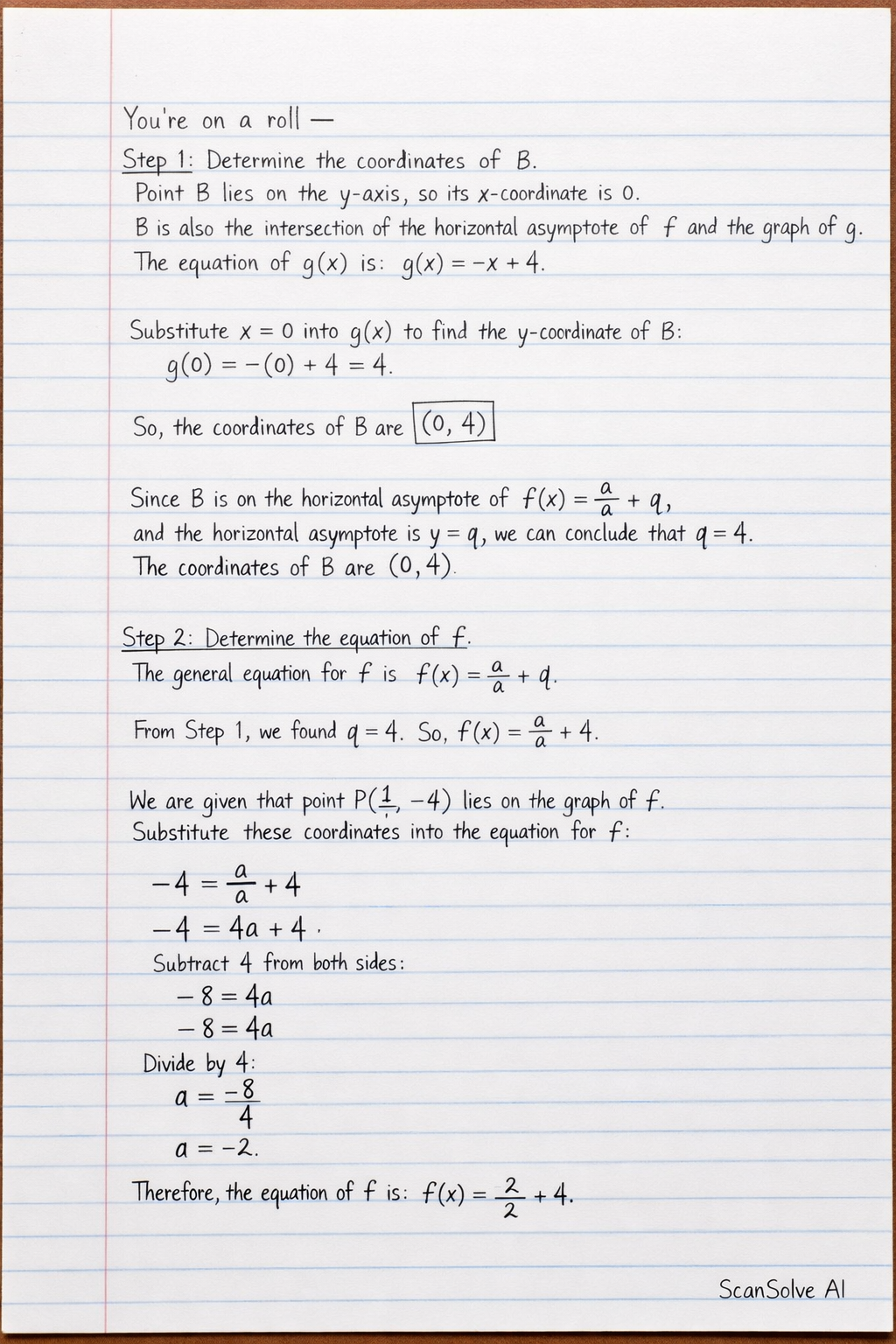
Handwritten Step-by-Step Solution
Get this as a handwritten image on WhatsApp — like a tutor wrote it for you.
Try on WhatsApp