
We read your photo as:
Let g(x) = x+c. The graph of f(x) = (a)/(x+p) + q has a vertical asymptote x=-p and a horizontal asymptote y=q. If the graph of g and the vertical asymptote of f intersect at the x-axis, and the graph
ScanSolve AI Answer
This answer stops before the end.
It was cut off when it was first written. Ask ScanSolve this question again for the full working.
6.1
The equation of graph is .
To find the x-intercept of , we set :
So the x-intercept of is .
The equation of graph is .
The vertical asymptote of occurs when the denominator is zero:
The problem states that graph and the vertical asymptote of intersect at the x-axis. This means their x-intercepts are the same.
Therefore, , which implies .
Substituting into the x-intercept of :
The coordinates of the x-intercept of are .
6.2
We need to determine the equation of . We already know .
Step 1: Use the information that intersects the horizontal asymptote of at .
The horizontal asymptote of is .
Since intersects at , we have .
Substitute into :
So, . Since , we have .
Step 2: Use the information that and intersect on the y-axis.
This means .
Substitute into :
Substitute into :
Equating and :
Substitute :
Step 3: Use the information that and intersect at .
This means .
Substitute into :
Substitute into :
Equating and :
Substitute and :
Subtract from both sides:
Still stuck on this one?
Ask a follow-up, and the answer starts from this question.
More Mathematics Questions
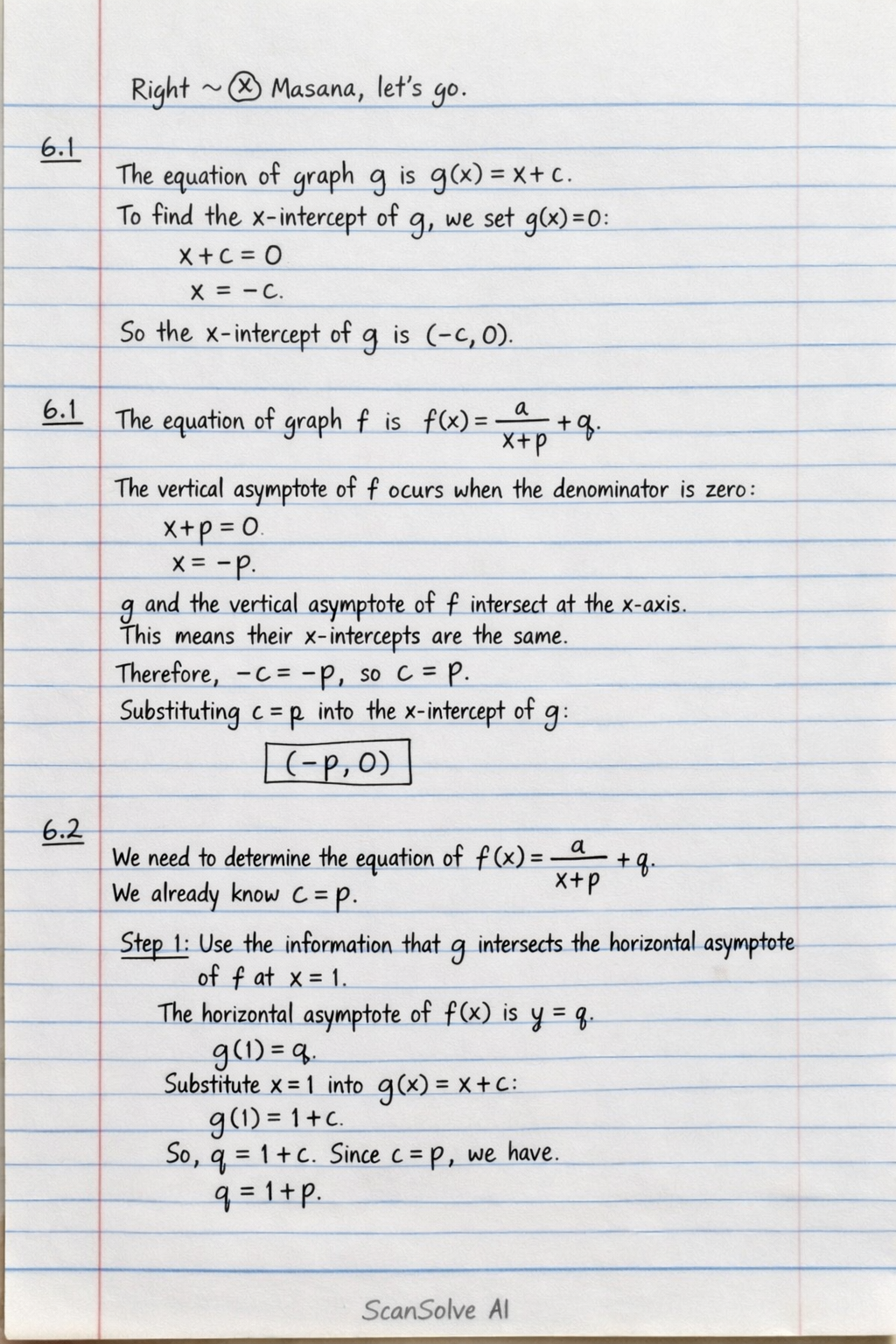
Handwritten Step-by-Step Solution
Get this as a handwritten image on WhatsApp — like a tutor wrote it for you.
Try on WhatsApp