
We read your photo as:
The graphs of f(x) = ax2 + bx + c and g(x) = -4/(x-3) + 8 are drawn below. P is the turning point of f and the point of intersection of the asymptotes of g. M and T are x-intercepts of f and g respectively.
ScanSolve AI Answer
Step-by-step solution
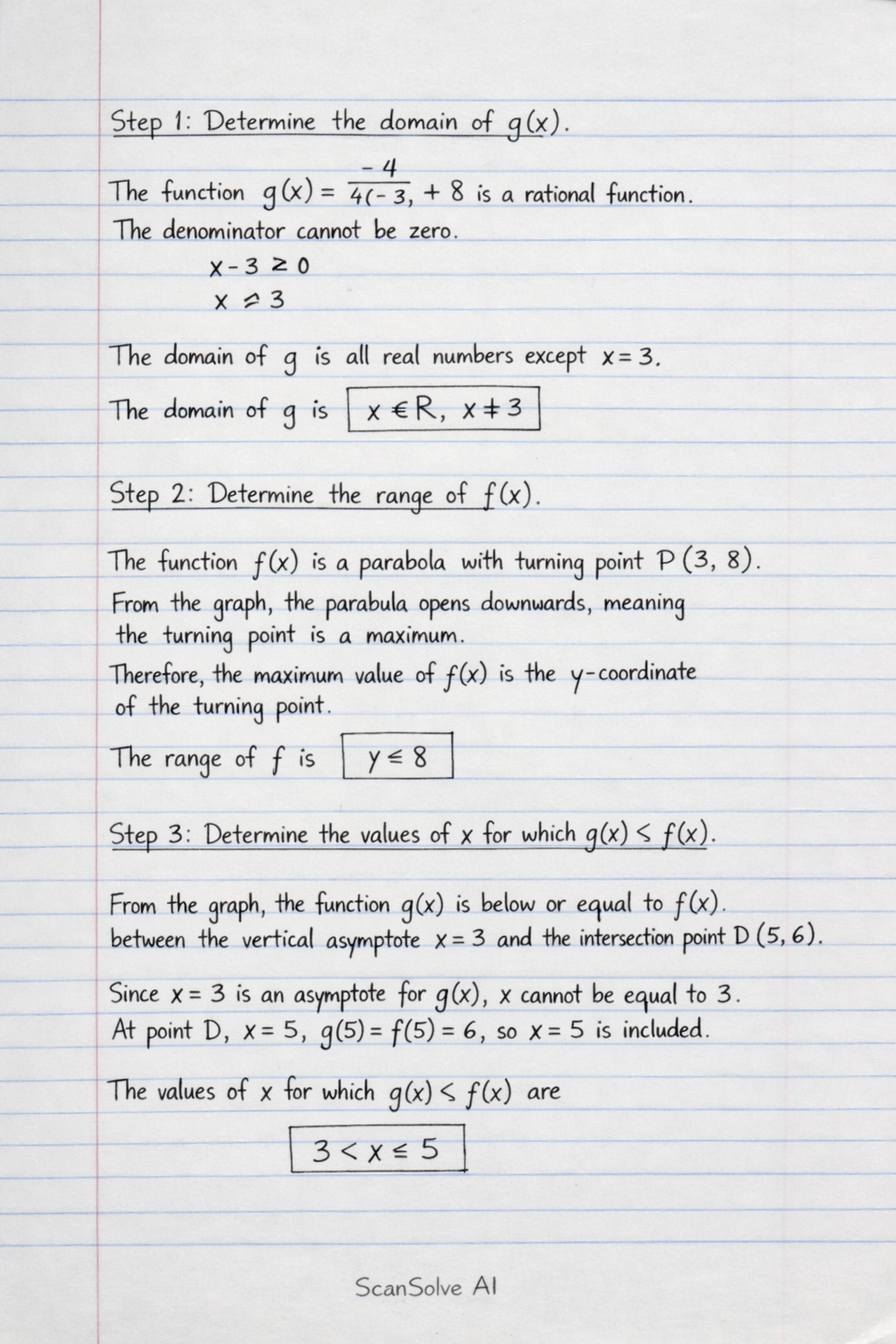
7 stepsDetermine the domain of .
The function is a rational function. The denominator cannot be zero.
The domain of is all real numbers except .
The domain of is .Determine the range of .
The function is a parabola with turning point P . From the graph, the parabola opens downwards, meaning the turning point is a maximum.
Therefore, the maximum value of is the y-coordinate of the turning point.
The range of is .Determine the values of for which .
From the graph, the function is below or equal to between the vertical asymptote and the intersection point D .
Since is an asymptote for , cannot be equal to 3. At point D, , , so is included.
The values of for which are .Determine the values of for which .
First, we need the equation of . The turning point is P , so .
The graph passes through D . Substitute D into the equation:So, .
Now, we solve :Multiply by and reverse the inequality sign:
Take the square root of both sides:
This implies two separate inequalities:
The values of for which are .
Show that the equation of the parabola is .
From Step 4, we found .
Expand the expression:The equation is shown to be .
Calculate the length of MT.
M is the x-intercept of , and T is the x-intercept of .
To find T, set :So, T is .
To find M, set :
Multiply by 2 to clear fractions:
Factor the quadratic equation:
From the graph, M is the negative x-intercept, so M is .
The length of MT is the distance between the x-coordinates of M and T:The length of MT is .
Determine the equation of the tangent to at D.
The point D is .
To find the equation of the tangent line, we need its slope, which is the derivative of evaluated at .Find the derivative :
Now, evaluate at to find the slope :
Using the point-slope form of a linear equation, , with D and :
The equation of the tangent to at D is .
Still stuck on this one?
Ask a follow-up, and the answer starts from this question.
More Mathematics Questions
Handwritten Step-by-Step Solution
Get this as a handwritten image on WhatsApp — like a tutor wrote it for you.
Try on WhatsApp