We read your photo as:

Given a random variable X with E[X] = 0 and Var(X) = 1, find the expected value and variance of Z = X2.

Mathematics

ScanSolve AI Answer

Step-by-step solution

3 steps
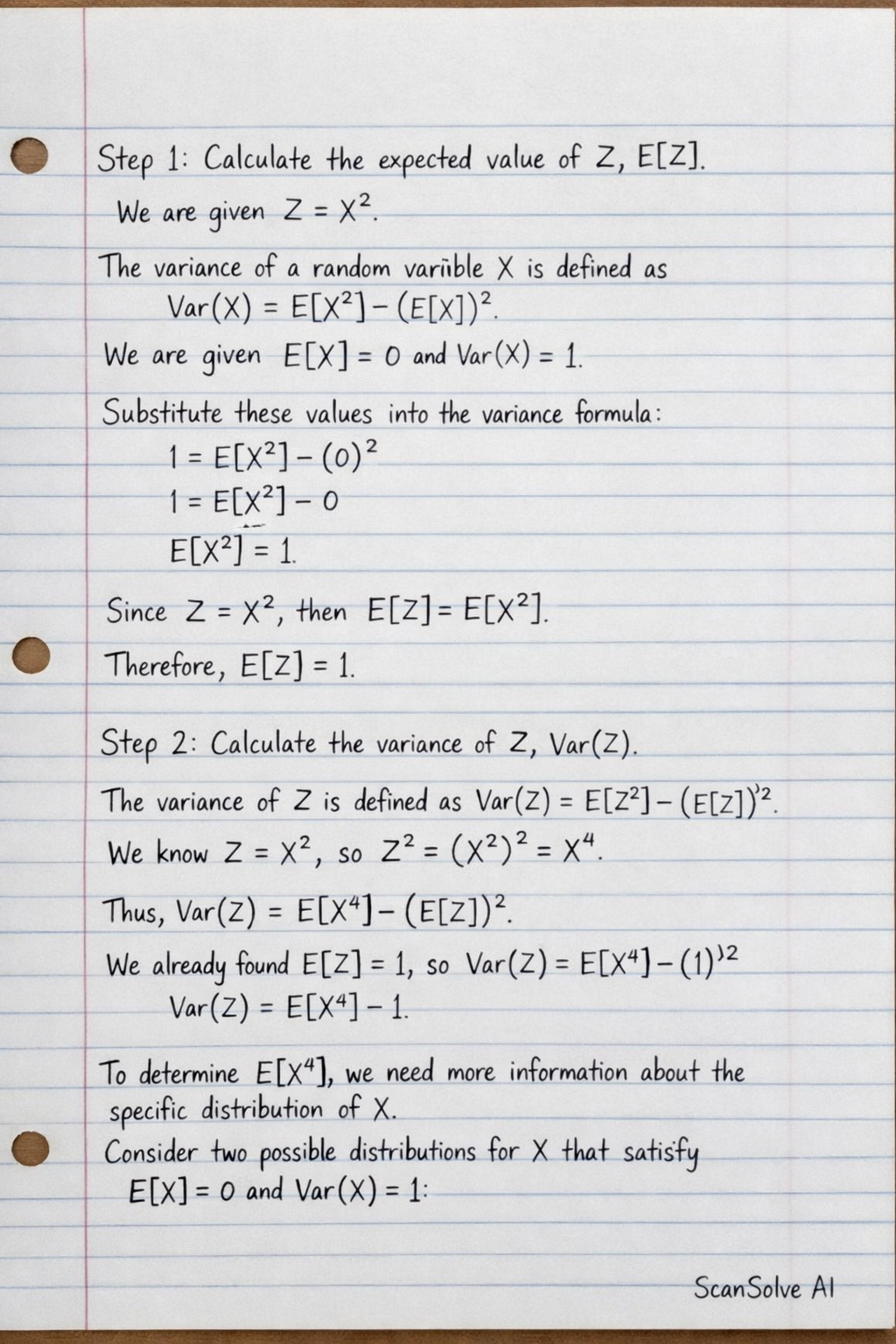
  1. Calculate the expected value of ZZ, E[Z]E[Z].

    We are given Z=X2Z = X^2.
    The variance of a random variable XX is defined as Var(X)=E[X2]−(E[X])2Var(X) = E[X^2] - (E[X])^2.
    We are given E[X]=0E[X] = 0 and Var(X)=1Var(X) = 1.
    Substitute these values into the variance formula:

    1=E[X2]−(0)21 = E[X^2] - (0)^2 1=E[X2]−01 = E[X^2] - 0 E[X2]=1E[X^2] = 1

    Since Z=X2Z = X^2, then E[Z]=E[X2]E[Z] = E[X^2].
    Therefore, E[Z]=1E[Z] = 1.

  2. Calculate the variance of ZZ, Var(Z)Var(Z).

    The variance of ZZ is defined as Var(Z)=E[Z2]−(E[Z])2Var(Z) = E[Z^2] - (E[Z])^2.
    We know Z=X2Z = X^2, so Z2=(X2)2=X4Z^2 = (X^2)^2 = X^4.
    Thus, Var(Z)=E[X4]−(E[Z])2Var(Z) = E[X^4] - (E[Z])^2.
    We already found E[Z]=1E[Z] = 1, so Var(Z)=E[X4]−(1)2=E[X4]−1Var(Z) = E[X^4] - (1)^2 = E[X^4] - 1.

    To determine E[X4]E[X^4], we need more information about the specific distribution of XX.
    Consider two possible distributions for XX that satisfy E[X]=0E[X]=0 and Var(X)=1Var(X)=1:

    Case 1: XX takes values −1-1 and 1 with probabilities P(X=−1)=0.5P(X=-1) = 0.5 and P(X=1)=0.5P(X=1) = 0.5.

    • E[X]=(−1)(0.5)+(1)(0.5)=0E[X] = (-1)(0.5) + (1)(0.5) = 0.
    • E[X2]=(−1)2(0.5)+(1)2(0.5)=1(0.5)+1(0.5)=1E[X^2] = (-1)^2(0.5) + (1)^2(0.5) = 1(0.5) + 1(0.5) = 1.
    • Var(X)=E[X2]−(E[X])2=1−02=1Var(X) = E[X^2] - (E[X])^2 = 1 - 0^2 = 1. In this case, Z=X2Z = X^2 will always be 12=11^2 = 1 or (−1)2=1(-1)^2 = 1. So ZZ is always 1. If ZZ is always 1, then E[Z]=1E[Z] = 1 and Var(Z)=0Var(Z) = 0.

    Case 2: XX takes values −3-\sqrt{3}, 0, 3\sqrt{3} with probabilities P(X=−3)=1/6P(X=-\sqrt{3}) = 1/6, P(X=0)=4/6P(X=0) = 4/6, P(X=3)=1/6P(X=\sqrt{3}) = 1/6.

    • E[X]=(−3)(1/6)+(0)(4/6)+(3)(1/6)=0E[X] = (-\sqrt{3})(1/6) + (0)(4/6) + (\sqrt{3})(1/6) = 0.
    • E[X2]=(−3)2(1/6)+(0)2(4/6)+(3)2(1/6)=3(1/6)+0+3(1/6)=1E[X^2] = (-\sqrt{3})^2(1/6) + (0)^2(4/6) + (\sqrt{3})^2(1/6) = 3(1/6) + 0 + 3(1/6) = 1.
    • Var(X)=E[X2]−(E[X])2=1−02=1Var(X) = E[X^2] - (E[X])^2 = 1 - 0^2 = 1. In this case, Z=X2Z = X^2 can take values: If X=−3X = -\sqrt{3}, Z=(−3)2=3Z = (-\sqrt{3})^2 = 3. If X=0X = 0, Z=02=0Z = 0^2 = 0. If X=3X = \sqrt{3}, Z=(3)2=3Z = (\sqrt{3})^2 = 3. So ZZ can be 0 or 3. P(Z=0)=P(X=0)=4/6=2/3P(Z=0) = P(X=0) = 4/6 = 2/3. P(Z=3)=P(X=−3)+P(X=3)=1/6+1/6=2/6=1/3P(Z=3) = P(X=-\sqrt{3}) + P(X=\sqrt{3}) = 1/6 + 1/6 = 2/6 = 1/3. Now calculate E[Z]E[Z] and Var(Z)Var(Z) for this distribution: E[Z]=(0)(2/3)+(3)(1/3)=0+1=1E[Z] = (0)(2/3) + (3)(1/3) = 0 + 1 = 1. (Matches Step 1) E[Z2]=(0)2(2/3)+(3)2(1/3)=0+9(1/3)=3E[Z^2] = (0)^2(2/3) + (3)^2(1/3) = 0 + 9(1/3) = 3. Var(Z)=E[Z2]−(E[Z])2=3−(1)2=3−1=2Var(Z) = E[Z^2] - (E[Z])^2 = 3 - (1)^2 = 3 - 1 = 2. In this case, Var(Z)=2Var(Z) = 2, which is positive.

    Since Var(Z)Var(Z) can be 0 or 2 (or other positive values depending on the distribution of XX), Var(Z)Var(Z) can be positive, and its exact value depends on the distribution of XX.

  3. Evaluate the given options.

    A. E[Z]=1E[Z] = 1 but Var(Z)Var(Z) can be positive, depending on the distribution of XX. This matches our findings.
    B. E[Z]=1E[Z] = 1 and Var(Z)=0Var(Z) = 0 because squaring removes variability when variance is 1. This is incorrect, as Var(Z)Var(Z) can be positive.
    C. Neither E[Z]E[Z] nor Var(Z)Var(Z) can be determined from the given information. This is incorrect, as E[Z]E[Z] can be determined.
    D. E[Z]=0E[Z] = 0 because E[X]=0E[X] = 0 and Var(Z)=1Var(Z) = 1 by definition. This is incorrect, as E[Z]=1E[Z] = 1.

    The correct statement is A.

    A. E[Z]=1 but Var(Z) can be positive, depending on the distribution of X.\boxed{\text{A. } E[Z] = 1 \text{ but } Var(Z) \text{ can be positive, depending on the distribution of } X.}
Was this helpful?

Still stuck on this one?

Ask a follow-up, and the answer starts from this question.

Got a different question?Ask your own question
Handwritten step-by-step solution preview

Handwritten Step-by-Step Solution

Get this as a handwritten image on WhatsApp — like a tutor wrote it for you.

Try on WhatsApp