
We read your photo as:
Given a universal set = \1, 2, ..., 20\ and sets A, B, C, find the following: c) Set C = Even numbers less than 15, d) A C, e) B C, f) A B C, g) A C.
ScanSolve AI Answer
Step-by-step solution
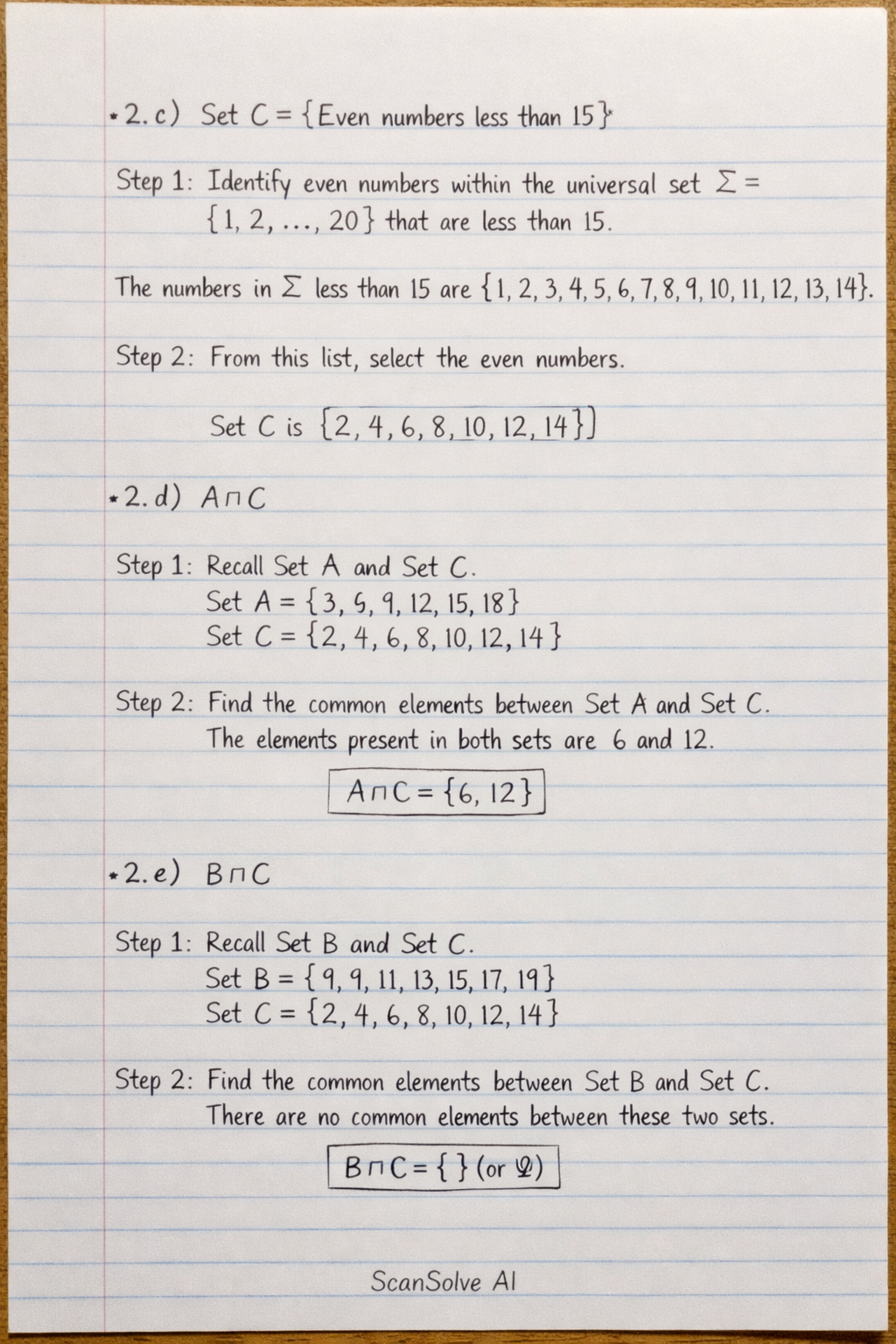
16 steps2. c) Set C = {Even numbers less than 15}
Identify even numbers within the universal set that are less than 15.
The numbers in less than 15 are .
From this list, select the even numbers.
Set C is .
2. d)
Recall Set A and Set C.
Set A =
Set C =Find the common elements between Set A and Set C.
The elements present in both sets are 6 and 12.
.2. e)
Recall Set B and Set C.
Set B =
Set C =Find the common elements between Set B and Set C.
There are no common elements between these two sets.
(or ).2. f)
Find the intersection of Set A, Set B, and Set C.
We know that .
The intersection of any set with an empty set is an empty set.
(or ).
2. g)
Recall Set A and Set C.
Set A =
Set C =Combine all unique elements from both sets.
.
3. a) Find the L.C.M of 8, 12 and 18
Find the prime factorization of each number.
Identify the highest power for each prime factor present in any of the numbers.
The prime factors are 2 and 3.
Highest power of 2 is .
Highest power of 3 is .Multiply these highest powers to find the L.C.M.
The L.C.M of 8, 12, and 18 is .
3. b) Find the H.C.F of 36, 48 and 60
Find the prime factorization of each number.
Identify the lowest power for each common prime factor present in all numbers.
The common prime factors are 2 and 3.
Lowest power of 2 is .
Lowest power of 3 is .Multiply these lowest powers to find the H.C.F.
The H.C.F of 36, 48, and 60 is .
Still stuck on this one?
Ask a follow-up, and the answer starts from this question.
More Mathematics Questions
Handwritten Step-by-Step Solution
Get this as a handwritten image on WhatsApp — like a tutor wrote it for you.
Try on WhatsApp