
We read your photo as:
Given D is the midpoint of AB and E is the midpoint of AC. If AD = a and AE = b, express AB, AC, DE, and BC in terms of a and b.
ScanSolve AI Answer
Answers
4 partsStep-by-step solution
9 stepsHere's how to solve this vector problem based on the given figure and information.
Given:
D is the midpoint of AB.
E is the midpoint of AC.
Part a· 2 steps
Express in terms of and .
Use the definition of a midpoint.
Since D is the midpoint of AB, the vector is twice the vector .
Substitute the given vector value.
The vector is .
Part b
Express in terms of and .
Use the definition of a midpoint.
Since E is the midpoint of AC, the vector is twice the vector .
Substitute the given vector value.
The vector is .
Part c
Express in terms of and .
Use the triangle law of vector addition for .
To go from D to E, we can go from D to A, then from A to E.
Express in terms of and substitute .
Since is the reverse of , .
The vector is .
Part d
Express in terms of and .
Use the triangle law of vector addition for .
To go from B to C, we can go from B to A, then from A to C.
Express in terms of and substitute .
From part (a), , so .
From part (b), .Factorize the expression.
The vector is .
Try one yourself
A new problem that tests the same skill.
Still stuck on this one?
Ask a follow-up, and the answer starts from this question.
More Mathematics Questions
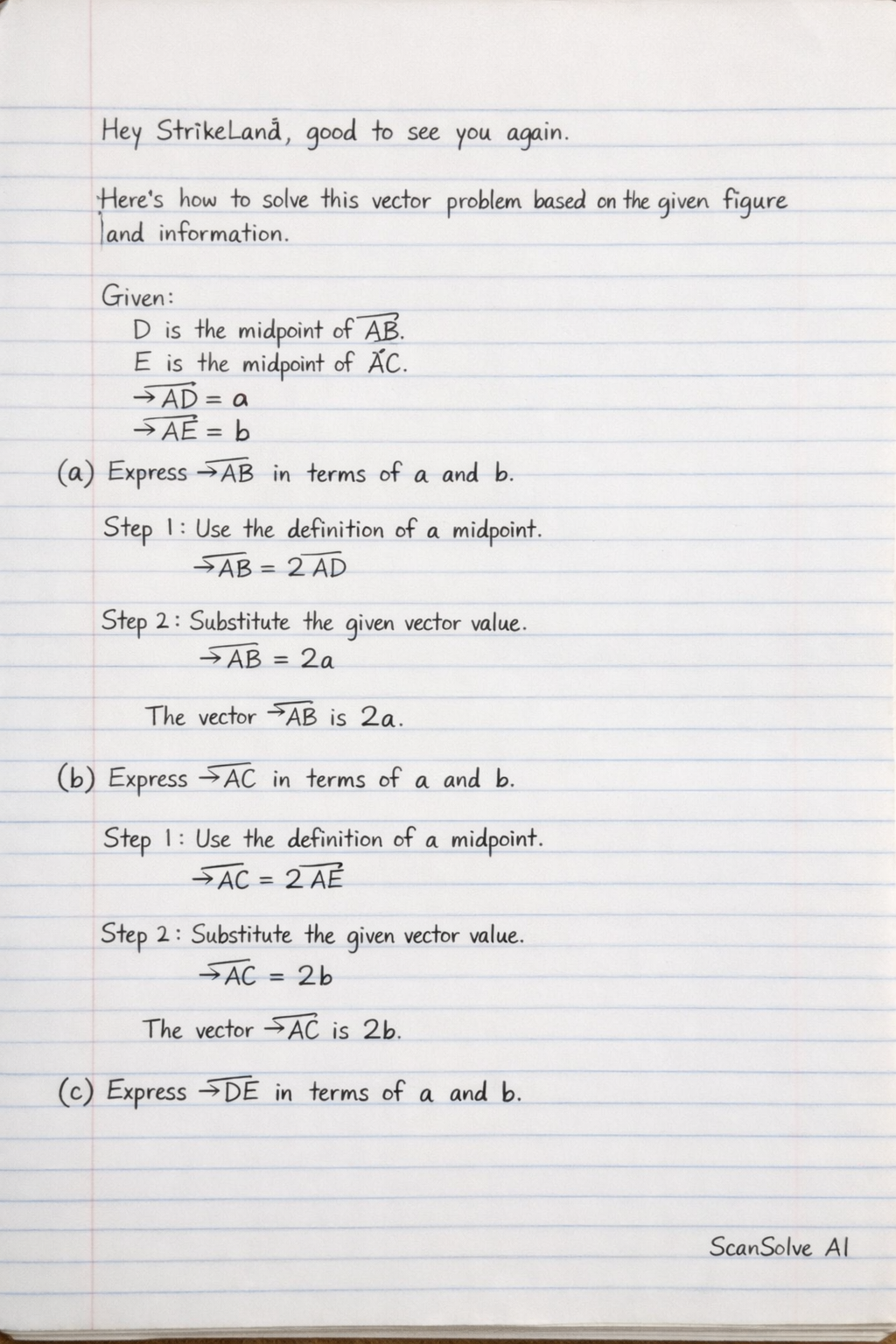
Handwritten Step-by-Step Solution
Get this as a handwritten image on WhatsApp — like a tutor wrote it for you.
Try on WhatsApp