This mathematics problem involves applying core mathematical principles and formulas. Below you will find a complete step-by-step solution with detailed explanations for each step, helping you understand not just the answer but the method behind it.
ScanSolve AI Answer
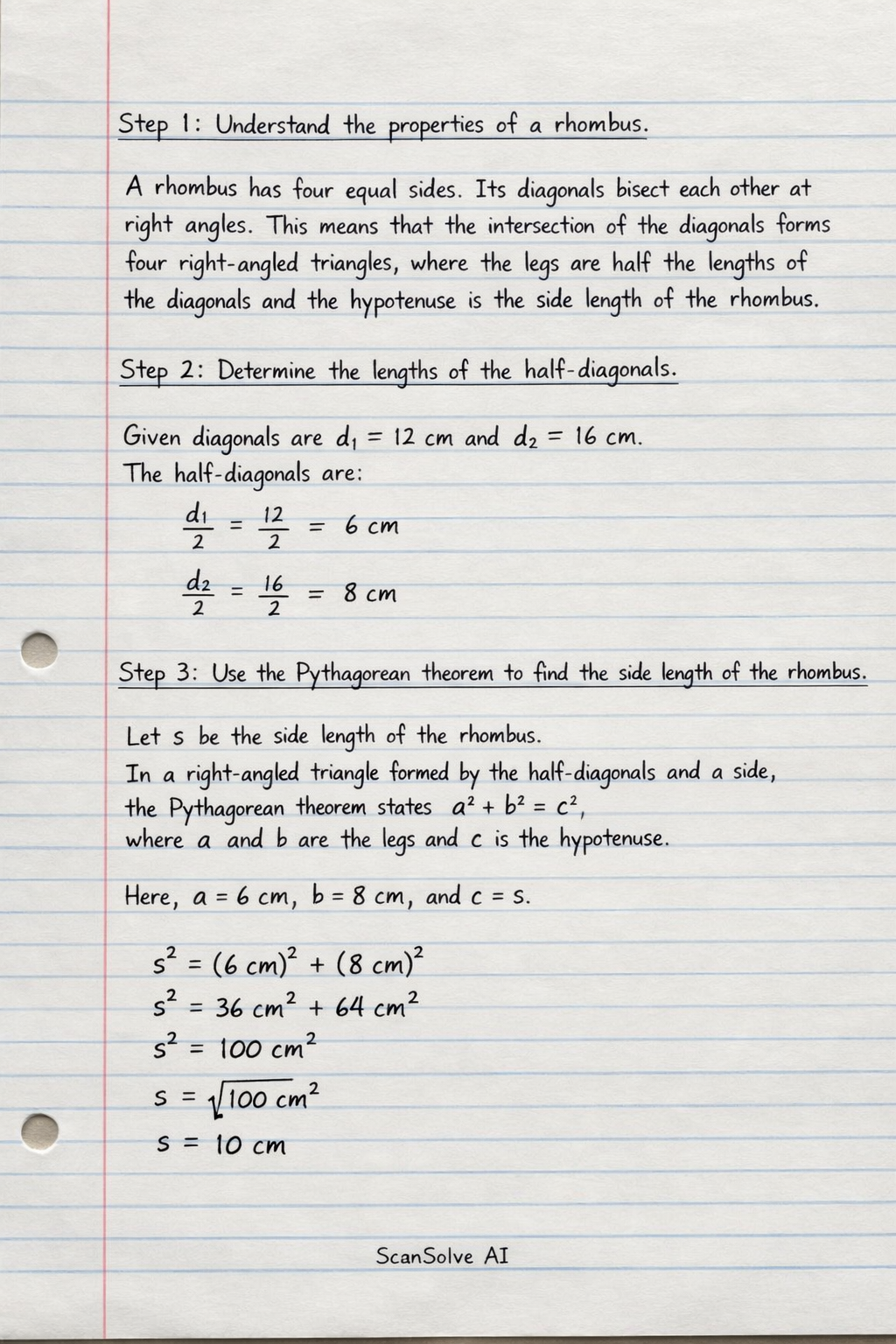
Step 1: Understand the properties of a rhombus.
A rhombus has four equal sides. Its diagonals bisect each other at right angles. This means that the intersection of the diagonals forms four right-angled triangles, where the legs are half the lengths of the diagonals and the hypotenuse is the side length of the rhombus.
Step 2: Determine the lengths of the half-diagonals.
Given diagonals are $d_1 = 12$ cm and $d_2 = 16$ cm.
The half-diagonals are:
$$ \frac{d_1}{2} = \frac{12}{2} = 6 \text{ cm} $$
$$ \frac{d_2}{2} = \frac{16}{2} = 8 \text{ cm} $$
Step 3: Use the Pythagorean theorem to find the side length of the rhombus.
Let $s$ be the side length of the rhombus. In a right-angled triangle formed by the half-diagonals and a side, the Pythagorean theorem states $a^2 + b^2 = c^2$, where $a$ and $b$ are the legs and $c$ is the hypotenuse.
Here, $a = 6$ cm, $b = 8$ cm, and $c = s$.
$$ s^2 = (6 \text{ cm})^2 + (8 \text{ cm})^2 $$
$$ s^2 = 36 \text{ cm}^2 + 64 \text{ cm}^2 $$
$$ s^2 = 100 \text{ cm}^2 $$
$$ s = \sqrt{100 \text{ cm}^2} $$
$$ s = 10 \text{ cm} $$
Step 4: Calculate the perimeter of the rhombus.
The perimeter $P$ of a rhombus is $4$ times its side length $s$.
$$ P = 4s $$
$$ P = 4 \times 10 \text{ cm} $$
$$ P = 40 \text{ cm} $$
The perimeter of the rhombus is $\boxed{\text{40 cm}}$.
Given diagonals are d1 = 12 cm and d2 = 16 cm.
|Mathematics
Given diagonals are d1 = 12 cm and d2 = 16 cm.
ScanSolve AI Answer
Step 1: Understand the properties of a rhombus.
A rhombus has four equal sides. Its diagonals bisect each other at right angles. This means that the intersection of the diagonals forms four right-angled triangles, where the legs are half the lengths of the diagonals and the hypotenuse is the side length of the rhombus.
Step 2: Determine the lengths of the half-diagonals.
Given diagonals are d1=12 cm and d2=16 cm.
The half-diagonals are:
2d1=212=6cm2d2=216=8cm
Step 3: Use the Pythagorean theorem to find the side length of the rhombus.
Let s be the side length of the rhombus. In a right-angled triangle formed by the half-diagonals and a side, the Pythagorean theorem states a2+b2=c2, where a and b are the legs and c is the hypotenuse.
Here, a=6 cm, b=8 cm, and c=s.
s2=(6cm)2+(8cm)2s2=36cm2+64cm2s2=100cm2s=100cm2s=10cm
Step 4: Calculate the perimeter of the rhombus.
The perimeter P of a rhombus is 4 times its side length s.
P=4sP=4×10cmP=40cm
The perimeter of the rhombus is 40cm.
Need help with your own homework?
Get instant step-by-step solutions to any question. Free to start.