

This mathematics problem involves applying core mathematical principles and formulas. Below you will find a complete step-by-step solution with detailed explanations for each step, helping you understand not just the answer but the method behind it.
ScanSolve AI Answer
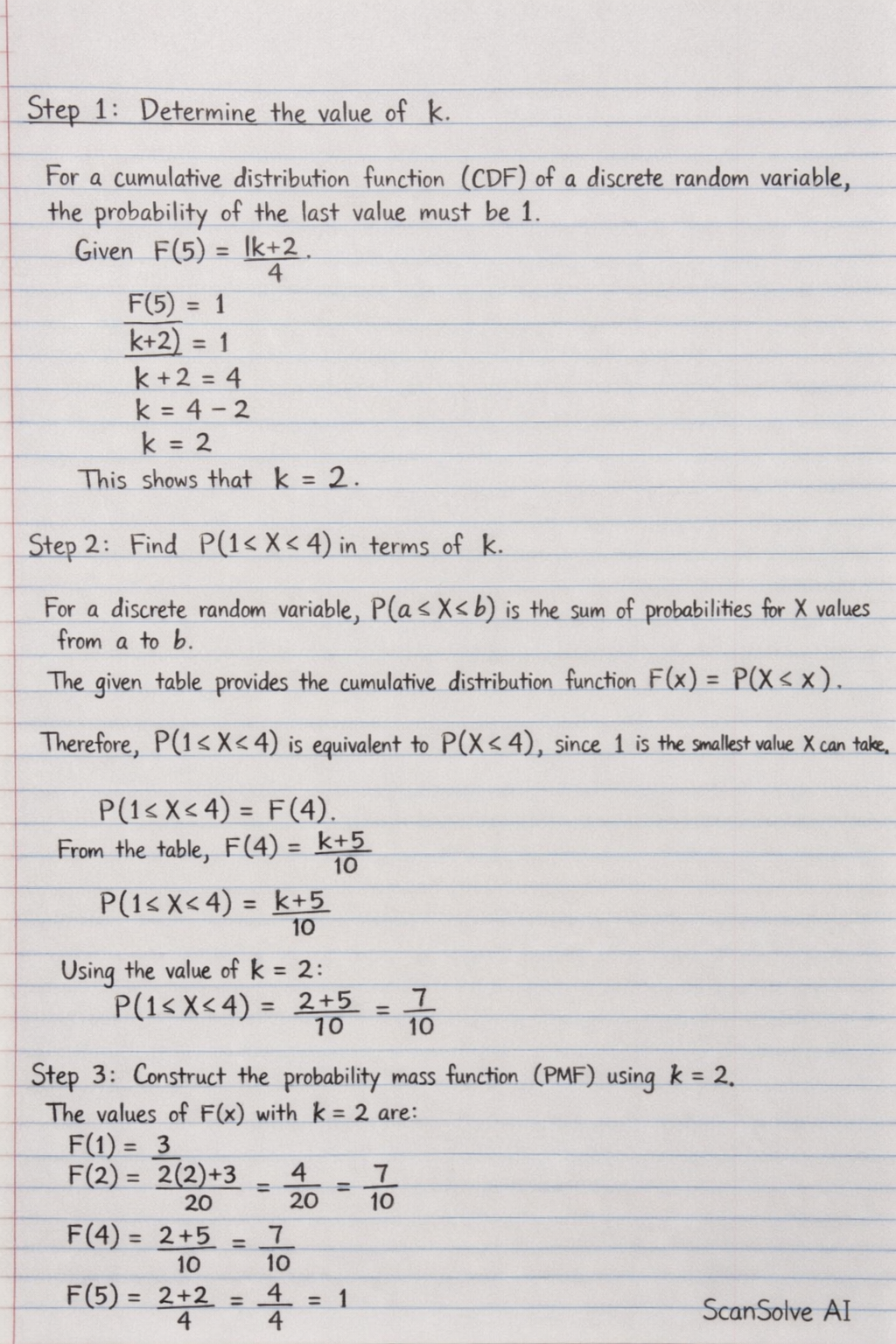
Step 1: Determine the value of k. For a cumulative distribution function (CDF) of a discrete random variable, the probability of the last value must be 1. Given F(5) = (k+2)/(4). F(5) = 1 (k+2)/(4) = 1 k+2 = 4 k = 4-2 k = 2 This shows that k=2. Step 2: Find P(1 X 4) in terms of k. For a discrete random variable, P(a X b) is the sum of probabilities for X values from a to b. The given table provides the cumulative distribution function F(x) = P(X x). Therefore, P(1 X 4) is equivalent to P(X 4), since 1 is the smallest value X can take. P(1 X 4) = F(4) From the table, F(4) = (k+5)/(10). P(1 X 4) = (k+5)/(10) Using the value of k=2: P(1 X 4) = (2+5)/(10) = (7)/(10) Step 3: Construct the probability mass function (PMF) using k=2. The values of F(x) with k=2 are: F(1) = (3)/(10) F(2) = (2(2)+3)/(20) = (4+3)/(20) = (7)/(20) F(4) = (2+5)/(10) = (7)/(10) F(5) = (2+2)/(4) = (4)/(4) = 1 Now, calculate the individual probabilities P(X=x): P(X=1) = F(1) = (3)/(10) P(X=2) = F(2) - F(1) = (7)/(20) - (3)/(10) = (7)/(20) - (6)/(20) = (1)/(20) P(X=4) = F(4) - F(2) = (7)/(10) - (7)/(20) = (14)/(20) - (7)/(20) = (7)/(20) P(X=5) = F(5) - F(4) = 1 - (7)/(10) = (3)/(10) The PMF is: x | P(X=x) --|----------- 1 | (3)/(10) 2 | (1)/(20) 4 | (7)/(20) 5 | (3)/(10) Step 4: Calculate E(X). E(X) = x · P(X=x) E(X) = 1 · (3)/(10) + 2 · (1)/(20) + 4 · (7)/(20) + 5 · (3)/(10) E(X) = (3)/(10) + (2)/(20) + (28)/(20) + (15)/(10) E(X) = (6)/(20) + (2)/(20) + (28)/(20) + (30)/(20) E(X) = (6+2+28+30)/(20) = (66)/(20) = (33)/(10) E(X) = 3.3 Step 5: Calculate Var(X). First, calculate E(X^2): E(X^2) = x^2 · P(X=x) E(X^2) = 1^2 · (3)/(10) + 2^2 \