We read your photo as:

Given f(x) = 5 − 4x − 3x2.

Mathematics

ScanSolve AI Answer

Answer

-4 - 6x

-1, 0
Graph of f(x) = 5 − 4x − 3x²

Use the left and right arrow keys to trace the curve, up and down to jump between key points, and plus and minus to zoom.

Key points of f(x) = 5 − 4x − 3x²
Pointxy
x-intercept−2.120
Maximum−0.676.33
y-intercept05
x-intercept0.790

Step-by-step solution

9 steps

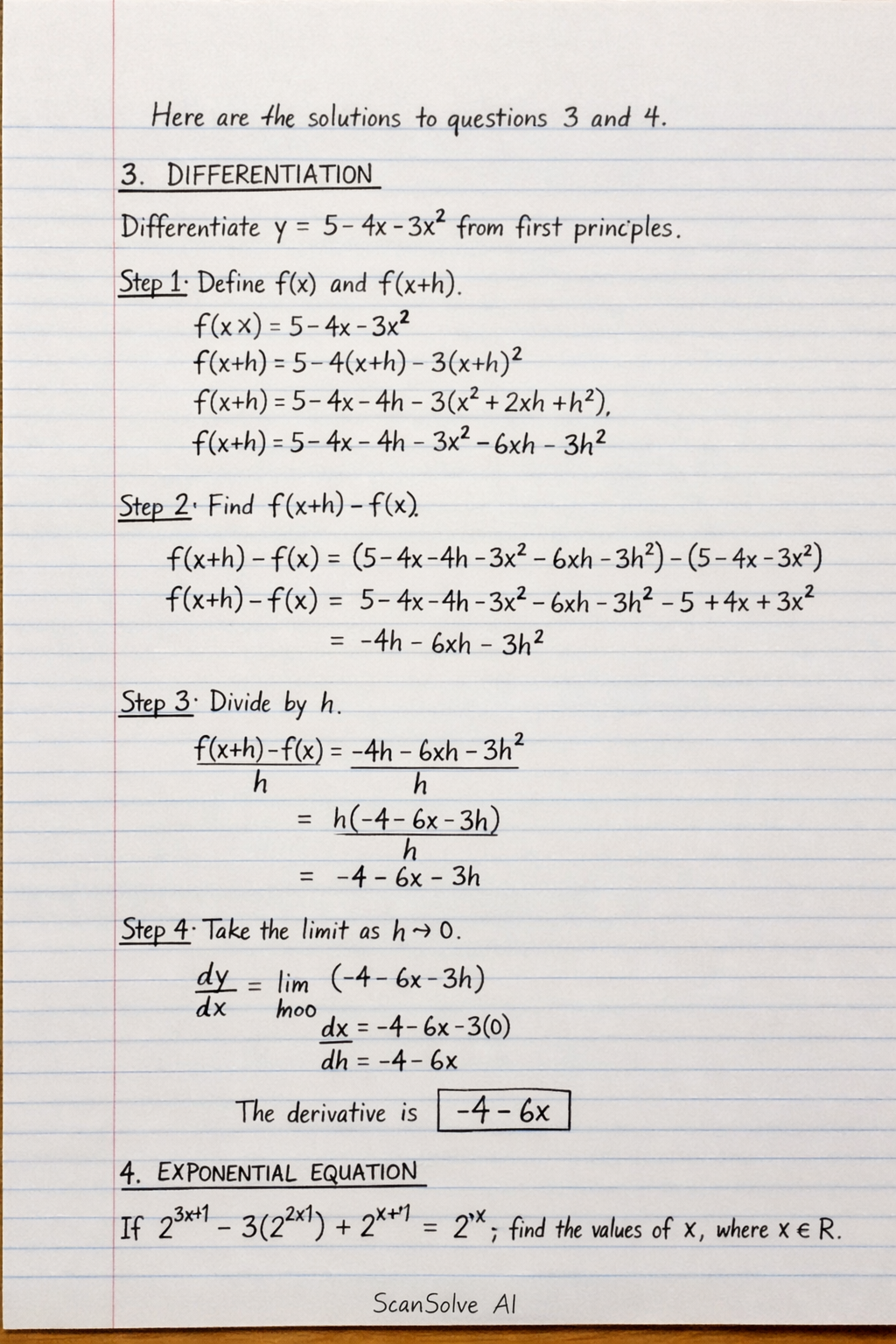
Here are the solutions to questions 3 and 4.

3. DIFFERENTIATION

Differentiate y=5−4x−3x2y = 5 - 4x - 3x^2 from first principles.

  1. Define f(x)f(x) and f(x+h)f(x+h).

    Given f(x)=5−4x−3x2f(x) = 5 - 4x - 3x^2.

    f(x+h)=5−4(x+h)−3(x+h)2f(x+h) = 5 - 4(x+h) - 3(x+h)^2 f(x+h)=5−4x−4h−3(x2+2xh+h2)f(x+h) = 5 - 4x - 4h - 3(x^2 + 2xh + h^2) f(x+h)=5−4x−4h−3x2−6xh−3h2f(x+h) = 5 - 4x - 4h - 3x^2 - 6xh - 3h^2
  2. Find f(x+h)−f(x)f(x+h) - f(x).

    f(x+h)−f(x)=(5−4x−4h−3x2−6xh−3h2)−(5−4x−3x2)f(x+h) - f(x) = (5 - 4x - 4h - 3x^2 - 6xh - 3h^2) - (5 - 4x - 3x^2) f(x+h)−f(x)=5−4x−4h−3x2−6xh−3h2−5+4x+3x2f(x+h) - f(x) = 5 - 4x - 4h - 3x^2 - 6xh - 3h^2 - 5 + 4x + 3x^2 f(x+h)−f(x)=−4h−6xh−3h2f(x+h) - f(x) = -4h - 6xh - 3h^2
  3. Divide by hh.

    f(x+h)−f(x)h=−4h−6xh−3h2h\frac{f(x+h) - f(x)}{h} = \frac{-4h - 6xh - 3h^2}{h} =h(−4−6x−3h)h= \frac{h(-4 - 6x - 3h)}{h} =−4−6x−3h= -4 - 6x - 3h
  4. Take the limit as h→0h \to 0.

    dydx=lim⁡h→0(−4−6x−3h)\frac{dy}{dx} = \lim_{h \to 0} (-4 - 6x - 3h) dydx=−4−6x−3(0)\frac{dy}{dx} = -4 - 6x - 3(0) dydx=−4−6x\frac{dy}{dx} = -4 - 6x

    The derivative is −4−6x\boxed{-4 - 6x}.

    4. EXPONENTIAL EQUATION

    If 23x+1−3(22x)+2x+1=2x2^{3x+1} - 3(2^{2x}) + 2^{x+1} = 2^x, find the values of xx, where x∈Rx \in \mathbb{R}.

  5. Rewrite the terms using exponent rules am+n=amana^{m+n} = a^m a^n and amn=(am)na^{mn} = (a^m)^n.

    23x+1=23x⋅21=(2x)3⋅22^{3x+1} = 2^{3x} \cdot 2^1 = (2^x)^3 \cdot 2 22x=(2x)22^{2x} = (2^x)^2 2x+1=2x⋅21=2⋅2x2^{x+1} = 2^x \cdot 2^1 = 2 \cdot 2^x

    Substitute these into the equation:

    2(2x)3−3(2x)2+2(2x)=2x2(2^x)^3 - 3(2^x)^2 + 2(2^x) = 2^x
  6. Let u=2xu = 2^x.

    Since x∈Rx \in \mathbb{R}, uu must be positive (u>0u > 0).
    The equation becomes a cubic polynomial in uu:

    2u3−3u2+2u=u2u^3 - 3u^2 + 2u = u
  7. Rearrange the equation and factor.

    2u3−3u2+2u−u=02u^3 - 3u^2 + 2u - u = 0 2u3−3u2+u=02u^3 - 3u^2 + u = 0

    Factor out uu:

    u(2u2−3u+1)=0u(2u^2 - 3u + 1) = 0
  8. Solve for uu.

    This gives two possibilities:

    1. u=0u = 0
    2. 2u2−3u+1=02u^2 - 3u + 1 = 0

    For u=0u=0: Since u=2xu = 2^x, 2x=02^x = 0 has no solution because 2x2^x is always positive.

    For 2u2−3u+1=02u^2 - 3u + 1 = 0: Factor the quadratic equation.

    (2u−1)(u−1)=0(2u - 1)(u - 1) = 0

    This gives two solutions for uu:

    2u−1=0  ⟹  2u=1  ⟹  u=122u - 1 = 0 \implies 2u = 1 \implies u = \frac{1}{2} u−1=0  ⟹  u=1u - 1 = 0 \implies u = 1
  9. Substitute back u=2xu = 2^x to find the values of xx.

    Case 1: u=12u = \frac{1}{2}

    2x=122^x = \frac{1}{2} 2x=2−12^x = 2^{-1} x=−1x = -1

    Case 2: u=1u = 1

    2x=12^x = 1 2x=202^x = 2^0 x=0x = 0

    The values of xx are −1,0\boxed{-1, 0}.

Was this helpful?

Try one yourself

A new problem that tests the same skill.

Still stuck on this one?

Ask a follow-up, and the answer starts from this question.

Got a different question?Ask your own question
Handwritten step-by-step solution preview

Handwritten Step-by-Step Solution

Get this as a handwritten image on WhatsApp — like a tutor wrote it for you.

Try on WhatsApp