
We read your photo as:
Given four points A, B, C, and D, represented by complex numbers, prove whether the quadrilateral ABCD is a square.
ScanSolve AI Answer
Step-by-step solution
5 stepsDefine the complex numbers representing the points A, B, C, and D.
Let
Let
Let
LetCalculate the complex numbers representing the vectors for each side of the quadrilateral.
Vector :
Vector :
Vector :
Vector :Calculate the magnitude (length) of each side.
The magnitude of a complex number is .
Length of AB:
Length of BC:
Length of CD:
Length of DA:
Since all four sides have equal length (13 units), the quadrilateral ABCD is a rhombus.Check for perpendicularity of adjacent sides to prove it's a square.
We can check if the angle at vertex B is a right angle. This means checking if vector is perpendicular to vector .
Vector .
Vector .
To check for perpendicularity, we examine the ratio . If this ratio is purely imaginary, the vectors are perpendicular.Multiply the numerator and denominator by the conjugate of the denominator, which is :
Since :
Since the ratio is , which is a purely imaginary number, the vectors and are perpendicular. This means that the angle is .
Conclusion.
A quadrilateral with four equal sides (a rhombus) and at least one right angle is a square.
Therefore, ABCD is a square.
Still stuck on this one?
Ask a follow-up, and the answer starts from this question.
More Mathematics Questions
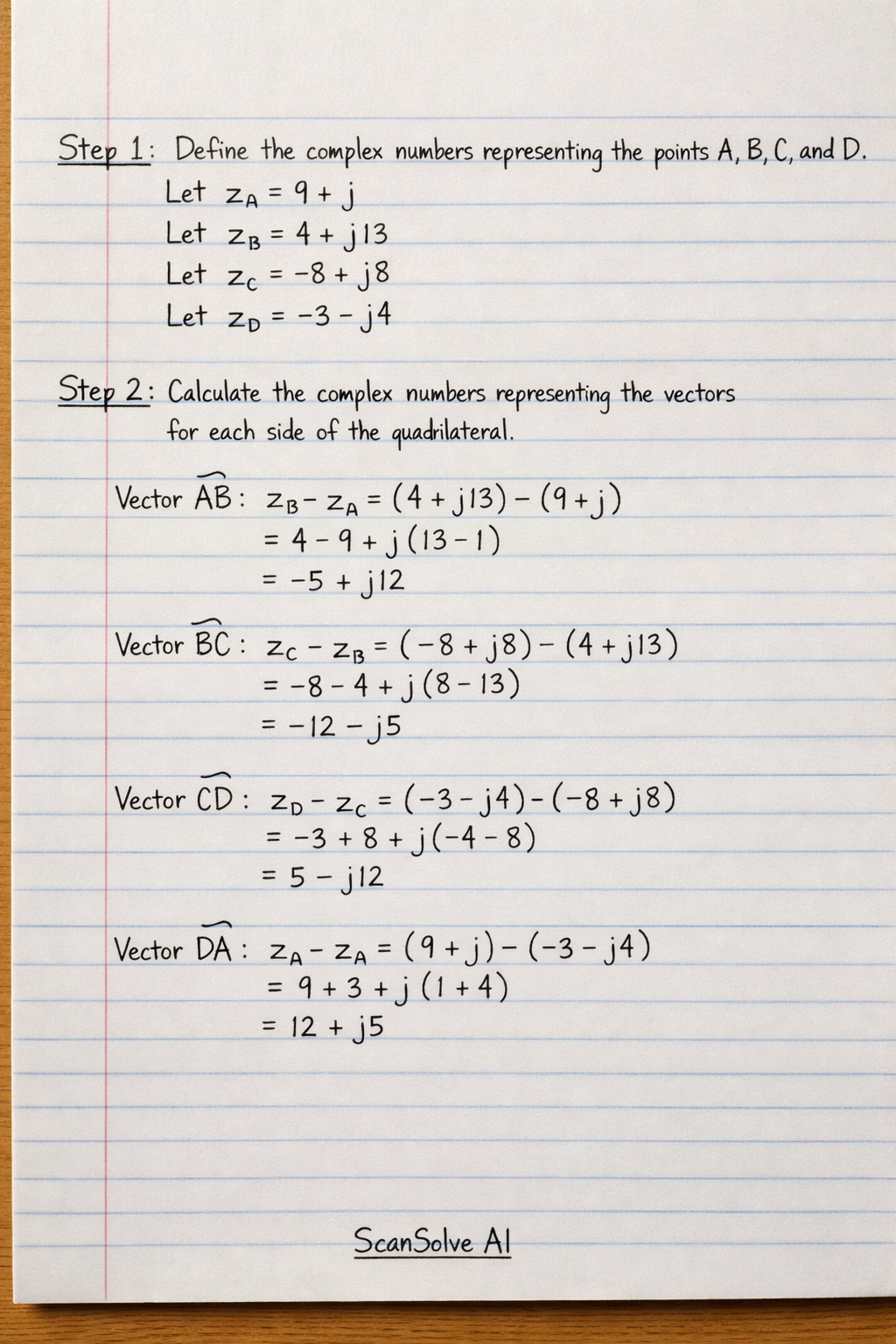
Handwritten Step-by-Step Solution
Get this as a handwritten image on WhatsApp — like a tutor wrote it for you.
Try on WhatsApp