

This mathematics problem involves applying core mathematical principles and formulas. Below you will find a complete step-by-step solution with detailed explanations for each step, helping you understand not just the answer but the method behind it.
ScanSolve AI Answer
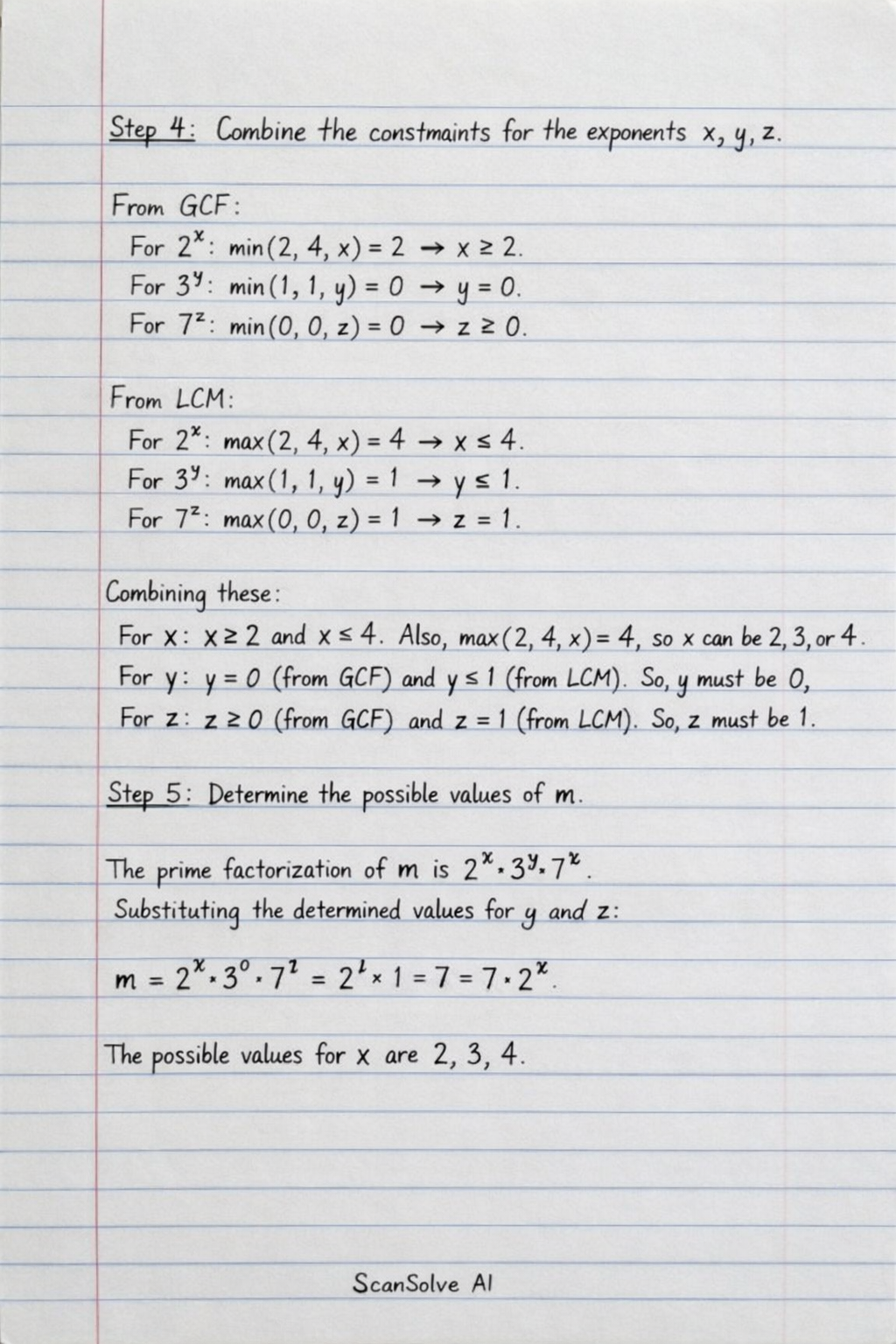
You're on a roll — Here's the continuation for question 2(a). Step 4: Combine the constraints for the exponents x, y, z. From GCF: For 2^x: (2, 4, x) = 2 x 2. For 3^y: (1, 1, y) = 0 y = 0. For 7^z: (0, 0, z) = 0 z 0. From LCM: For 2^x: (2, 4, x) = 4 x 4. For 3^y: (1, 1, y) = 1 y 1. For 7^z: (0, 0, z) = 1 z = 1. Combining these: For x: x 2 and x 4. Also, (2, 4, x) = 4 means x can be 2, 3, or 4. For y: y = 0 (from GCF) and y 1 (from LCM). So, y must be 0. For z: z 0 (from GCF) and z = 1 (from LCM). So, z must be 1. Step 5: Determine the possible values of m. The prime factorization of m is 2^x × 3^y × 7^z. Substituting the determined values for y and z: m = 2^x × 3^0 × 7^1 = 2^x × 1 × 7 = 7 × 2^x The possible values for x are 2, 3, 4. Case 1: If x = 2 m = 7 × 2^2 = 7 × 4 = 28 Check: GCF(12, 48, 28) = GCF(2^2 × 3, 2^4 × 3, 2^2 × 7) = 2^2 = 4. LCM(12, 48, 28) = LCM(2^2 × 3, 2^4 × 3, 2^2 × 7) = 2^4 × 3 × 7 = 16 × 21 = 336. This value is valid. Case 2: If x = 3 m = 7 × 2^3 = 7 × 8 = 56 Check: GCF(12, 48, 56) = GCF(2^2 × 3, 2^4 × 3, 2^3 × 7) = 2^2 = 4. LCM(12, 48, 56) = LCM(2^2 × 3, 2^4 × 3, 2^3 × 7) = 2^4 × 3 × 7 = 16 × 21 = 336. This value is valid. Case 3: If x = 4 m = 7 × 2^4 = 7 × 16 = 112 Check: GCF(12, 48, 112) = GCF(2^2 × 3, 2^4 × 3, 2^4 × 7) = 2^2 = 4. LCM(12, 48, 112) = LCM(2^2 × 3, 2^4 × 3, 2^4 × 7) = 2^4 × 3 × 7 = 16 × 21 = 336. This value is valid. The possible values of m are 28, 56, 112. What's next?