

This mathematics problem involves applying core mathematical principles and formulas. Below you will find a complete step-by-step solution with detailed explanations for each step, helping you understand not just the answer but the method behind it.
ScanSolve AI Answer
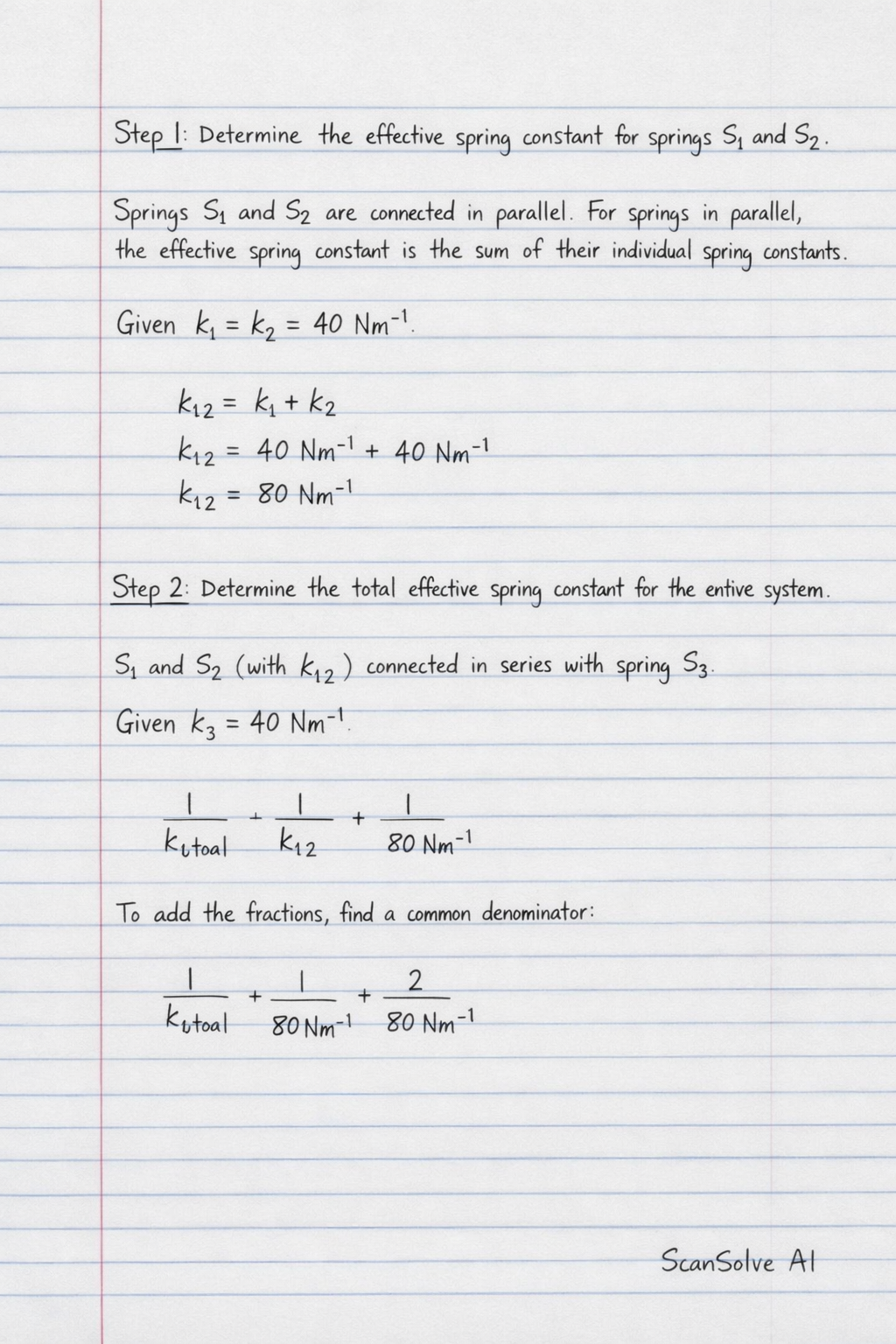
Step 1: Determine the effective spring constant for springs S_1 and S_2. Springs S_1 and S_2 are connected in parallel. For springs in parallel, the effective spring constant is the sum of their individual spring constants. Given k_1 = k_2 = 40 \, Nm^-1. k_12 = k_1 + k_2 k_12 = 40 \, Nm^-1 + 40 \, Nm^-1 k_12 = 80 \, Nm^-1 Step 2: Determine the total effective spring constant for the entire system. The combination of S_1 and S_2 (with effective constant k_12) is connected in series with spring S_3. For springs in series, the reciprocal of the total effective spring constant is the sum of the reciprocals of the individual spring constants. Given k_3 = 40 \, Nm^-1. (1)/(k_total) = (1)/(k_12) + (1)/(k_3) (1)/(k_total) = (1)/(80 \, Nm)^-1 + (1)/(40 \, Nm)^-1 To add the fractions, find a common denominator: (1)/(k_total) = (1)/(80 \, Nm)^-1 + (2)/(80 \, Nm)^-1 (1)/(k_total) = (3)/(80 \, Nm)^-1 k_total = (80)/(3) \, Nm^-1 Step 3: Calculate the total extension of the system. Using Hooke's Law, F = kx, where F is the applied force (weight), k is the total effective spring constant, and x is the total extension. Given F = 45 \, N. x_total = (F)/(k_total) x_total = 45 \, N(80)/(3) \, Nm^-1 x_total = 45 × (3)/(80) \, m x_total = (135)/(80) \, m Simplify the fraction: x_total = (27)/(16) \, m x_total = 1.6875 \, m The total extension of the system is 1.6875 m. Send me the next one 📸