We read your photo as:

Given matrices A = [[3, 1], [6, 2]] and B = [[-1, 3], [3, 9]], calculate (A+B)A. Also, given 2M + 3AB = 2CB − BA, express M in terms of CB and AB.

Mathematics

ScanSolve AI Answer

Answer

(30109331)\begin{pmatrix} 30 & 10 \\ 93 & 31 \end{pmatrix}

M⃗=CA⃗\vec{M} = \vec{CA}

Step-by-step solution

9 steps
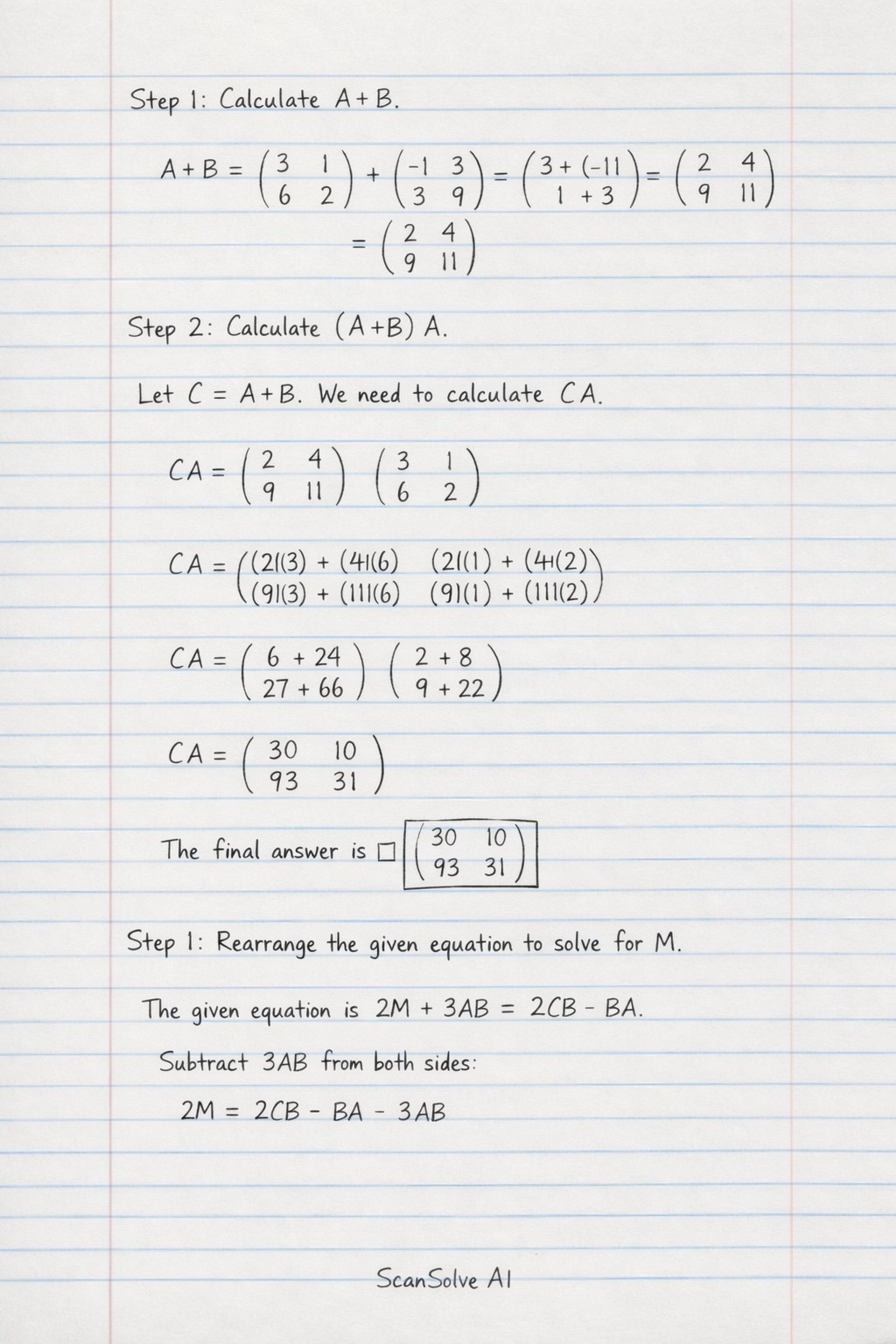
  1. Calculate A+BA+B.

    A+B=(3162)+(−1339)=(3+(−1)1+36+32+9)=(24911)A+B = \begin{pmatrix} 3 & 1 \\ 6 & 2 \end{pmatrix} + \begin{pmatrix} -1 & 3 \\ 3 & 9 \end{pmatrix} = \begin{pmatrix} 3 + (-1) & 1 + 3 \\ 6 + 3 & 2 + 9 \end{pmatrix} = \begin{pmatrix} 2 & 4 \\ 9 & 11 \end{pmatrix}
  2. Calculate (A+B)A(A+B)A.

    Let C=A+BC = A+B. We need to calculate CACA.

    CA=(24911)(3162)CA = \begin{pmatrix} 2 & 4 \\ 9 & 11 \end{pmatrix} \begin{pmatrix} 3 & 1 \\ 6 & 2 \end{pmatrix} CA=((2)(3)+(4)(6)(2)(1)+(4)(2)(9)(3)+(11)(6)(9)(1)+(11)(2))CA = \begin{pmatrix} (2)(3) + (4)(6) & (2)(1) + (4)(2) \\ (9)(3) + (11)(6) & (9)(1) + (11)(2) \end{pmatrix} CA=(6+242+827+669+22)CA = \begin{pmatrix} 6 + 24 & 2 + 8 \\ 27 + 66 & 9 + 22 \end{pmatrix} CA=(30109331)CA = \begin{pmatrix} 30 & 10 \\ 93 & 31 \end{pmatrix}

    The final answer is (30109331)\boxed{\begin{pmatrix} 30 & 10 \\ 93 & 31 \end{pmatrix}}.

  3. Rearrange the given equation to solve for M⃗\vec{M}.

    The given equation is 2M⃗+3AB⃗=2CB⃗−BA⃗2\vec{M} + 3\vec{AB} = 2\vec{CB} - \vec{BA}.
    Subtract 3AB⃗3\vec{AB} from both sides:

    2M⃗=2CB⃗−BA⃗−3AB⃗2\vec{M} = 2\vec{CB} - \vec{BA} - 3\vec{AB}
  4. Use the vector property BA⃗=−AB⃗\vec{BA} = -\vec{AB}.

    Substitute −AB⃗-\vec{AB} for BA⃗\vec{BA} in the equation:

    2M⃗=2CB⃗−(−AB⃗)−3AB⃗2\vec{M} = 2\vec{CB} - (-\vec{AB}) - 3\vec{AB} 2M⃗=2CB⃗+AB⃗−3AB⃗2\vec{M} = 2\vec{CB} + \vec{AB} - 3\vec{AB}
  5. Combine like terms.

    2M⃗=2CB⃗−2AB⃗2\vec{M} = 2\vec{CB} - 2\vec{AB}
  6. Divide by 2 to find M⃗\vec{M}.

    M⃗=CB⃗−AB⃗\vec{M} = \vec{CB} - \vec{AB}
  7. Express CA⃗\vec{CA} using vector addition.

    Using the triangle rule for vector addition, CA⃗\vec{CA} can be expressed as the sum of vectors from C to B and B to A:

    CA⃗=CB⃗+BA⃗\vec{CA} = \vec{CB} + \vec{BA}
  8. Substitute BA⃗=−AB⃗\vec{BA} = -\vec{AB} into the expression for CA⃗\vec{CA}.

    CA⃗=CB⃗+(−AB⃗)\vec{CA} = \vec{CB} + (-\vec{AB}) CA⃗=CB⃗−AB⃗\vec{CA} = \vec{CB} - \vec{AB}
  9. Compare the expressions for M⃗\vec{M} and CA⃗\vec{CA}.

    From Step 4, we have M⃗=CB⃗−AB⃗\vec{M} = \vec{CB} - \vec{AB}.
    From Step 6, we have CA⃗=CB⃗−AB⃗\vec{CA} = \vec{CB} - \vec{AB}.
    Since both expressions are identical, we have proven that M⃗=CA⃗\vec{M} = \vec{CA}.
    Therefore, M⃗=CA⃗\boxed{\vec{M} = \vec{CA}}.

Was this helpful?

Try one yourself

A new problem that tests the same skill.

Still stuck on this one?

Ask a follow-up, and the answer starts from this question.

Got a different question?Ask your own question
Handwritten step-by-step solution preview

Handwritten Step-by-Step Solution

Get this as a handwritten image on WhatsApp — like a tutor wrote it for you.

Try on WhatsApp