
We read your photo as:
Given n(S) = 17, n(SS) = 15, n(BDT) = 16, n(BDT ∩ SS) = 4, n(S ∩ SS) = 6, n(BDT ∩ S) = 3, n(S ∩ SS ∩ BDT) = 6, and total students = 67, determine if these values are consistent for a Venn diagram.
ScanSolve AI Answer
Step-by-step solution
4 stepsHere's an analysis of the problem:
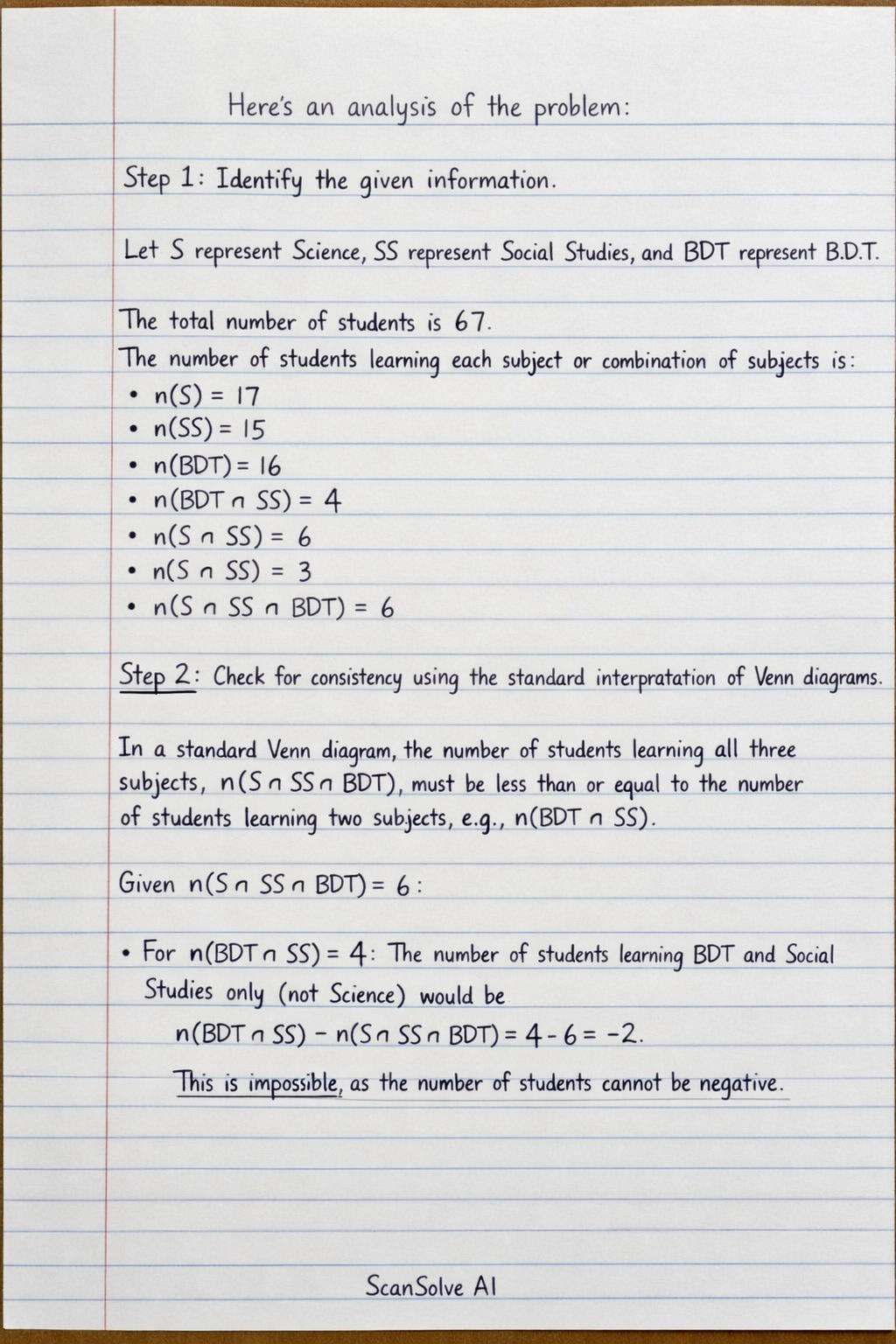
Identify the given information.
Let represent Science, represent Social Studies, and represent B.D.T.
The total number of students is 67.
The number of students learning each subject or combination of subjects is:Check for consistency using the standard interpretation of Venn diagrams.
In a standard Venn diagram, the number of students learning all three subjects, , must be less than or equal to the number of students learning any two subjects, e.g., .
Given :- For : The number of students learning BDT and Social Studies only (not Science) would be . This is impossible, as the number of students cannot be negative.
- For : The number of students learning BDT and Science only (not Social Studies) would be . This is also impossible.
- For : The number of students learning Science and Social Studies only (not BDT) would be . This is possible.
Since two of the calculated "only two subjects" regions result in negative numbers, the problem statement is contradictory under the standard interpretation.
Check for consistency using an alternative common interpretation.
Sometimes, problems phrase to mean "only and (not )". Let's test this interpretation.
Assume the given two-subject intersection numbers are for only those two subjects, and .Now, calculate the number of students learning only one subject:
- For Science only:
This is possible.
- For Social Studies only:
This is impossible, as the number of students cannot be negative. The sum of students in the intersections involving Social Studies () is already greater than the total number of students learning Social Studies (15).
Conclusion.
Both the standard and common alternative interpretations of the given data lead to impossible negative numbers of students in certain categories. Therefore, the problem statement contains contradictory information and cannot be solved as written.
Still stuck on this one?
Ask a follow-up, and the answer starts from this question.
More Mathematics Questions
Handwritten Step-by-Step Solution
Get this as a handwritten image on WhatsApp — like a tutor wrote it for you.
Try on WhatsApp