We read your photo as:

Given P = (1−a) and T = (1+a)(1+a2)(1+a4)...(1+a512). Determine the value of P * T. Also, consider the geometric series 4 + 2 + 1 + 1/2 + ... Does it converge? Justify.

Mathematics

ScanSolve AI Answer

Answer

P×T=1−a1024P \times T = 1-a^{1024}

S∞=8S_{\infty} = 8

k=3k = 3

Step-by-step solution

13 steps

1.3
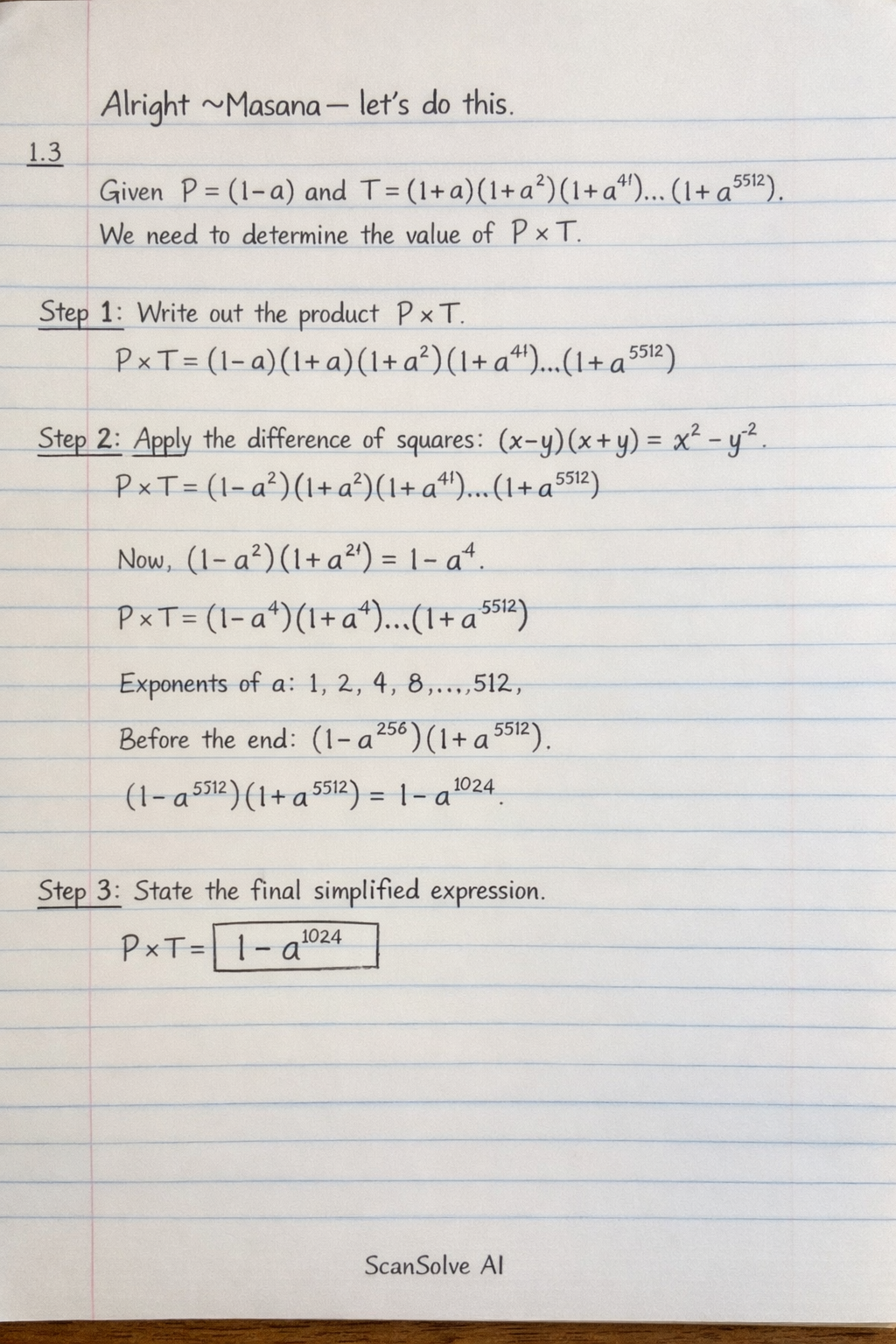
Given P=(1−a)P = (1-a) and T=(1+a)(1+a2)(1+a4)...(1+a512)T = (1+a)(1+a^2)(1+a^4)...(1+a^{512}).
We need to determine the value of P×TP \times T.

  1. Write out the product P×TP \times T.

    P×T=(1−a)(1+a)(1+a2)(1+a4)...(1+a512)P \times T = (1-a)(1+a)(1+a^2)(1+a^4)...(1+a^{512})
  2. Apply the difference of squares formula, (x−y)(x+y)=x2−y2(x-y)(x+y) = x^2 - y^2, repeatedly.

    The first two terms (1−a)(1+a)(1-a)(1+a) simplify to (1−a2)(1-a^2).

    P×T=(1−a2)(1+a2)(1+a4)...(1+a512)P \times T = (1-a^2)(1+a^2)(1+a^4)...(1+a^{512})

    Next, (1−a2)(1+a2)(1-a^2)(1+a^2) simplifies to (1−(a2)2)=(1−a4)(1-(a^2)^2) = (1-a^4).

    P×T=(1−a4)(1+a4)...(1+a512)P \times T = (1-a^4)(1+a^4)...(1+a^{512})

    This pattern continues. The exponents of aa in the factors of TT are 20,21,22,...,292^0, 2^1, 2^2, ..., 2^9.
    The last term in the product is (1+a512)(1+a^{512}), where 512=29512 = 2^9.
    The product will continue until the last term is multiplied.
    The term before (1+a512)(1+a^{512}) would have been (1−a256)(1-a^{256}).
    So, the final step in the pattern is (1−a512)(1+a512)(1-a^{512})(1+a^{512}).

    (1−a512)(1+a512)=1−(a512)2=1−a1024(1-a^{512})(1+a^{512}) = 1-(a^{512})^2 = 1-a^{1024}
  3. State the final simplified expression.

    P×T=1−a1024P \times T = \boxed{1-a^{1024}}

    2.1.1
    Consider the geometric series: 4+2+1+12+...4 + 2 + 1 + \frac{1}{2} + ...
    Does this series converge? Justify your answer.

  4. Identify the first term (aa) and the common ratio (rr).

    The first term is a=4a = 4.
    The common ratio is r=24=12r = \frac{2}{4} = \frac{1}{2}.

  5. Check the condition for convergence of a geometric series.

    A geometric series converges if and only if the absolute value of its common ratio is less than 1, i.e., ∣r∣<1|r| < 1.
    In this case, ∣r∣=∣12∣=12|r| = \left|\frac{1}{2}\right| = \frac{1}{2}.

  6. Justify the convergence.

    Since 12<1\frac{1}{2} < 1, the series converges.

    2.1.2
    Calculate S∞S_{\infty}.

  7. Use the formula for the sum to infinity of a convergent geometric series.

    The formula is S∞=a1−rS_{\infty} = \frac{a}{1-r}.
    From 2.1.1, we have a=4a=4 and r=12r=\frac{1}{2}.

  8. Substitute the values and calculate S∞S_{\infty}.

    S∞=41−12S_{\infty} = \frac{4}{1 - \frac{1}{2}} S∞=412S_{\infty} = \frac{4}{\frac{1}{2}} S∞=4×2S_{\infty} = 4 \times 2 S∞=8S_{\infty} = \boxed{8}

    2.2
    Given: ∑p=k103p−1=29520\sum_{p=k}^{10} 3^{p-1} = 29520. Calculate the value of kk.

  9. Identify the properties of the geometric series.

    The sum is ∑p=k103p−1\sum_{p=k}^{10} 3^{p-1}.
    The first term of this sum is when p=kp=k, so A=3k−1A = 3^{k-1}.
    The common ratio is R=3R = 3.
    The number of terms is N=10−k+1N = 10 - k + 1.

  10. Write the sum using the formula for a geometric series.

    The sum of a geometric series is SN=A(RN−1)R−1S_N = \frac{A(R^N - 1)}{R-1}.

    29520=3k−1(3(10−k+1)−1)3−129520 = \frac{3^{k-1}(3^{(10-k+1)} - 1)}{3-1} 29520=3k−1(311−k−1)229520 = \frac{3^{k-1}(3^{11-k} - 1)}{2}
  11. Simplify the equation.

    Multiply both sides by 2:

    59040=3k−1(311−k−1)59040 = 3^{k-1}(3^{11-k} - 1)

    Distribute 3k−13^{k-1}:

    59040=3k−1⋅311−k−3k−159040 = 3^{k-1} \cdot 3^{11-k} - 3^{k-1}

    Using the exponent rule xa⋅xb=xa+bx^a \cdot x^b = x^{a+b}:

    59040=3(k−1)+(11−k)−3k−159040 = 3^{(k-1) + (11-k)} - 3^{k-1} 59040=310−3k−159040 = 3^{10} - 3^{k-1}
  12. Calculate 3103^{10} and solve for 3k−13^{k-1}.

    310=590493^{10} = 59049

    Substitute this value into the equation:

    59040=59049−3k−159040 = 59049 - 3^{k-1}

    Rearrange to solve for 3k−13^{k-1}:

    3k−1=59049−590403^{k-1} = 59049 - 59040 3k−1=93^{k-1} = 9
  13. Express 9 as a power of 3 and solve for kk.

    3k−1=323^{k-1} = 3^2

    Equating the exponents:

    k−1=2k-1 = 2 k=2+1k = 2 + 1 k=3k = \boxed{3}
Was this helpful?

Still stuck on this one?

Ask a follow-up, and the answer starts from this question.

Got a different question?Ask your own question
Handwritten step-by-step solution preview

Handwritten Step-by-Step Solution

Get this as a handwritten image on WhatsApp — like a tutor wrote it for you.

Try on WhatsApp