
We read your photo as:
Given P(A) = 0,48 and P(B) = 0,26. Calculate P(A or B) if: 1.1.1 A and B are mutually exclusive events. 1.1.2 A and B are independent events.
ScanSolve AI Answer
Step-by-step solution
5 stepsHere are the solutions to Question 1:
Part 1.1· 2 steps
Given and .
Calculate for mutually exclusive events.
For mutually exclusive events, the probability of A or B occurring is the sum of their individual probabilities.
Calculate for independent events.
For independent events, the probability of A and B occurring is the product of their individual probabilities: .
The general formula for is:Substitute the formula for independent events:
Part 1.2· 3 steps
A survey was conducted amongst 150 grade 11 learners.
Write down the value of .
From the table, the total number of boys is 80. The sum of boys' preferences for Netball, Soccer, and Rugby must equal this total.
Calculate the probability that a learner is a boy and does not like netball.
Total learners = 150.
Number of boys = 80.
Number of boys who like Netball = 32.
Number of boys who do not like Netball = Total boys - Boys who like NetballThe probability is the number of boys who do not like netball divided by the total number of learners.
Simplify the fraction:
Determine if the events "being a boy" and "liking soccer" are independent.
Two events A and B are independent if .
Let A be the event "being a boy".
Let B be the event "liking soccer".Calculate the individual probabilities:
Total learners = 150.
Number of boys = 80.Number of learners who like Soccer = 33.
Number of boys who like Soccer (value of ) = 21.
Check for independence:
Is ?Calculate the right side:
Simplify by dividing by 6:
Now compare this to the left side:
Simplify by dividing by 3:
Since (or ), the events are not independent.
Still stuck on this one?
Ask a follow-up, and the answer starts from this question.
More Mathematics Questions
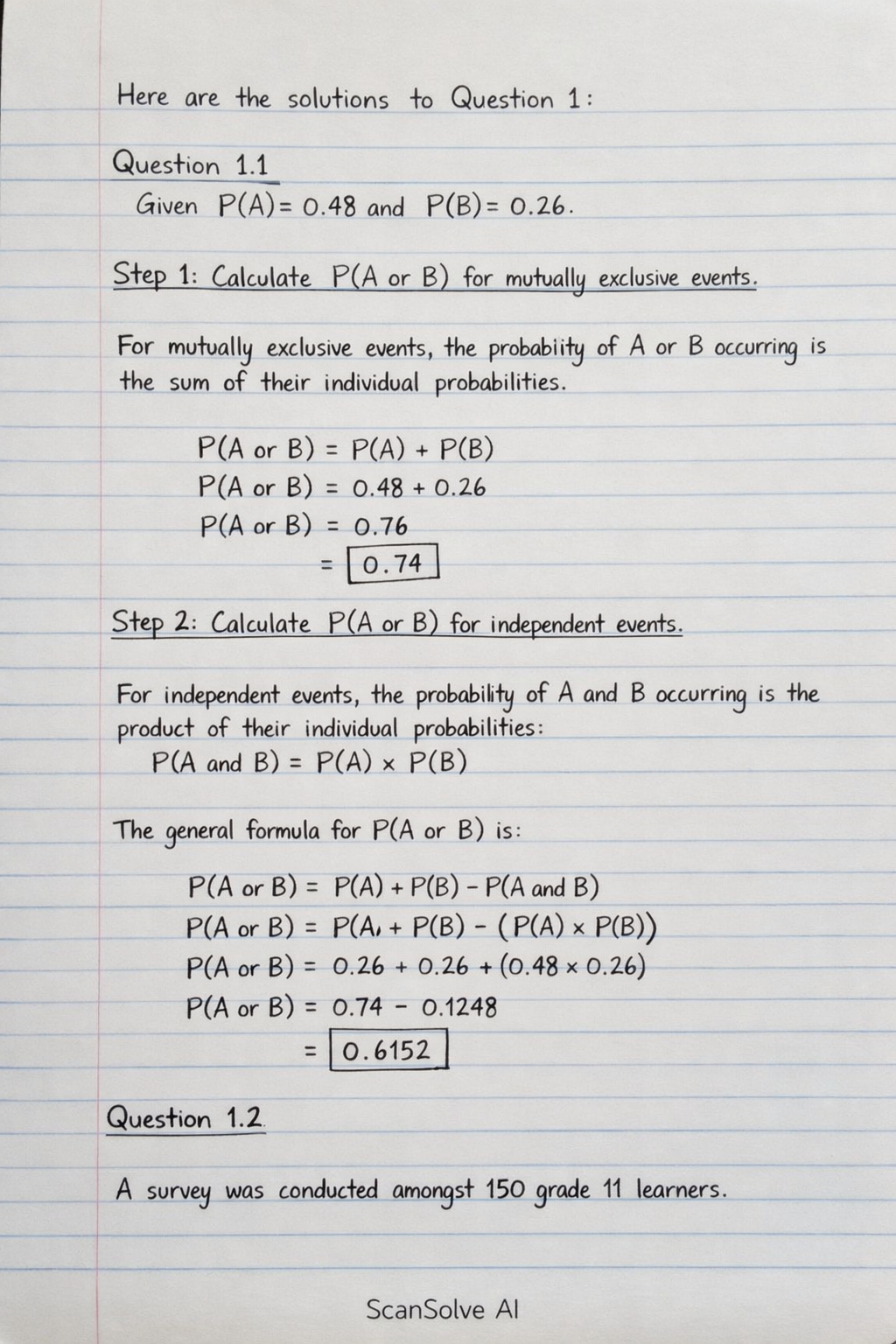
Handwritten Step-by-Step Solution
Get this as a handwritten image on WhatsApp — like a tutor wrote it for you.
Try on WhatsApp