
We read your photo as:
Given P(A)=(1)/(2), P(B^c)=(5)/(6), and P(A B)=(5)/(12). Find P(A B) and P(A B^c).
Mathematics
ScanSolve AI Answer
Answers
2 partsStep-by-step solution
4 stepsHere's the solution for question 2(i):
Part i· 1 step
Given , , and .
Calculate .
Part a
Find .
Use the Addition Rule for Probability.
Substitute the known values:
Find a common denominator for the fractions on the right side:
Simplify to :
Rearrange to solve for :
Find a common denominator for and :
Part b
Find .
Understand the notation .
The event means that event occurs and event does not occur. If does not occur, it means event occurs.
Therefore, is equivalent to .Use the result from part (a).
Was this helpful?
Still stuck on this one?
Ask a follow-up, and the answer starts from this question.
Got a different question?Ask your own question
More Mathematics Questions
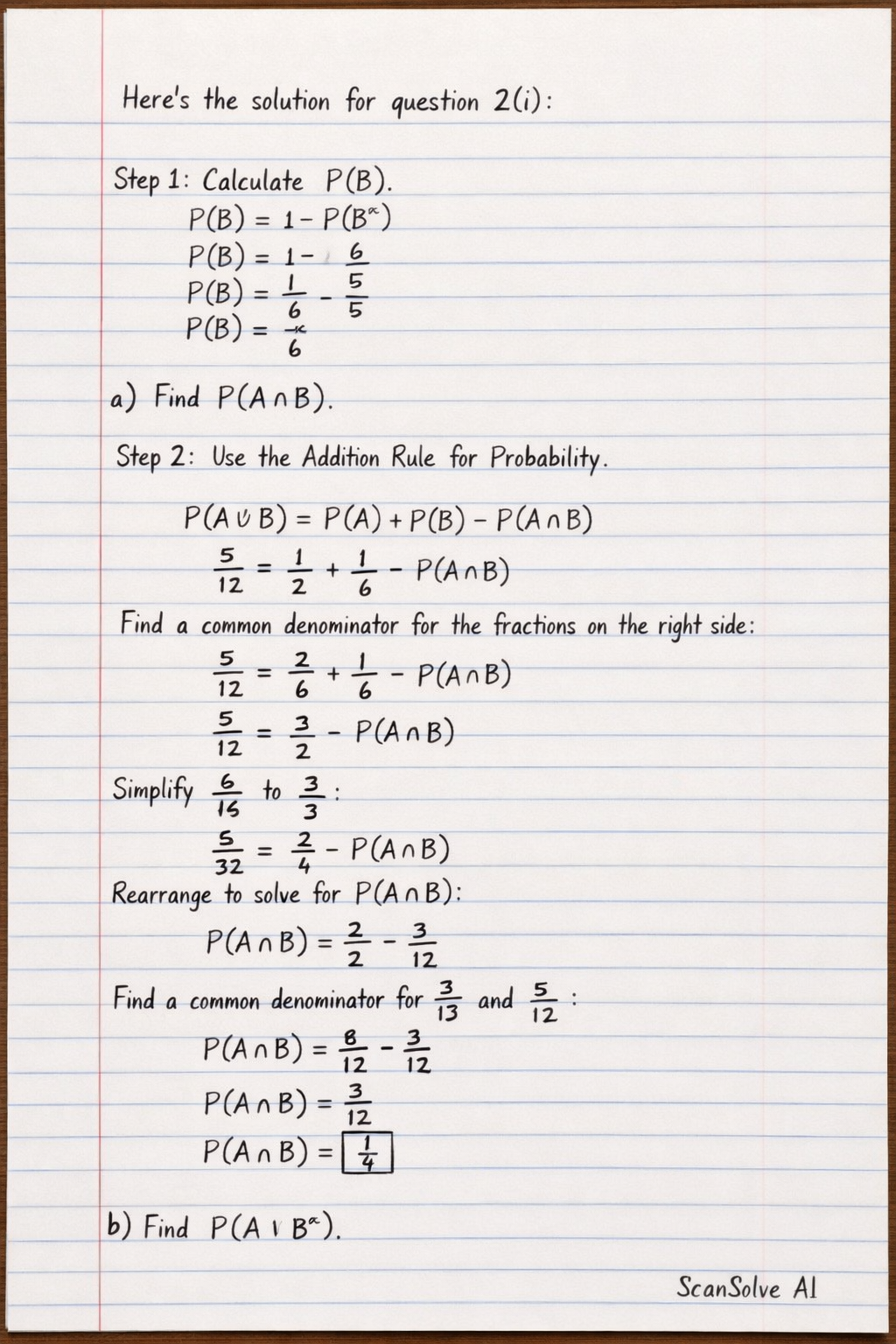
Handwritten Step-by-Step Solution
Get this as a handwritten image on WhatsApp — like a tutor wrote it for you.
Try on WhatsApp