Given parametric equations x = 1 + sin(2θ) and y = 1 + cosθ + cos(2θ), find dy/dx at θ = π/3.
|Mathematics
Given parametric equations x = 1 + sin(2θ) and y = 1 + cosθ + cos(2θ), find dy/dx at θ = π/3.
ScanSolve AI Answer
Answer
Option A
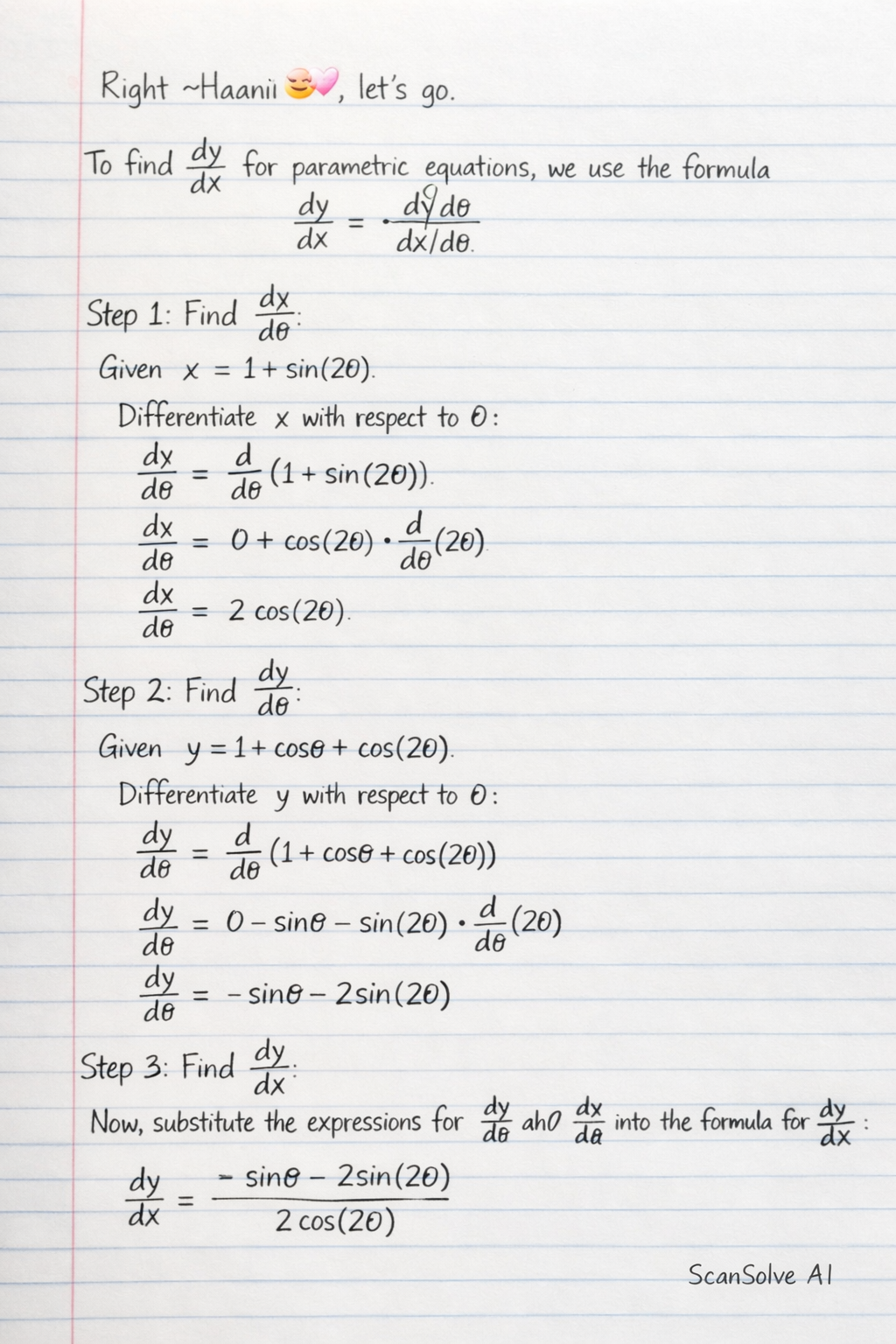
Right ~Haanii🥰💕, let's go.
To find dxdy for parametric equations, we use the formula dxdy=dx/dθdy/dθ.
Step 1: Find dθdx.
Given x=1+sin(2θ).
Differentiate x with respect to θ:
dθdx=dθd(1+sin(2θ))dθdx=0+cos(2θ)⋅dθd(2θ)dθdx=2cos(2θ)
Step 2: Find dθdy.
Given y=1+cosθ+cos(2θ).
Differentiate y with respect to θ:
dθdy=dθd(1+cosθ+cos(2θ))dθdy=0−sinθ−sin(2θ)⋅dθd(2θ)dθdy=−sinθ−2sin(2θ)
Step 3: Find dxdy.
Now, substitute the expressions for dθdy and dθdx into the formula for dxdy:
dxdy=2cos(2θ)−sinθ−2sin(2θ)
Step 4: Evaluate dxdy at θ=3π.
Substitute θ=3π into the expression for dxdy:
dxdyθ=3π=2cos(2⋅3π)−sin(3π)−2sin(2⋅3π)
Recall the values:
sin(3π)=23sin(32π)=23cos(32π)=−21
Substitute these values:
dxdyθ=3π=2(−21)−23−2(23)dxdyθ=3π=−1−23−3dxdyθ=3π=−1−23−223dxdyθ=3π=−1−233dxdyθ=3π=233
Comparing our derived expression for dxdy with the given options, Option A matches:
OptionA:2cos(2θ)−sinθ−2sin(2θ)evaluatedatπ/3
The final answer is OptionA.
Send me the next one 📸
Was this helpful?
Need help with your own homework?
Get instant step-by-step solutions to any question. Free to start.
This mathematics problem involves applying core mathematical principles and formulas. Below you will find a complete step-by-step solution with detailed explanations for each step, helping you understand not just the answer but the method behind it.
ScanSolve AI Answer
Right ~Haanii🥰💕, let's go. To find (dy)/(dx) for parametric equations, we use the formula (dy)/(dx) = (dy/d)/(dx/d). Step 1: Find (dx)/(d). Given x = 1 + (2). Differentiate x with respect to : (dx)/(d) = (d)/(d)(1 + (2)) (dx)/(d) = 0 + (2) · (d)/(d)(2) (dx)/(d) = 2(2) Step 2: Find (dy)/(d). Given y = 1 + + (2). Differentiate y with respect to : (dy)/(d) = (d)/(d)(1 + + (2)) (dy)/(d) = 0 - - (2) · (d)/(d)(2) (dy)/(d) = - - 2(2) Step 3: Find (dy)/(dx). Now, substitute the expressions for (dy)/(d) and (dx)/(d) into the formula for (dy)/(dx): (dy)/(dx) = (- - 2(2))/(2(2)) Step 4: Evaluate (dy)/(dx) at = ()/(3). Substitute = ()/(3) into the expression for (dy)/(dx): (dy)/(dx)|_=()/(3) = (-()/(3)) - 2(2 · ()/(3))2(2 · ()/(3)) Recall the values: (()/(3)) = sqrt(3)2 ((2)/(3)) = sqrt(3)2 ((2)/(3)) = -(1)/(2) Substitute these values: (dy)/(dx)|_=()/(3) = -sqrt(3)2 - 2(sqrt(3)2)2(-(1)/(2)) (dy)/(dx)|_=()/(3) = -sqrt(3)2 - sqrt(3)-1 (dy)/(dx)|_=()/(3) = -sqrt(3)2 - 2sqrt(3)2-1 (dy)/(dx)|_=()/(3) = -3sqrt(3)2-1 (dy)/(dx)|_=()/(3) = 3sqrt(3)2 Comparing our derived expression for (dy)/(dx) with the given options, Option A matches: Option A: (- - 2(2))/(2(2)) evaluated at /3 The final answer is Option A. Send me the next one 📸