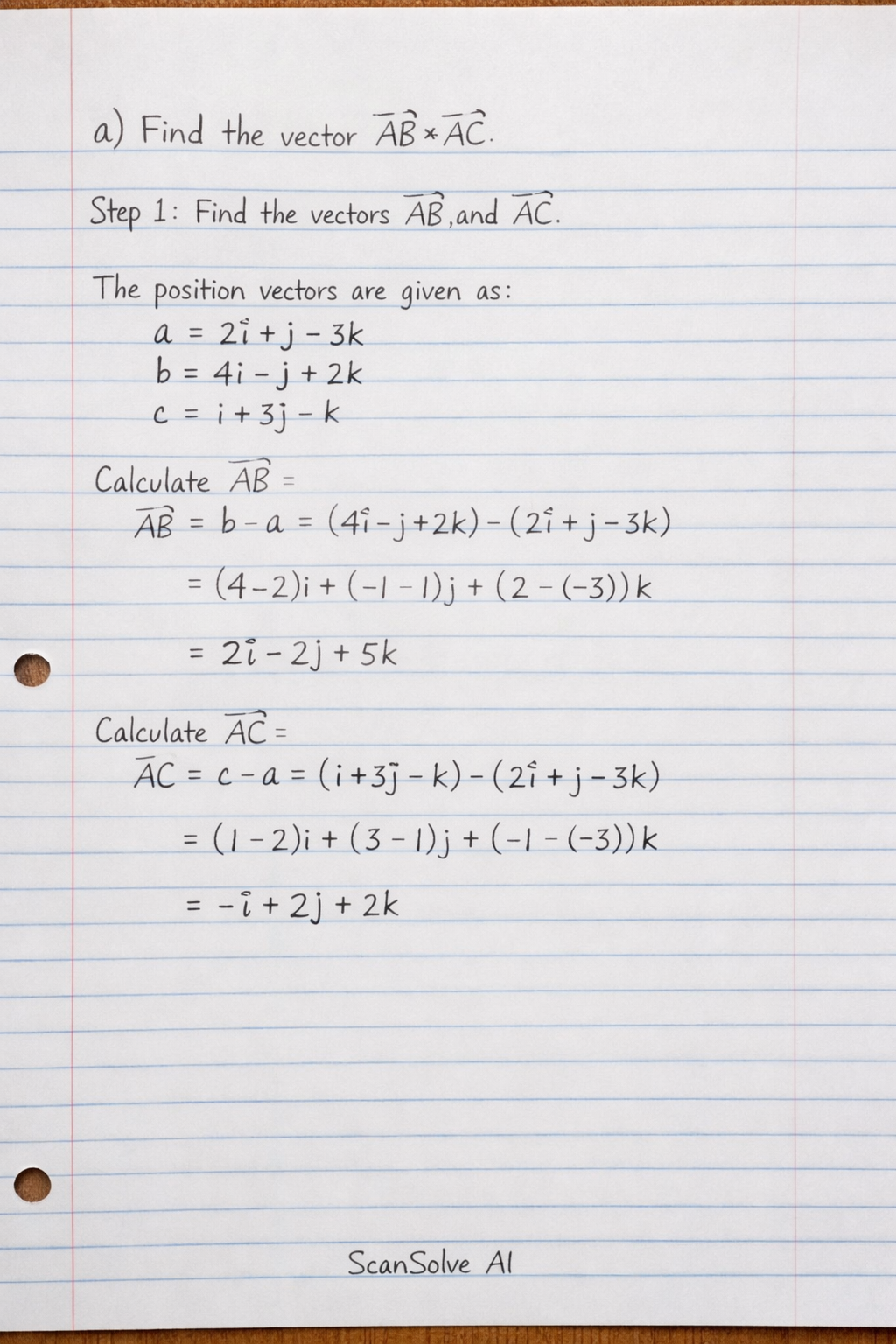
We read your photo as:

Given points A, B, and C with position vectors a, b, and c respectively, find the cross product AB x AC.

Mathematics

ScanSolve AI Answer

Answers

2 parts
a

−14i−9j+2k\mathbf{-14\mathbf{i} - 9\mathbf{j} + 2\mathbf{k}}

b

12281 units2\frac{1}{2}\sqrt{281} \text{ units}^2

Step-by-step solution

6 steps

Part a· 2 steps

Find the vector AB⃗×AC⃗\vec{AB} \times \vec{AC}.

  1. Find the vectors AB⃗\vec{AB} and AC⃗\vec{AC}.

    The position vectors are given as:

    a=2i+j−3k\mathbf{a} = 2\mathbf{i} + \mathbf{j} - 3\mathbf{k} b=4i−j+2k\mathbf{b} = 4\mathbf{i} - \mathbf{j} + 2\mathbf{k} c=i+3j−k\mathbf{c} = \mathbf{i} + 3\mathbf{j} - \mathbf{k}

    Calculate AB⃗\vec{AB}:

    AB⃗=b−a=(4i−j+2k)−(2i+j−3k)\vec{AB} = \mathbf{b} - \mathbf{a} = (4\mathbf{i} - \mathbf{j} + 2\mathbf{k}) - (2\mathbf{i} + \mathbf{j} - 3\mathbf{k}) AB⃗=(4−2)i+(−1−1)j+(2−(−3))k\vec{AB} = (4-2)\mathbf{i} + (-1-1)\mathbf{j} + (2-(-3))\mathbf{k} AB⃗=2i−2j+5k\vec{AB} = 2\mathbf{i} - 2\mathbf{j} + 5\mathbf{k}

    Calculate AC⃗\vec{AC}:

    AC⃗=c−a=(i+3j−k)−(2i+j−3k)\vec{AC} = \mathbf{c} - \mathbf{a} = (\mathbf{i} + 3\mathbf{j} - \mathbf{k}) - (2\mathbf{i} + \mathbf{j} - 3\mathbf{k}) AC⃗=(1−2)i+(3−1)j+(−1−(−3))k\vec{AC} = (1-2)\mathbf{i} + (3-1)\mathbf{j} + (-1-(-3))\mathbf{k} AC⃗=−i+2j+2k\vec{AC} = -\mathbf{i} + 2\mathbf{j} + 2\mathbf{k}
  2. Compute the cross product AB⃗×AC⃗\vec{AB} \times \vec{AC}.

    AB⃗×AC⃗=∣ijk2−25−122∣\vec{AB} \times \vec{AC} = \begin{vmatrix} \mathbf{i} & \mathbf{j} & \mathbf{k} \\ 2 & -2 & 5 \\ -1 & 2 & 2 \end{vmatrix} =i((−2)(2)−(5)(2))−j((2)(2)−(5)(−1))+k((2)(2)−(−2)(−1))= \mathbf{i}((-2)(2) - (5)(2)) - \mathbf{j}((2)(2) - (5)(-1)) + \mathbf{k}((2)(2) - (-2)(-1)) =i(−4−10)−j(4−(−5))+k(4−2)= \mathbf{i}(-4 - 10) - \mathbf{j}(4 - (-5)) + \mathbf{k}(4 - 2) =i(−14)−j(4+5)+k(2)= \mathbf{i}(-14) - \mathbf{j}(4 + 5) + \mathbf{k}(2) =−14i−9j+2k= -14\mathbf{i} - 9\mathbf{j} + 2\mathbf{k}

    The vector AB⃗×AC⃗\vec{AB} \times \vec{AC} is −14i−9j+2k\boxed{\mathbf{-14\mathbf{i} - 9\mathbf{j} + 2\mathbf{k}}}.

Part b

12281 units2\frac{1}{2}\sqrt{281} \text{ units}^2

Hence, find the area of the triangle ABC.

  1. Calculate the magnitude of the cross product.

    The area of triangle ABC is half the magnitude of the vector AB⃗×AC⃗\vec{AB} \times \vec{AC}.

    ∣AB⃗×AC⃗∣=∣−14i−9j+2k∣|\vec{AB} \times \vec{AC}| = |-14\mathbf{i} - 9\mathbf{j} + 2\mathbf{k}| =(−14)2+(−9)2+(2)2= \sqrt{(-14)^2 + (-9)^2 + (2)^2} =196+81+4= \sqrt{196 + 81 + 4} =281= \sqrt{281}
  2. Calculate the area of the triangle.

    Area=12∣AB⃗×AC⃗∣\text{Area} = \frac{1}{2} |\vec{AB} \times \vec{AC}| Area=12281\text{Area} = \frac{1}{2}\sqrt{281}

    The area of the triangle ABC is 12281 units2\boxed{\frac{1}{2}\sqrt{281} \text{ units}^2}.

Part c· 2 steps

Find the Cartesian equation of the plane ABC.

  1. Identify the normal vector and a point on the plane.

    The vector AB⃗×AC⃗=−14i−9j+2k\vec{AB} \times \vec{AC} = -14\mathbf{i} - 9\mathbf{j} + 2\mathbf{k} is a normal vector to the plane ABC. Let n=−14i−9j+2k\mathbf{n} = -14\mathbf{i} - 9\mathbf{j} + 2\mathbf{k}.
    We can use point A (2,1,−3)(2, 1, -3) which lies on the plane.

  2. Write the Cartesian equation of the plane.

    The equation of a plane with normal vector n=Ai+Bj+Ck\mathbf{n} = A\mathbf{i} + B\mathbf{j} + C\mathbf{k} passing through a point (x0,y0,z0)(x_0, y_0, z_0) is A(x−x0)+B(y−y0)+C(z−z0)=0A(x-x_0) + B(y-y_0) + C(z-z_0) = 0.
    Substituting the values:

Was this helpful?

Try one yourself

A new problem that tests the same skill.

Still stuck on this one?

Ask a follow-up, and the answer starts from this question.

Got a different question?Ask your own question
Handwritten step-by-step solution preview

Handwritten Step-by-Step Solution

Get this as a handwritten image on WhatsApp — like a tutor wrote it for you.

Try on WhatsApp