
We read your photo as:
Given points: P, R(3; 5), S(-3; -7), T(-5; k). Q(0; 5) is a point on the y-axis. PT || RS. RS cuts the y-axis at D. PR cuts the x-axis at F. PT cuts the x-axis at E. angle PEF = θ. Write down the equa
ScanSolve AI Answer
Step-by-step solution
20 stepsHere's the solution to your question.
Question 3
Given points: , , , .
is a point on the y-axis.
.
cuts the y-axis at .
cuts the x-axis at .
cuts the x-axis at .
.
3.1 Write down the equation of PR.
Identify the coordinates of P and R.
From the diagram, is on the y-axis and has the same y-coordinate as , so .
The coordinates of are given as .Determine the equation of the line passing through and .
Since both points have the same y-coordinate (), the line PR is a horizontal line.
The equation of PR is .
3.2 Calculate the:
3.2.1 Gradient of RS
Identify the coordinates of R and S.
and .
Use the gradient formula .
The gradient of RS is .
3.2.2 Size of
Identify the line associated with .
is the angle . This is the angle of inclination of the line PT with the positive x-axis.
Determine the gradient of PT.
It is given that . Therefore, their gradients are equal.
From 3.2.1, .
So, .Calculate the angle of inclination .
The gradient is equal to .
The size of is .
3.2.3 Coordinates of D
Identify the line and point D.
is the y-intercept of the line RS.
Find the equation of the line RS.
We have the gradient and a point .
Using the point-slope form :Find the y-intercept (where ).
Substitute into the equation:
The coordinates of D are .
3.3 If it is given that , calculate the value of .
Identify the coordinates of T and S.
and .
Use the distance formula .
Given .
Solve for .
Take the square root of both sides:
Case 1:
Case 2:
From the diagram, point T is in the third quadrant, meaning its y-coordinate () must be negative. Both values are negative. However, looking at the diagram, T is below the x-axis and its y-coordinate appears to be greater than -7 (S's y-coordinate). If , T would be much lower than S. If , T is higher than S, which aligns with the visual representation.
The value of is .
3.4 Parallelogram TDNS, with N in the 4th quadrant, is drawn. Calculate the coordinates of N.
Identify the vertices of the parallelogram TDNS.
(using from 3.3)
Let .Use the property that the diagonals of a parallelogram bisect each other.
The midpoint of TS must be the same as the midpoint of DN.
Midpoint of TS:
Midpoint of DN:
Equate the midpoints and solve for and .
The coordinates of N are .
Self-correction: The question states N is in the 4th quadrant. A point in the 4th quadrant has a positive x-coordinate and a negative y-coordinate. My calculated N(-8;-9) is in the 3rd quadrant. This means the order of vertices for the parallelogram is important.Let's re-evaluate using vector addition or the property that opposite sides are parallel and equal in length.
For parallelogram TDNS, .
Equating components:
So, . This point is in the 4th quadrant (positive x, negative y), which matches the condition.
The coordinates of N are .
3.5 APRD is reflected about the y-axis to form APRD'. Calculate the size of .
Identify the coordinates of A, P, R, D.
The problem statement mentions "trapezium PRST" and "parallelogram TDNS". It does not explicitly define point A. However, the question asks about APRD. Let's assume A is a point that forms a quadrilateral APRD. Given the context of reflections, we need the coordinates of R and D.
Find the coordinates of R' and D' after reflection about the y-axis.
When a point is reflected about the y-axis, its image is .
(D is on the y-axis, so it's invariant under y-axis reflection)Calculate the size of .
We need to find the angle formed by the lines DR and DR'.
The coordinates are , , .Calculate the gradient of DR ():
Calculate the gradient of DR' ():
Use the formula for the angle between two lines
.
Let and .The size of is .
Still stuck on this one?
Ask a follow-up, and the answer starts from this question.
More Mathematics Questions
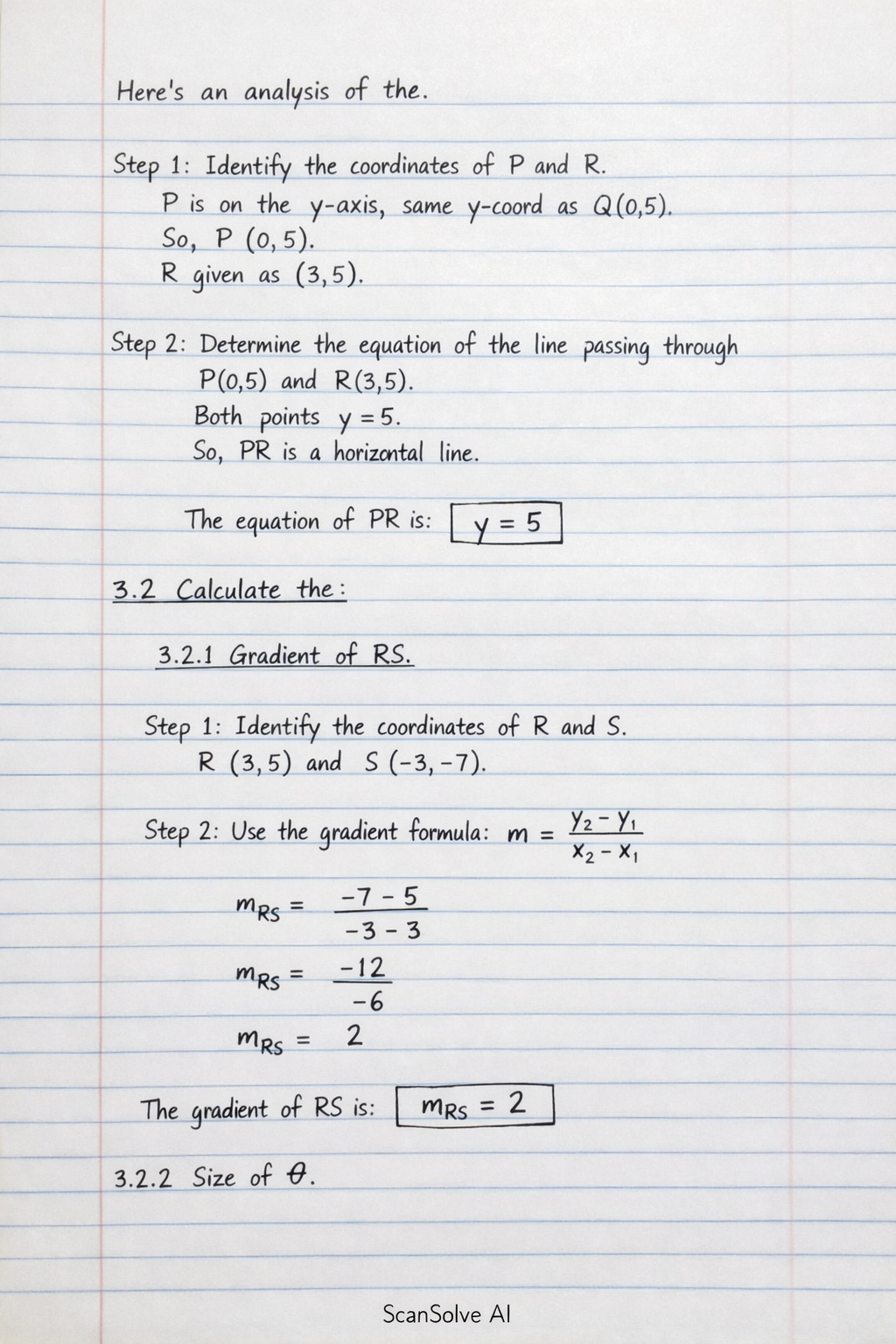
Handwritten Step-by-Step Solution
Get this as a handwritten image on WhatsApp — like a tutor wrote it for you.
Try on WhatsApp