
We read your photo as:
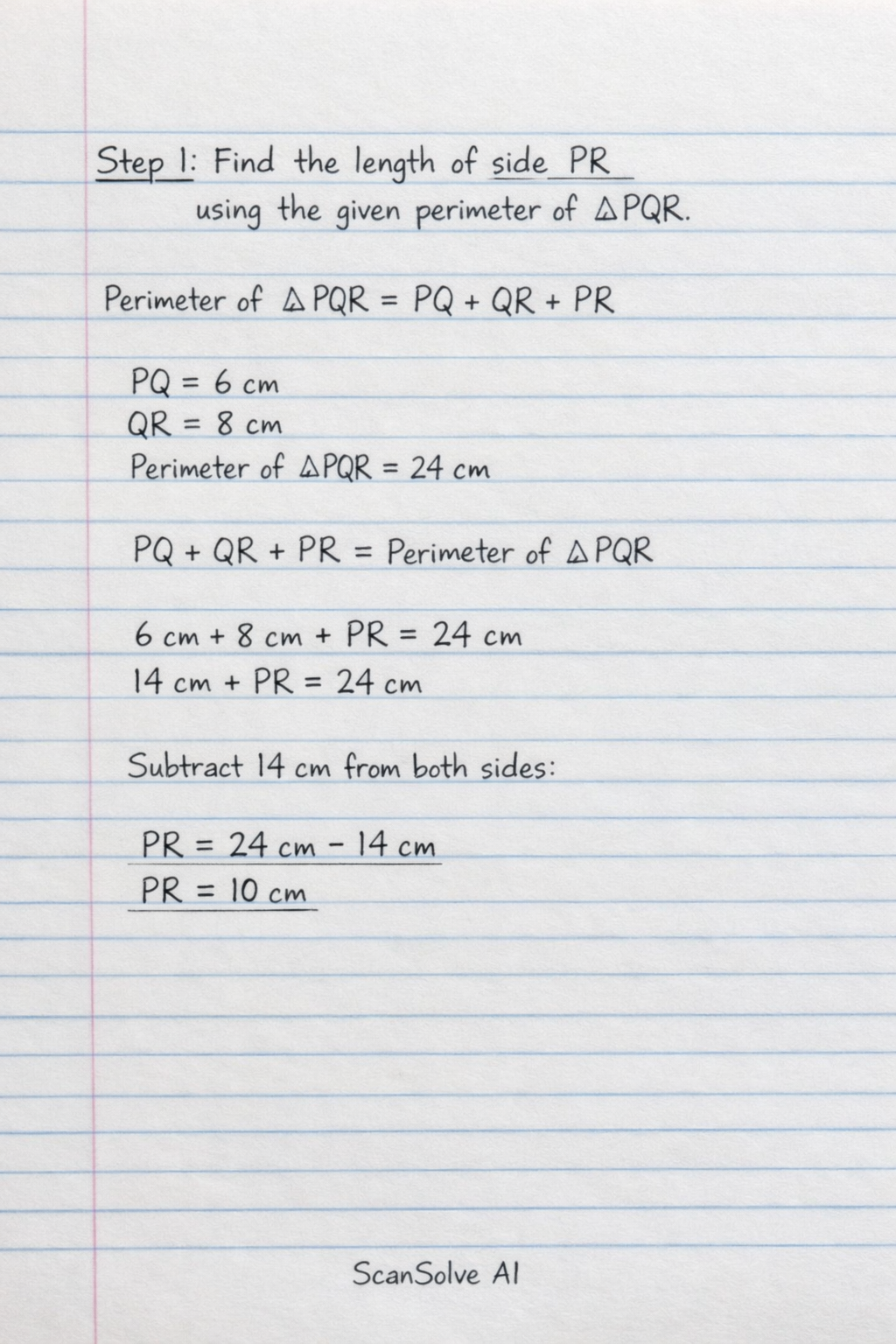
Given PQ = 6 cm, QR = 8 cm, and the perimeter of PQR = 24 cm.
Mathematics
ScanSolve AI Answer
Answer
Step-by-step solution
2 stepsFind the length of side using the given perimeter of .
The perimeter of is the sum of its sides , , and .
Given , , and the perimeter of .Subtract from both sides:
Calculate the area of .
The area of a triangle is given by the formula:
For , we can consider as the base. From the diagram, the perpendicular height from vertex to the base is given as .
Base ()
HeightThe area of is .
Was this helpful?
Try one yourself
A new problem that tests the same skill.
Still stuck on this one?
Ask a follow-up, and the answer starts from this question.
Got a different question?Ask your own question
More Mathematics Questions
QCan a triangle be constructed with side lengths PQ = 3.3 cm, QR = 4.6 cm, and PR = 8.2 cm?QConstruct triangle PQR in which PQ = 8cm, angle QPR = 50° and angle PQR = 70°. Measure and write the…QConstruct parallelogram PQRS with PQ=4cm, QR=6cm, and angle PQR=60 degrees. Then construct triangle…QIn the figure triangle PQR, PQ = 8cm, PR = 12cm and S is a point on PR such that ∠PQS = ∠PRQ. ⓘ…QConstruct triangle PQR with side lengths PQ=6cm, BC=6cm, AC=10cm, and calculate its angles.
Browse by topic:Geometry
Handwritten Step-by-Step Solution
Get this as a handwritten image on WhatsApp — like a tutor wrote it for you.
Try on WhatsApp