
We read your photo as:
Given PQS = 45^ and QPS = 45^.
Mathematics
ScanSolve AI Answer
Answer
Step-by-step solution
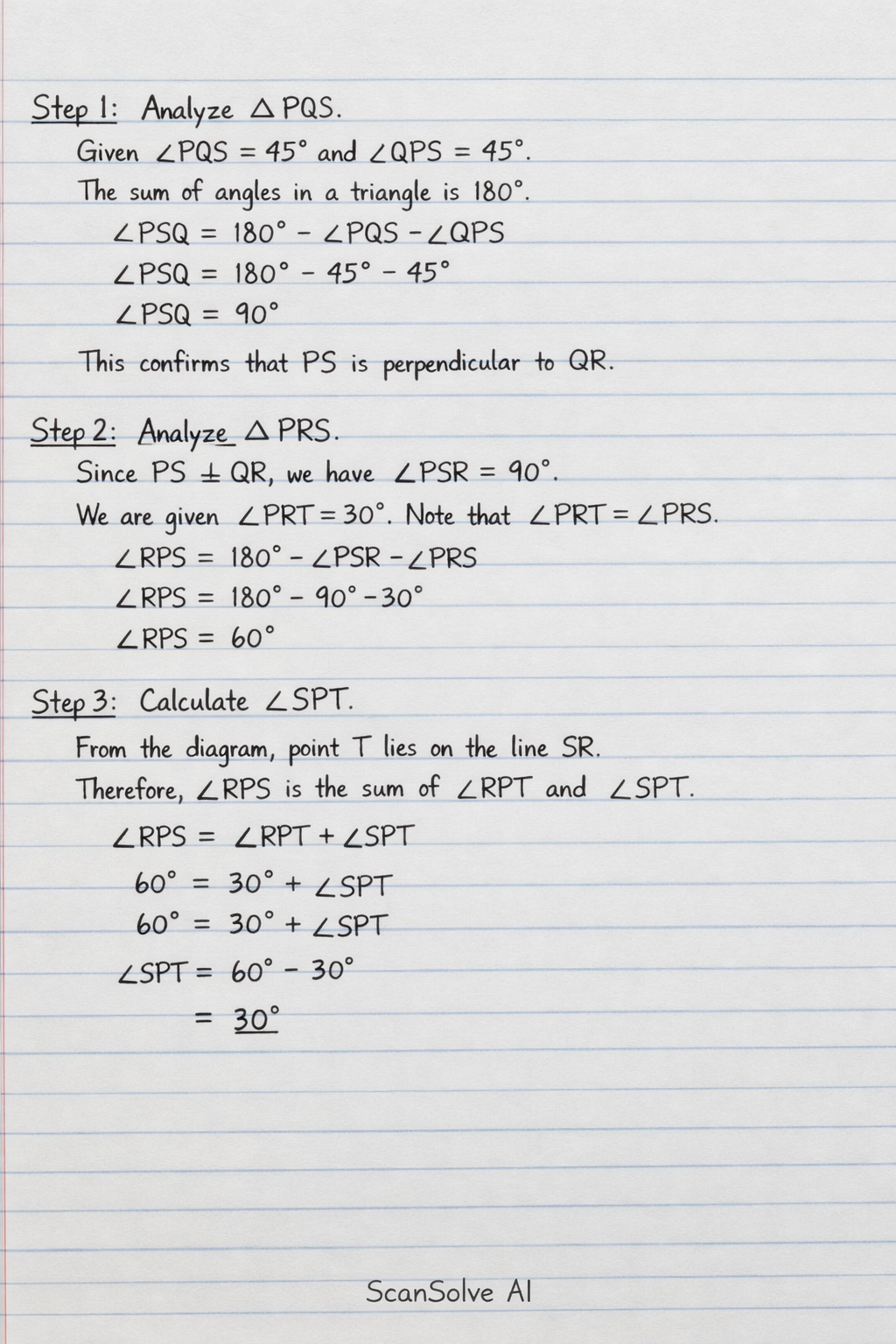
3 stepsAnalyze .
Given and .
The sum of angles in a triangle is .This confirms that is perpendicular to .
Analyze .
Since , we have .
We are given . Note that is the same as .
So, in right-angled :Calculate .
From the diagram, point lies on the line segment . Therefore, is the sum of and .
We know (from Step 2) and we are given .
The value cm is not required to solve for .
The final answer is .
Was this helpful?
Try one yourself
A new problem that tests the same skill.
Still stuck on this one?
Ask a follow-up, and the answer starts from this question.
Got a different question?Ask your own question
More Mathematics Questions
QGiven that PQRS is a square, P = 90^. It is also given that PT = PU.QGiven that PRS = 90^, and from the figure, PRQ = 90^.QPQRS is a cyclic quadrilateral. TPX is a tangent. RQX is a straight line. RPQ = 50^ . PRS = 25^ . If…QIn the diagram PQ // RS, QU // PT and PSR = 42^. Find angle x.QIdentify parallel lines and transversals. Given PQ parallel RS and QU parallel PT. If angle PSR…
Handwritten Step-by-Step Solution
Get this as a handwritten image on WhatsApp — like a tutor wrote it for you.
Try on WhatsApp