

This mathematics problem involves applying core mathematical principles and formulas. Below you will find a complete step-by-step solution with detailed explanations for each step, helping you understand not just the answer but the method behind it.
ScanSolve AI Answer
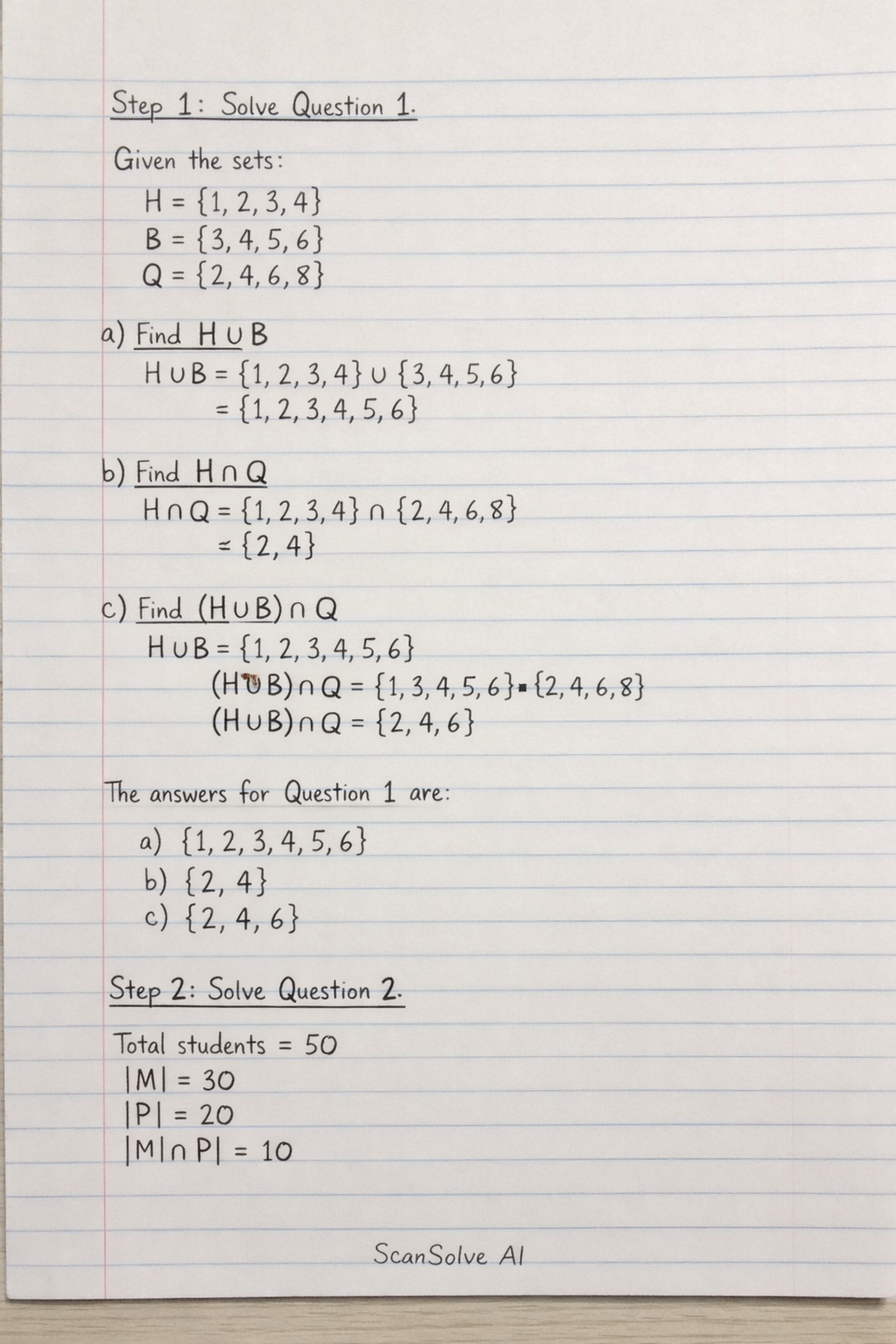
Step 1: Solve Question 1. Given the sets: H = \1, 2, 3, 4\ B = \3, 4, 5, 6\ Q = \2, 4, 6, 8\ a) Find H B The union of two sets includes all elements present in either set. H B = \1, 2, 3, 4\ \3, 4, 5, 6\ H B = \1, 2, 3, 4, 5, 6\ b) Find H Q The intersection of two sets includes only the elements common to both sets. H Q = \1, 2, 3, 4\ \2, 4, 6, 8\ H Q = \2, 4\ c) Find (H B) Q First, calculate H B. From part (a), H B = \1, 2, 3, 4, 5, 6\. Next, find the intersection of this result with Q. (H B) Q = \1, 2, 3, 4, 5, 6\ \2, 4, 6, 8\ (H B) Q = \2, 4, 6\ The answers for Question 1 are: *a) \1, 2, 3, 4, 5, 6\ *b) \2, 4\ *c) \2, 4, 6\ Step 2: Solve Question 2. Given: Total students = 50 Students who like Mathematics (|M|) = 30 Students who like Physics (|P|) = 20 Students who like both Mathematics and Physics (|M P|) = 10 a) How many students like only Mathematics? To find students who like only Mathematics, subtract those who like both from the total who like Mathematics. Only Mathematics = |M| - |M P| Only Mathematics = 30 - 10 Only Mathematics = 20 b) How many students like only Physics? To find students who like only Physics, subtract those who like both from the total who like Physics. Only Physics = |P| - |M P| Only Physics = 20 - 10 Only Physics = 10 The answers for Question 2 are: *a) 20 *b) 10 Step 3: Solve Question 3. Given the universal set U and sets A and N: U = \1, 2, 3, 4, 5, 6, 7, 8, 9\ (reordered from the original list) A = \1, 3, 5, 7\ (reordered from the original list) N = \2, 4, 6, 8\ (reordered from the original list) a) Find A^c (complement of A) The complement of A contains all elements in U that are not in A. A^c = U - A A^c = \1, 2, 3, 4, 5, 6, 7, 8, 9\ - \1, 3, 5, 7\ A^c = \2, 4, 6, 8, 9\ b) Find N^c (complement of N) The complement of N contains all elements in U that are not in N. N^c = U - N N^c = \1, 2, 3, 4, 5, 6, 7, 8, 9\ - \2, 4, 6, 8\ N^c = \1, 3, 5, 7, 9\ c) Find (A B)^c Assuming "B" is a typo and refers to set N from the problem statement, we will calculate (A N)^c. First, find A N. A N = \1, 3, 5, 7\ \2, 4, 6, 8\ A N = \1, 2, 3, 4, 5, 6, 7, 8\ Next, find the complement of (A N). (A N)^c = U - (A N) (A N)^c = \1, 2, 3, 4, 5, 6, 7, 8, 9\ - \1, 2, 3, 4, 5, 6, 7, 8\ (A N)^c = \9\ The answers for Question 3 are: *a) \2, 4, 6, 8, 9\ *b) \1, 3, 5, 7, 9\ *c) \9\ (assuming B refers to N) Step 4: Solve Question 4. Given the sets: A = \1, 2, 3, 4, 5\ M = \3, 4, 5, 6, 7\ a) Find A - M (set difference between A and M) The set difference A - M contains elements that are in A but not in M. A - M = \1, 2, 3, 4, 5\ - \3, 4, 5, 6, 7\ A - M = \1, 2\ b) Find M - A (set difference between M and A) The set difference M - A contains elements that are in M but not in A. M - A = \3, 4, 5, 6, 7\ - \1, 2, 3, 4, 5\