

This mathematics problem involves applying core mathematical principles and formulas. Below you will find a complete step-by-step solution with detailed explanations for each step, helping you understand not just the answer but the method behind it.
ScanSolve AI Answer
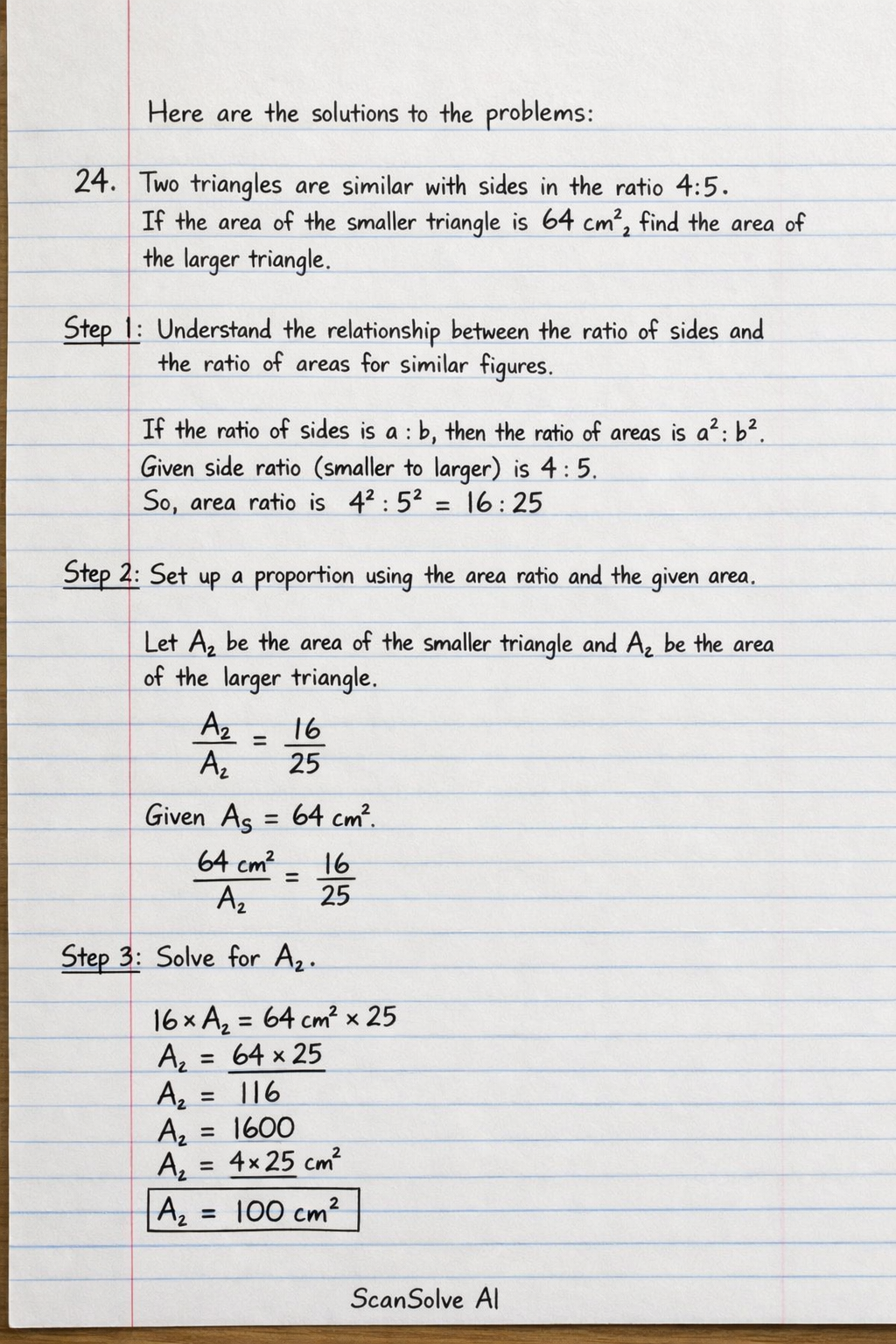
Here are the solutions to the problems: 24. Two triangles are similar with sides in the ratio 4:5. If the area of the smaller triangle is 64 cm^2, find the area of the larger triangle. Step 1: Understand the relationship between the ratio of sides and the ratio of areas for similar figures. If the ratio of corresponding sides of two similar triangles is a:b, then the ratio of their areas is a^2:b^2. Given side ratio (smaller to larger) is 4:5. So, the area ratio (smaller to larger) is 4^2:5^2 = 16:25. Step 2: Set up a proportion using the area ratio and the given area. Let A_s be the area of the smaller triangle and A_l be the area of the larger triangle. (A_s)/(A_l) = (16)/(25) Given A_s = 64 cm^2. 64 cm^2A_l = (16)/(25) Step 3: Solve for A_l. 16 × A_l = 64 cm^2 × 25 A_l = (64 × 25)/(16) cm^2 A_l = 4 × 25 cm^2 A_l = 100 cm^2 25. Define the term Circle and state the relationship between radius and diameter. A circle is a set of all points in a plane that are equidistant from a fixed central point. The relationship between radius (r) and diameter (d) is that the diameter is twice the radius, or d = 2r. 26. Find the circumference of a circle with a radius of 7 cm. ( = (22)/(7)) Step 1: Use the formula for the circumference of a circle. C = 2 r Step 2: Substitute the given values r = 7 cm and = (22)/(7). C = 2 × (22)/(7) × 7 cm C = 2 × 22 cm C = 44 cm 27. Calculate the area of the following use = (22)/(7) a) Circle with diameter 14cm* Step 1: Find the radius. r = diameter2 = 14 cm2 = 7 cm Step 2: Use the formula for the area of a circle. A = r^2 Step 3: Substitute the values. A = (22)/(7) × (7 cm)^2 A = (22)/(7) × 49 cm^2 A = 22 × 7 cm^2 A = 154 cm^2 b) Circle with diameter 12cm* Step 1: Find the radius. r = diameter2 = 12 cm2 = 6 cm Step 2: Use the formula for the area of a circle. A = r^2 Step 3: Substitute the values. A = (22)/(7) × (6 cm)^2 A = (22)/(7) × 36 cm^2 A = (792)/(7) cm^2 A = 113.14 cm^2 (approx.) or (792)/(7) cm^2 c) Quarter circle with radius 10cm* Step 1: Identify the radius. r = 10 cm Step 2: Use the formula for the area of a quarter circle. A = (1)/(4) r^2 Step 3: Substitute the values. A = (1)/(4) × (22)/(7) × (10 cm)^2 A = (1)/(4) × (22)/(7) × 100 cm^2 A = (2200)/(28) cm^2 A = (550)/(7) cm^2 A = 78.57 cm^2 (approx.) or (550)/(7) cm^2 28. The wheel of a bicycle has a radius of 35 cm. How many revolutions will it make in covering 1 km? Step 1: Calculate the circumference of the wheel. C = 2 r Using = (22)/(7) and r = 35 cm: C = 2 × (22)/(7) × 35 cm C = 2 × 22 × 5 cm C = 220 cm Step 2: Convert the total distance to centimeters. 1 km = 1000 m 1000 m = 1000 × 100 cm = 100000 cm Step 3: Calculate the number of revolutions. Number of Revolutions = Total DistanceCircumference Number of Revolutions = 100000 cm220 cm Number of Revolutions = (10000)/(22) Number of Revolutions = (5000)/(11) Number of Revolutions = 454.55 (approx.) or (5000)/(11) Since revolutions must be whole numbers for full rotations, the wheel makes 454 full revolutions.