
We read your photo as:
Find the limits in Exercises 17 22
ScanSolve AI Answer
This answer stops before the end.
It was cut off when it was first written. Ask ScanSolve this question again for the full working.
Step-by-step solution
25 stepshere are the solutions for the remaining limits:
- :
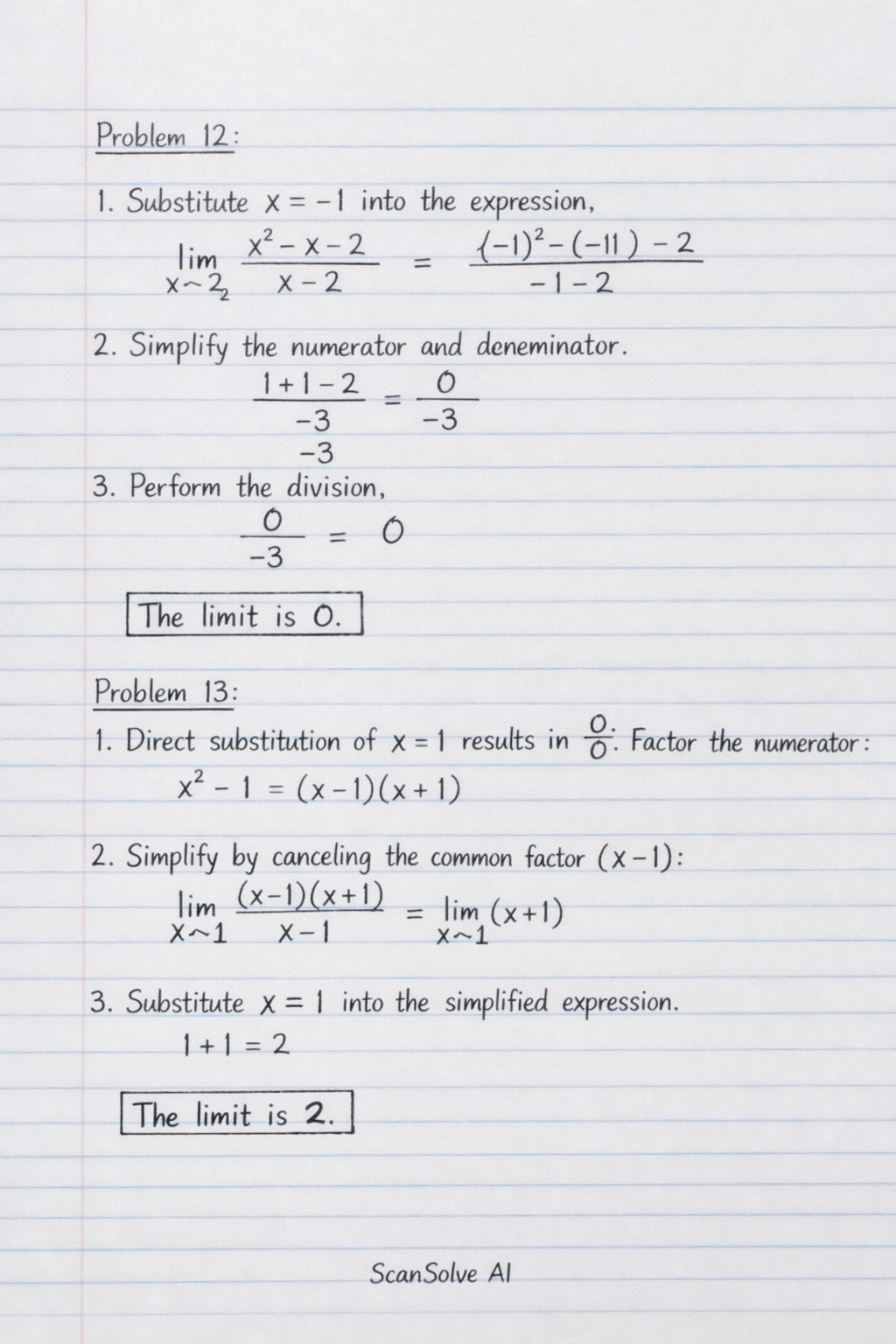
Substitute into the expression.
$$ \lim_{x \to -1} \frac{x^2 - x - 2}{x - 2} = \frac{(-1)^2 - (-1) - 2}{-1 - 2} $$Simplify the numerator and denominator.
$$ \frac{1 + 1 - 2}{-3} = \frac{0}{-3} $$Perform the division.
$$ \frac{0}{-3} = 0 $$ The limit is $\boxed{\text{0}}$.- :
Direct substitution of results in , an indeterminate form.
Factor the numerator.
Simplify the expression by canceling the common factor .
$$ \lim_{x \to 1} \frac{(x - 1)(x + 1)}{x - 1} = \lim_{x \to 1} (x + 1) $$Substitute into the simplified expression.
$$ 1 + 1 = 2 $$ The limit is $\boxed{\text{2}}$.- :
Direct substitution of results in , an indeterminate form.
Factor the numerator.
Simplify the expression by canceling the common factor .
$$ \lim_{x \to -5} \frac{(x + 5)(x - 2)}{x + 5} = \lim_{x \to -5} (x - 2) $$Substitute into the simplified expression.
$$ -5 - 2 = -7 $$ The limit is $\boxed{\text{-7}}$.- :
Direct substitution of results in , an indeterminate form.
Factor the denominator.
Simplify the expression by canceling the common factor .
$$ \lim_{x \to 2} \frac{x - 2}{(x + 3)(x - 2)} = \lim_{x \to 2} \frac{1}{x + 3} $$Substitute into the simplified expression.
$$ \frac{1}{2 + 3} = \frac{1}{5} $$ The limit is $\boxed{\frac{1}{5}}$.- :
Direct substitution of results in , an indeterminate form.
Factor the numerator and denominator.
Simplify the expression by canceling the common factor .
$$ \lim_{x \to 1} \frac{(x - 1)^2}{(x - 1)(x^2 + x - 1)} = \lim_{x \to 1} \frac{x - 1}{x^2 + x - 1} $$Substitute into the simplified expression.
$$ \frac{1 - 1}{1^2 + 1 - 1} = \frac{0}{1} = 0 $$ The limit is $\boxed{\text{0}}$.- :
Divide the numerator and denominator by the highest power of in the denominator, which is .
$$ \lim_{x \to \infty} \frac{2x + 3}{5x + 7} = \lim_{x \to \infty} \frac{\frac{2x}{x} + \frac{3}{x}}{\frac{5x}{x} + \frac{7}{x}} = \lim_{x \to \infty} \frac{2 + \frac{3}{x}}{5 + \frac{7}{x}} $$As , terms of the form approach 0.
$$ \frac{2 + 0}{5 + 0} = \frac{2}{5} $$ The limit is $\boxed{\frac{2}{5}}$.- :
Divide the numerator and denominator by the highest power of in the denominator, which is .
$$ \lim_{x \to \infty} \frac{2x^2 + 3}{5x^2 + 7} = \lim_{x \to \infty} \frac{\frac{2x^2}{x^2} + \frac{3}{x^2}}{\frac{5x^2}{x^2} + \frac{7}{x^2}} = \lim_{x \to \infty} \frac{2 + \frac{3}{x^2}}{5 + \frac{7}{x^2}} $$As , terms of the form approach 0.
$$ \frac{2 + 0}{5 + 0} = \frac{2}{5} $$ The limit is $\boxed{\frac{2}{5}}$.- :
Divide the numerator and denominator by the highest power of in the denominator, which is .
$$ \lim_{x \to \infty} \frac{x^2 - 4x + 8}{3x^3} = \lim_{x \to \infty} \frac{\frac{x^2}{x^3} - \frac{4x}{x^3} + \frac{8}{x^3}}{\frac{3x^3}{x^3}} = \lim_{x \to \infty} \frac{\frac{1}{x} - \frac{4}{x^2} + \frac{8}{x^3}}{3} $$As , terms of the form approach 0.
$$ \frac{0 - 0 + 0}{3} = \frac{0}{3} = 0 $$ The limit is $\boxed{\text{0}}$.- :
As , the denominator approaches .
$$ \lim_{x \to \infty} \frac{1}{x^3 - 7x + 1} $$A constant divided by an infinitely large number approaches 0.
$$ \frac{1}{\infty} = 0 $$ The limit is $\boxed{\text{0}}$.- :
Divide the numerator and denominator by the highest power of in the denominator, which is .
$$ \lim_{x \to \infty} \frac{x^2 - 7x}{x + 1} = \lim_{x \to \infty} \frac{\frac{x^2}{x} - \frac{7x}{x}}{\frac{x}{x} + \frac{1}{x}} = \lim_{x \to \infty} \frac{x - 7}{1 + \frac{1}{x}} $$As $
Still stuck on this one?
Ask a follow-up, and the answer starts from this question.
More Mathematics Questions
Handwritten Step-by-Step Solution
Get this as a handwritten image on WhatsApp — like a tutor wrote it for you.
Try on WhatsApp