

This mathematics problem involves applying core mathematical principles and formulas. Below you will find a complete step-by-step solution with detailed explanations for each step, helping you understand not just the answer but the method behind it.
ScanSolve AI Answer
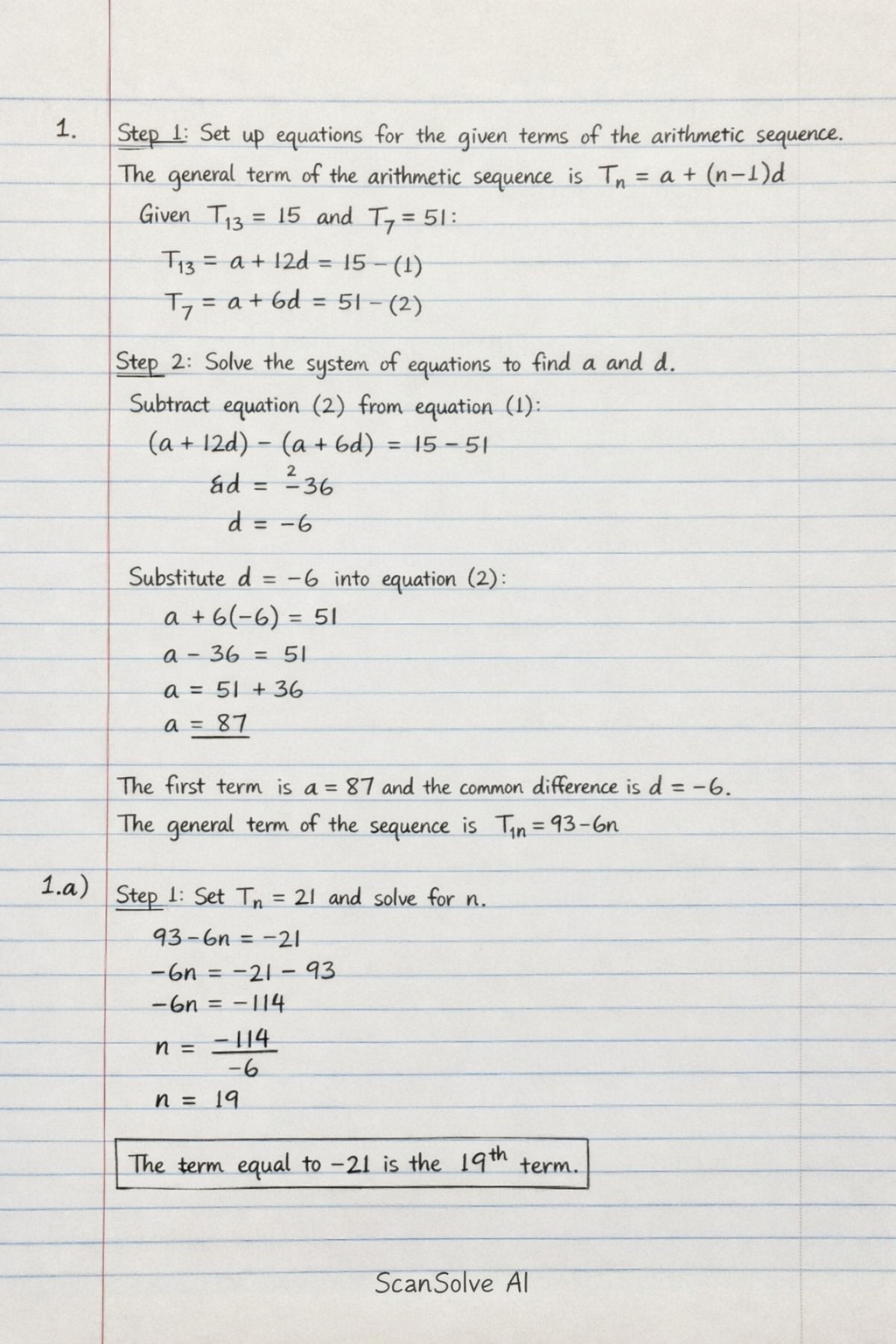
You're on a roll — 1. Step 1: Set up equations for the given terms of the arithmetic sequence. The general term of an arithmetic sequence is T_n = a + (n-1)d. Given T_13 = 15 and T_7 = 51. T_13 = a + (13-1)d a + 12d = 15 (1) T_7 = a + (7-1)d a + 6d = 51 (2) Step 2: Solve the system of equations to find a and d. Subtract equation (2) from equation (1): (a + 12d) - (a + 6d) = 15 - 51 6d = -36 d = -6 Substitute d = -6 into equation (2): a + 6(-6) = 51 a - 36 = 51 a = 51 + 36 a = 87 The first term is a=87 and the common difference is d=-6. The general term of the sequence is T_n = 87 + (n-1)(-6) = 87 - 6n + 6 = 93 - 6n. 1.a) Step 1: Set T_n = -21 and solve for n. 93 - 6n = -21 -6n = -21 - 93 -6n = -114 n = (-114)/(-6) n = 19 The term equal to -21 is the 19th term. 1.b) Step 1: Set T_n = 66 and solve for n. 93 - 6n = 66 -6n = 66 - 93 -6n = -27 n = (-27)/(-6) n = (9)/(2) n = 4.5 Since n is not an integer, 66 is not a term of the sequence. 2. Step 1: Identify the given values for the arithmetic series. First term a = 5. Last term L = 61. Sum of all terms S_n = 957. Step 2: Use the formula for the sum of an arithmetic series. The formula for the sum of an arithmetic series is S_n = (n)/(2)(a + L). Substitute the given values into the formula: 957 = (n)/(2)(5 + 61) 957 = (n)/(2)(66) 957 = 33n Step 3: Solve for n. n = (957)/(33) n = 29 The number of terms in the series is 29. Got more? Send 'em!