Given that A = [[4, 9, 2], [-8, 6, -3], [3, 1, -5]], Evaluate |A| + |A^T|. Hence or otherwise solve the equations 4x + 9y + 2z = 21, -8x + 6y - 3z = 41, 3x + y - 5z = -73.
|Mathematics
Given that A = [[4, 9, 2], [-8, 6, -3], [3, 1, -5]], Evaluate |A| + |A^T|. Hence or otherwise solve the equations 4x + 9y + 2z = 21, -8x + 6y - 3z = 41, 3x + y - 5z = -73.
ScanSolve AI Answer
Answer
-1202
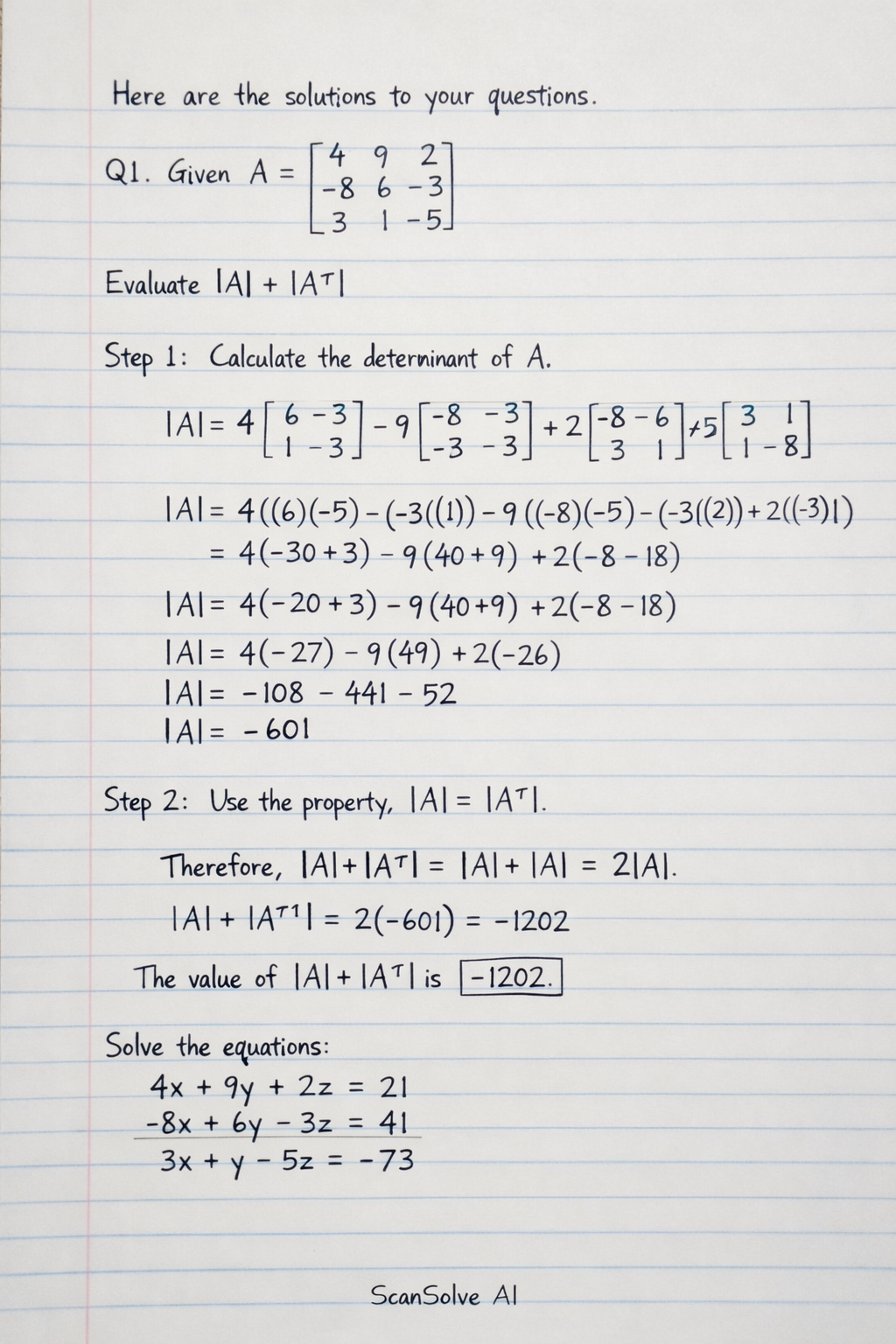
Here are the solutions to your questions.
Q1. Given that A=4−839612−3−5.
Evaluate ∣A∣+∣AT∣
Step 1: Calculate the determinant of matrix A.
∣A∣=461−3−5−9−83−3−5+2−8361∣A∣=4((6)(−5)−(−3)(1))−9((−8)(−5)−(−3)(3))+2((−8)(1)−(6)(3))∣A∣=4(−30+3)−9(40+9)+2(−8−18)∣A∣=4(−27)−9(49)+2(−26)∣A∣=−108−441−52∣A∣=−601
Step 2: Use the property that ∣A∣=∣AT∣.
Therefore, ∣A∣+∣AT∣=∣A∣+∣A∣=2∣A∣.
∣A∣+∣AT∣=2(−601)=−1202
The value of ∣A∣+∣AT∣ is −1202.
Solve the equations:4x+9y+2z=21−8x+6y−3z=413x+y−5z=−73
Step 3: Recognize that the coefficient matrix of the system is A. We use Cramer's Rule to solve for x,y,z. We already found ∣A∣=−601.
Calculate the determinant of Ax (matrix A with the first column replaced by the constant terms):
Ax=2141−739612−3−5∣Ax∣=21((6)(−5)−(−3)(1))−9((41)(−5)−(−3)(−73))+2((41)(1)−(6)(−73))∣Ax∣=21(−30+3)−9(−205−219)+2(41+438)∣Ax∣=21(−27)−9(−424)+2(479)∣Ax∣=−567+3816+958=4207x=∣A∣∣Ax∣=−6014207=−7
Step 4: Calculate the determinant of Ay (matrix A with the second column replaced by the constant terms):
Ay=4−832141−732−3−5∣Ay∣=4((41)(−5)−(−3)(−73))−21((−8)(−5)−(−3)(3))+2((−8)(−73)−(41)(3))∣Ay∣=4(−205−219)−21(40+9)+2(584−123)∣Ay∣=4(−424)−21(49)+2(461)∣Ay∣=−1696−1029+922=−1803y=∣A∣∣Ay∣=−601−1803=3
Step 5: Calculate the determinant of Az (matrix A with the third column replaced by the constant terms):
Az=4−839612141−73∣Az∣=4((6)(−73)−(41)(1))−9((−8)(−73)−(41)(3))+21((−8)(1)−(6)(3))∣Az∣=4(−438−41)−9(584−123)+21(−8−18)∣Az∣=4(−479)−9(461)+21(−26)∣Az∣=−1916−4149−546=−6611z=∣A∣∣Az∣=−601−6611=11
The solution to the system of equations is x=−7,y=3,z=11.
Q2.(a) Evaluate in polar form
(i) 2∠15∘16∠75∘
Step 1: To divide complex numbers in polar form, divide their magnitudes and subtract their angles.
2∠15∘16∠75∘=(216)∠(75∘−15∘)=8∠60∘
The result is 8∠60∘.
(ii) 6∠−3π10∠4π×12∠2π
Step 1: First, multiply the complex numbers in the numerator. Multiply magnitudes and add angles.
10∠4π×12∠2π=(10×12)∠(4π+2π)=120∠(4π+42π)=120∠43π
Step 2: Now, divide the result from Step 1 by the denominator. Divide magnitudes and subtract angles.
6∠−3π120∠43π=(6120)∠(43π−(−3π))=20∠(43π+3π)=20∠(129π+124π)=20∠1213π
The result is 20∠1213π.
Q2.(b) If Z=R+jωL+jωC1, express Z in (a+jb) form when R=10,L=5,C=0.04 and ω=4.
Step 1: Substitute the given values into the expression for Z.
Z=10+j(4)(5)+j(4)(0.04)1
Step 2: Simplify the terms.
Z=10+j20+j(0.16)1
Step 3: Simplify the fraction j(0.16)1 by multiplying the numerator and denominator by j (or −j).
j(0.16)1=j(0.16)1×jj=j2(0.16)j
Since j2=−1:
=−(0.16)j=−0.161j
Convert the fraction to a decimal: 0.161=16100=425=6.25.
So, j(0.16)1=−6.25j.
Step 4: Substitute this back into the expression for Z and combine the imaginary terms.
Z=10+j20−j6.25Z=10+j(20−6.25)Z=10+j13.75
The expression for Z in (a+jb) form is 10+j13.75.
Send me the next one 📸
Was this helpful?
Need help with your own homework?
Get instant step-by-step solutions to any question. Free to start.
This mathematics problem involves applying core mathematical principles and formulas. Below you will find a complete step-by-step solution with detailed explanations for each step, helping you understand not just the answer but the method behind it.
ScanSolve AI Answer
Here are the solutions to your questions. Q1. Given that A = 4 & 9 & 2 \\ -8 & 6 & -3 \\ 3 & 1 & -5 . Evaluate |A| + |A^T| Step 1: Calculate the determinant of matrix A. |A| = 4 6 & -3 \\ 1 & -5 - 9 -8 & -3 \\ 3 & -5 + 2 -8 & 6 \\ 3 & 1 |A| = 4((6)(-5) - (-3)(1)) - 9((-8)(-5) - (-3)(3)) + 2((-8)(1) - (6)(3)) |A| = 4(-30 + 3) - 9(40 + 9) + 2(-8 - 18) |A| = 4(-27) - 9(49) + 2(-26) |A| = -108 - 441 - 52 |A| = -601 Step 2: Use the property that |A| = |A^T|. Therefore, |A| + |A^T| = |A| + |A| = 2|A|. |A| + |A^T| = 2(-601) = -1202 The value of |A| + |A^T| is -1202. Solve the equations: 4x + 9y + 2z = 21 -8x + 6y - 3z = 41 3x + y - 5z = -73 Step 3: Recognize that the coefficient matrix of the system is A. We use Cramer's Rule to solve for x, y, z. We already found |A| = -601. Calculate the determinant of A_x (matrix A with the first column replaced by the constant terms): A_x = 21 & 9 & 2 \\ 41 & 6 & -3 \\ -73 & 1 & -5 |A_x| = 21((6)(-5) - (-3)(1)) - 9((41)(-5) - (-3)(-73)) + 2((41)(1) - (6)(-73)) |A_x| = 21(-30 + 3) - 9(-205 - 219) + 2(41 + 438) |A_x| = 21(-27) - 9(-424) + 2(479) |A_x| = -567 + 3816 + 958 = 4207 x = (|A_x|)/(|A|) = (4207)/(-601) = -7 Step 4: Calculate the determinant of A_y (matrix A with the second column replaced by the constant terms): A_y = 4 & 21 & 2 \\ -8 & 41 & -3 \\ 3 & -73 & -5 |A_y| = 4((41)(-5) - (-3)(-73)) - 21((-8)(-5) - (-3)(3)) + 2((-8)(-73) - (41)(3)) |A_y| = 4(-205 - 219) - 21(40 + 9) + 2(584 - 123) |A_y| = 4(-424) - 21(49) + 2(461) |A_y| = -1696 - 1029 + 922 = -1803 y = (|A_y|)/(|A|) = (-1803)/(-601) = 3 Step 5: Calculate the determinant of A_z (matrix A with the third column replaced by the constant terms): A_z = 4 & 9 & 21 \\ -8 & 6 & 41 \\ 3 & 1 & -73 |A_z| = 4((6)(-73) - (41)(1)) - 9((-8)(-73) - (41)(3)) + 21((-8)(1) - (6)(3)) |A_z| = 4(-438 - 41) - 9(584 - 123) + 21(-8 - 18) |A_z| = 4(-479) - 9(461) + 21(-26) |A_z| = -1916 - 4149 - 546 = -6611 z = (|A_z|)/(|A|) = (-6611)/(-601) = 11 The solution to the system of equations is x = -7, y = 3, z = 11. Q2.(a) Evaluate in polar form (i) (16 75^)/(2 15^) Step 1: To divide complex numbers in polar form, divide their magnitudes and subtract their angles. (16 75^)/(2 15^) = ((16)/(2)) (75^ - 15^) = 8 60^ The result is 8 60^. (ii) (10 )/(4) × 12 ()/(2)6 -()/(3) Step 1: First, multiply the complex numbers in the numerator. Multiply magnitudes and add angles. 10 ()/(4) × 12 ()/(2) = (10 × 12) (()/(4) + ()/(2)) = 120 (()/(4) + (2)/(4)) = 120 (3)/(4) Step 2: Now, divide the result from Step 1 by the denominator. Divide magnitudes and subtract angles. (120 3)/(4)6 -()/(3) = ((120)/(6)) ((3)/(4) - (-()/(3))) = 20 ((3)/(4) + ()/(3)) = 20 ((9)/(12) + (4)/(12)) = 20 (13)/(12) The result is 20 (13)/(12). Q2.(b) If Z = R + j L + (1)/(j C), express Z in (a+jb) form when R=10, L=5, C=0.04 and =4. Step 1: Substitute the given values into the expression for Z. Z = 10 + j(4)(5) + (1)/(j(4)(0.04)) Step 2: Simplify the terms. Z = 10 + j20 + (1)/(j(0.16)) Step 3: Simplify the fraction (1)/(j(0.16)) by multiplying the numerator and denominator by j (or -j). (1)/(j(0.16)) = (1)/(j(0.16)) × (j)/(j) = (j)/(j^2(0.16)) Since j^2 = -1: = (j)/(-(0.16)) = -(1)/(0.16)j Convert the fraction to a decimal: (1)/(0.16) = (100)/(16) = (25)/(4) = 6.25. So, (1)/(j(0.16)) = -6.25j. Step 4: Substitute this back into the expression for Z and combine the imaginary terms. Z = 10 + j20 - j6.25 Z = 10 + j(20 - 6.25) Z = 10 + j13.75 The expression for Z in (a+jb) form is 10 + j13.75. Send me the next one 📸