
We read your photo as:
Given that line L1 is parallel to line L2, find the measure of angle 'a', 'b', 'c', 'd', 'e', 'f', 'g', 'h', and 'i'.
ScanSolve AI Answer
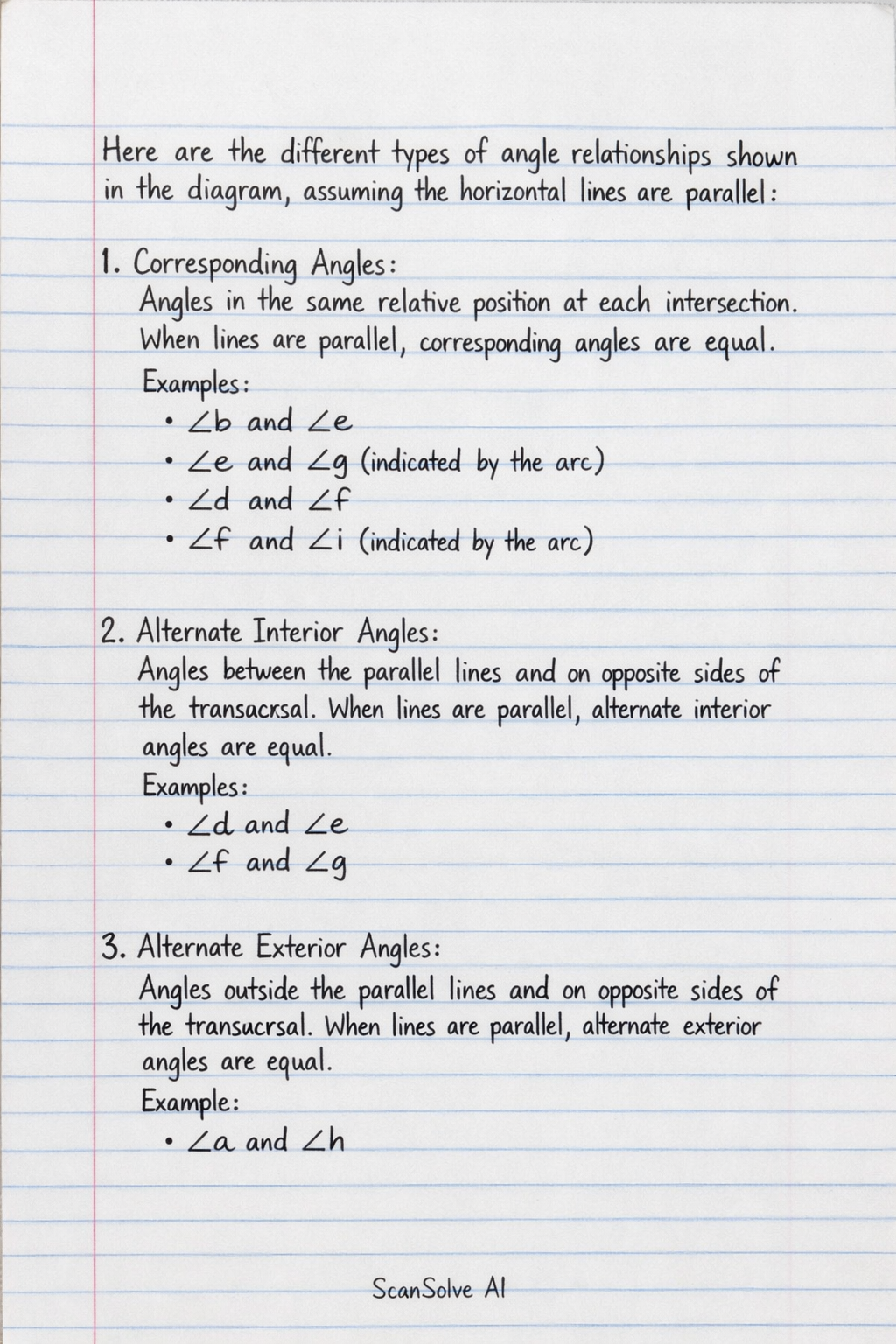
Here are the different types of angle relationships shown in the diagram, assuming the horizontal lines are parallel:
-
Corresponding Angles: Angles in the same relative position at each intersection. When lines are parallel, corresponding angles are equal. Examples:
- and
- and (indicated by the arc)
- and
- and (indicated by the arc)
-
Alternate Interior Angles: Angles between the parallel lines and on opposite sides of the transversal. When lines are parallel, alternate interior angles are equal. Examples:
- and
- and
-
Alternate Exterior Angles: Angles outside the parallel lines and on opposite sides of the transversal. When lines are parallel, alternate exterior angles are equal. Example:
- and
-
Consecutive Interior Angles (or Same-Side Interior Angles): Angles between the parallel lines and on the same side of the transversal. When lines are parallel, consecutive interior angles are supplementary (their sum is ). Example:
- and
-
Vertically Opposite Angles: Angles opposite each other at an intersection. Vertically opposite angles are always equal. Examples:
- and
- and
- and
-
Angles on a Straight Line (or Linear Pair): Angles that form a straight line. They are always supplementary (their sum is ). Examples:
- and
- and
Still stuck on this one?
Ask a follow-up, and the answer starts from this question.
More Mathematics Questions
Handwritten Step-by-Step Solution
Get this as a handwritten image on WhatsApp — like a tutor wrote it for you.
Try on WhatsApp